49 works in this view — arrow keys or swipe to move between them.
Dance in Art
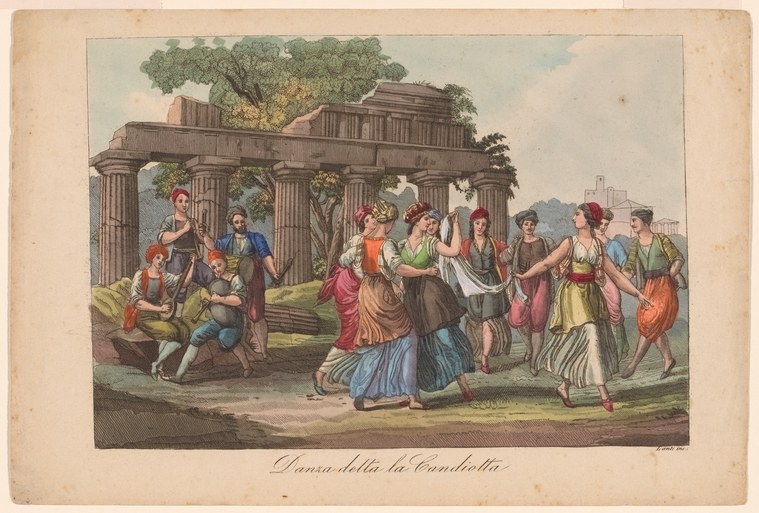
Danza detta la Candiotta
Unknown artist
- Collection:
- Prints depicting dance
- Source:
- New York Public Library
- Rights:
- Public domain — free to use, share and adapt.
- Recorded as:
- Public Domain
The Candiotta is no longer commonly danced, and this print may be among the most vivid surviving records of how it actually looked in motion. For historians of Italian dance and folk culture, it documents a specific movement vocabulary—the high kicks, the hopping rhythm, the open circle or line formation—that would otherwise be lost to text alone. For art historians, it exemplifies the early 19th-century fascination with folk and regional identity expressed through visual documentation.
What you are looking at
A lively outdoor gathering beneath a classical portico with fluted columns and a pediment, set in a sunlit Italian landscape with hills and a distant town visible. A group of about fifteen figures in early 19th-century dress are arranged in loose formation on the ground before the colonnade. The women wear high-waisted Empire silhouettes in contrasting colors—crimson, yellow, green, pale blue—with their hair adorned with ribbons and feathers. The men wear shorter jackets and breeches. In the foreground, figures gesture expansively with raised arms and extended legs; one woman in red skirts appears to be executing a high kick or leap while her companions watch and clap. Others stand in pairs or small groups, some with arms linked, others with hands raised. The composition suggests active movement and music-making, with musicians barely visible in the shadows of the colonnade. The hand-coloring is vivid and the light is warm and theatrical, emphasizing the festive mood.
The dancing
The dancers display a range of postures from social standing to active hopping and kicking. Arms are frequently raised above the shoulder, and several figures show legs extended high off the ground in a characteristic bouncing or hopping motion. There is no closed ballroom hold visible; instead, dancers are either solo, loosely paired, or moving within a group formation. The energy is vertical and percussive rather than flowing—weight appears to be on the balls of the feet, with bodies upright and energetic. The kicks and leaps suggest a folk or peasant style rather than courtly refinement.
The dance depicted
The title identifies this as the Candiotta (or Candiotto), an Italian folk dance. The visual evidence—the outdoor rustic setting, the high kicks, the open formation, the raised arms, and the apparent hopping motion—all align with what is known of this vigorous popular dance form. The Candiotta was a Neapolitan or southern Italian social dance of the late 18th and early 19th centuries, typically performed in groups outdoors at festivals or celebrations. The figures' postures and the absence of any closed couple hold support this identification. This image documents the movement vocabulary and social context of a regional Italian dance that is now obscure.
How it was made
This is a hand-colored engraving or aquatint print, evident from the fine line-work defining the figures and architecture, the graduated tones in the sky and shadows, and the characteristic color application. The technique allowed wide circulation as a relatively inexpensive print that could be sold individually or bound into collections. The quality of execution and the lively hand-coloring suggest this was a commercial product aimed at a literate, cultured audience—likely Italians or travelers to Italy—rather than folk documentation. The precision of the architectural setting and the legibility of the figures indicate professional studio work.
About this work
This is a hand-colored Italian engraving documenting the Candiotta, a regional folk dance of the late 18th or early 19th century. It captures a moment of celebratory outdoor dancing beneath a classical ruin, showing the dance's characteristic vigorous leg work, open formation, and energetic vertical movement. The work belongs in a dance gallery as evidence of how a now-forgotten popular dance was practiced, portrayed, and circulated through prints during the Romantic era—a period when European artists were increasingly documenting folk customs and regional identity. It also illustrates how dance was understood visually in the age before photography: through the selective freezing of a moment of exuberant movement in a richly colored, theatrically composed scene.
How to look at it
Notice the moment the artist chose: not a static pose but a peak of action, with multiple figures caught in the midst of high kicks and raised-arm gestures. The composition uses the classical portico to frame and elevate the dancers, treating their folk movement with the dignity of history painting. Observe how the artist has differentiated the dancers' postures—some are mid-leap, others are clapping or watching—to convey the infectious, participatory nature of the dance. The vivid hand-coloring of the women's skirts creates visual rhythm and emphasizes the high-energy vertical movement that defines the Candiotta.
The period
This print dates to the early 19th century, a period when Romantic ideals were driving European artists to recover and celebrate folk culture and regional traditions. In Italy, this coincided with rising nationalist sentiment and a scholarly interest in the customs of the countryside and southern regions. The Candiotta was part of a broader family of southern Italian circle and couple dances—tarantella, saltarello, and others—that fascinated northern European travelers and artists. Prints like this one served both as souvenirs of travel and as documents of ethnographic interest, circulating among the educated public who consumed such imagery as evidence of picturesque local life.
Where it lives
This work is held in the NYPL Prints collection, catalogued as depicting dance. It is part of a broader collection of European prints documenting dance, costume, and festival practices, acquired for their documentary and historical interest.
Dance in this work
Questions about this work
What is the Candiotta?
The Candiotta (or Candiotto) was a vigorous, energetic folk dance from southern Italy, particularly Naples, popular in the late 18th and early 19th centuries. It was typically performed outdoors in groups at festivals and celebrations, characterized by high kicks, hopping motions, raised arms, and an open circular or line formation. The dance embodied the spirit of folk revelry and was documented by artists and travelers of the Romantic era who were fascinated by regional Italian customs.
Who made this print and when?
The artist is not recorded in the catalogue. Based on the style, technique, and subject matter, the print dates to the early 19th century and is likely by an Italian or northern European printmaker working in the tradition of picturesque travel documentation. The quality and commercial finish suggest a professional studio in an urban center, possibly Rome, Naples, or Venice, or perhaps a northern European press specializing in Italian subjects.
Is this how the Candiotta was actually danced?
This print provides one artist's interpretation of the dance, chosen and composed for visual interest and circulation. The high kicks, the open formation, the energetic postures, and the outdoor setting are consistent with what is known of the Candiotta from other sources and descriptions. However, like all images of dance from the pre-photographic era, it is a selective, idealized record—the artist froze a moment and arranged the composition for dramatic effect. It should be read as evidence of the dance's character and movement vocabulary, not as a literal transcript of every dancer's motion.
More dance artwork





