49 works in this view — arrow keys or swipe to move between them.
Dance in Art
Dance on music covers
Unknown artist
- Collection:
- Prints depicting dance
- Source:
- New York Public Library
- Rights:
- Public domain — free to use, share and adapt.
- Recorded as:
- Public Domain
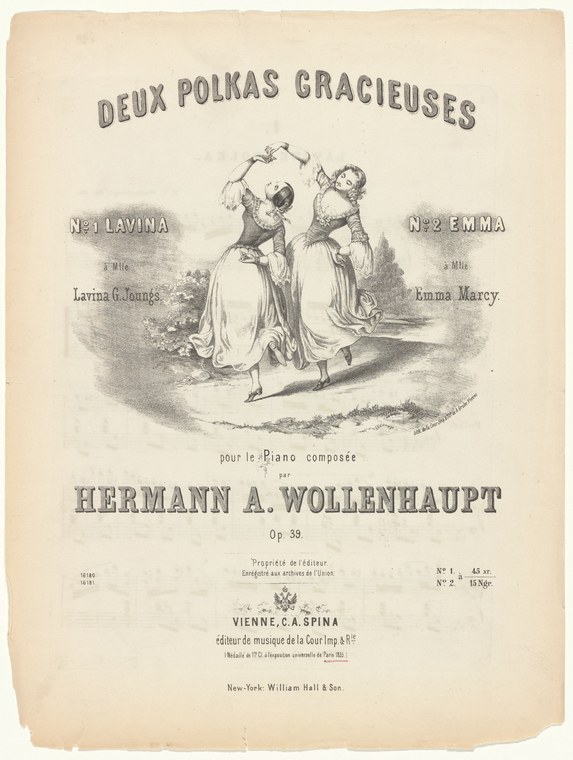
This cover documents how one of the 19th century's most successful dances was marketed to and performed by respectable middle-class dancers, particularly young women. The careful rendering of the dancers' bodies and dress reveals the standards of elegance and propriety that governed ballroom performance even as the polka itself was considered daringly fast and intimate by conservative observers.
What you are looking at
This is the cover sheet for a polka composition published in Vienna in the mid-19th century. Two young women in full white muslin ball gowns dominate the composition, dancing together in a parlor or ballroom setting suggested by the landscape visible behind them. Both wear their hair up in the style of the 1850s, and their light, full skirts are caught mid-motion, suggesting the quick turning movement of the polka. The woman on the left (identified as Lavina C. Jungs) leads; the woman on the right (Emma Marcy) follows. They hold each other in a close, face-to-face frame, their bodies angled toward the viewer. The engraved line-work is delicate and precisely rendered, with careful attention to the fall and movement of the fabric. The title, in bold sans-serif capitals, sits above the dancers; the composer's name and opus number anchor the lower half of the page, along with publication details for Vienna, New York, and London.
The dancing
The two dancers stand close together in a frontal pose, their bodies tilted slightly toward each other and the viewer. Their arms frame the upper body in the close hold typical of 19th-century ballroom dance—not locked rigid, but suggesting physical partnership and mutual control. The women's weight appears to be on their back legs, hips forward, in a pose that conveys the moment just before or at the peak of a turn. The skirts billow and are caught mid-swirl, showing the centrifugal force of the polka's characteristic rotation. The faces are serene and composed, following the convention of genteel ballroom deportment; this is not folk exuberance but refined social dance for the concert hall.
The dance depicted
This is a polka, a couple dance that swept through European ballrooms from the 1840s onward. The polka is a fast, turning dance in 2/4 time, characterized by a distinctive hop, step, close pattern and rapid rotations. The composition was written for piano, suggesting it was intended for domestic performance and parlor dancing as well as public balls. The image shows the polka at its height of fashion in the mid-19th century, when it was danced by fashionable young women and men across Europe and America. The names of the dancers—presumably the composer's dedicatees or the first performers—suggest amateur dancers of social standing rather than professional performers.
How it was made
This is a wood or steel engraving, a relief printing technique that allowed precise, fine-line reproduction and economical distribution of sheet music covers. The engraved image would have been printed on the same press as the musical notation below, making this a complete, integrated object. The delicate linework, particularly visible in the rendering of the muslin, the faces, and the landscape, is characteristic of mid-19th-century commercial engraving. This technique permitted wide circulation among the middle-class households that could afford sheet music; the presence of multiple publisher imprints (Vienna, New York, London) confirms that the work reached an international market.
About this work
This is a published dance composition cover from the mid-19th century, documenting both the polka's cultural dominance and the conventions of how dance was represented in commercial print. The engraving shows two fashionable young women in the moment of dancing, their bodies and dress caught in a pose that conveys both movement and social refinement. The work sits at the intersection of musical publishing, ballroom culture, and printmaking: it is simultaneously a score, a commercial advertisement, and a visual record of how the polka was understood and performed in genteel society. For historians of dance, fashion, and visual culture, it offers evidence of the polka's reach into amateur performance and the gendered aesthetics of 19th-century ballroom dance.
How to look at it
Notice the exact posture of the dancers: the forward tilt of the hips, the slight lean into each other, and the position of the arms—all conventions of the polka hold. The billowing skirts are the key to reading the moment: the engraver chose to capture the peak of the turn, when the centrifugal force of rotation would lift and spread the fabric. This was the moment that best showed the vigor and elegance of the dance simultaneously. The serene faces and upright deportment, despite the motion in the skirts, embody the mid-19th-century ideal: emotional restraint and physical abandon held in perfect tension. The landscape glimpsed behind them situates the dance in a genteel domestic or semi-public space, not a tavern or folk setting.
The artist
Hermann A. Wollenhaupt was an Austrian composer and music publisher active in Vienna in the mid-19th century. He wrote salon music, dances, and variations for piano, the staple repertoire of domestic music-making in prosperous households. Opus 33 places this polka in the middle of his career. The publication by C. A. Spina in Vienna, with distribution through major houses in New York and London, indicates that Wollenhaupt's work circulated widely among the international musical bourgeoisie. His practice was typical of the period: composing fashionable dance music for piano, securing publication in multiple cities, and crediting the dedicatees (or first dancers) on the cover.
The period
The polka arrived in Western Europe from Bohemia around 1840 and became an epidemic. By the 1850s, when this cover was printed, the polka was danced at every respectable ball and performed in thousands of parlors across Europe and America. The dance was controversial—some condemned it as improper because of the close contact between partners and the vigorous rotation—but it prevailed. Sheet music covers became a major vehicle for promoting new dances and for advertising the composers and publishers who supplied them. The engraved image was not merely decorative; it legitimized the dance by showing it executed with grace and propriety by fashionable, identifiable young women. In visual representation, the polka competed with older, slower dances like the waltz and minuet for dominance of the ballroom.
Where it lives
This is a printed sheet music cover from the New York Public Library's collection of prints depicting dance. It represents a category of commercial publishing that was central to the dissemination of dance culture in the 19th century: the mass-produced engraved cover that advertised both the music and, through its image, the dance itself.
Dance in this work
Questions about this work
Who were Lavina C. Jungs and Emma Marcy?
The record does not identify them. They may have been the dedicatees of the composition, the first performers, or simply models chosen to represent the dance. The use of their names on the cover suggests they were known to the publisher's audience, perhaps as fashionable dancers or social figures in Vienna or New York.
What makes this a polka and not another couple dance?
The rapid turning motion evident in the billowing skirts, the close frame and forward-tilting posture of the dancers, and the composition's title and opus number as a piano polka all identify it. The polka was a specific dance form with a characteristic rhythm and figure—hop, step, close, step—that became standardized and publishable as a named genre.
Why is this image on a sheet music cover?
In the 19th century, sheet music covers were prime advertising space. An engraved image of the dance being performed elegantly legitimized the music and appealed to buyers—usually women or families—who wanted to learn fashionable steps. The cover promised not just a score but an image of how the dance should look.
What does the dress tell us about the dancers?
The white muslin ball gowns, the upswept hair, and the refined posture mark these as respectable young women of the middle or upper-middle class. The polka, though it was danced by people across the social spectrum, is here presented as a dance for genteel society, not for folk celebration.
More dance artwork





