49 works in this view — arrow keys or swipe to move between them.
Dance in Art
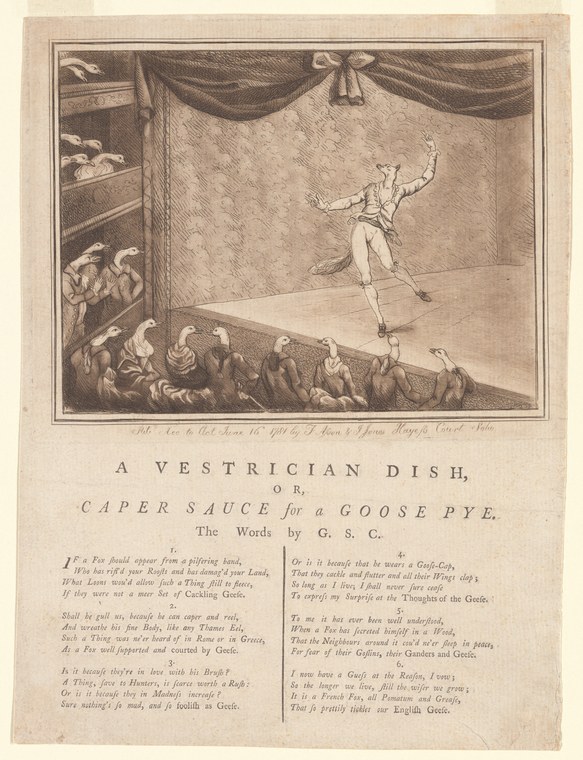
A Vestrician dish, or, Caper sauce for a goose pye
Unknown artist
- Collection:
- Prints depicting dance
- Source:
- New York Public Library
- Rights:
- Public domain — free to use, share and adapt.
- Recorded as:
- Public Domain
This is one of the few surviving images of rope-dancing and popular acrobatics in the 18th century, a form of performance that left little trace but was central to theatre and street entertainment. The satirical framing tells us as much about critical attitudes toward the body and spectacle as it does about the acrobat's practice—it shows how high art and popular performance were understood as fundamentally opposed.
What you are looking at
A theatrical acrobat in light drapery performs a dramatic aerial leap or vault above a stage, captured in the moment of suspension with legs extended and body arched. The performer wears minimal costume—apparently classical drapery in the neoclassical style—and is caught mid-movement, one leg raised high, demonstrating considerable athleticism. The stage is defined by a decorated proscenium arch with swags and a ribbon bow at top, and a crowd of spectators fills the pit or lower gallery below, rendered in small scale to emphasize the height and distance of the performer. The composition uses dramatic perspective to enhance the acrobat's elevation. The print is hand-colored in brown and sepia tones, with fine cross-hatching to define musculature and shadow. This is a comedic or satirical work: the title announces itself as a "caper sauce for a goose pye"—a burlesque commentary on theatrical taste.
The dancing
A single figure dominates the composition, suspended in a horizontal or near-horizontal position with the body arched and extended. The legs are splayed, one raised higher than the other; the arms are positioned for balance and momentum. The posture suggests an acrobatic or gymnastic feat rather than balletic movement—the body is fully extended and the effort is visible. Below, the audience is rendered as a dense crowd of heads in profile and three-quarter view, undifferentiated and small, a convention for emphasizing the spectacle above them.
The dance depicted
This depicts theatrical acrobatics or rope-dancing of the 18th century, a form of entertainment distinct from ballet but a staple of popular theatre and pleasure gardens. The suspension and extended posture suggest the performer is working apparatus—likely a rope or wire—though none is clearly drawn. The inscription attributes words to "G. S. C." and the subject matter (a satirical "caper sauce") suggests this is a commentary on the taste for such spectacular but artistically lightweight entertainments. The acrobatic flying leap was a signature feat of rope-dancers and tumbling performers who worked the circuits of London theatres and pleasure gardens in the 18th century. The disproportion between the tiny audience and the massive feat is part of the satire.
How it was made
This is a hand-colored engraving or etching, executed with fine parallel line work (hatching) to create tone and volume. The printing technique allowed for broad circulation—this was a popular print, sold to theatre audiences and collectors of satirical comedy. The hand coloring (visible in the sepia and brown tones) indicates it was produced for a middle-class market willing to pay for finished impressions. The technique allowed the artist precise control over line and perspective, essential for the exaggerated spatial recession that sells the joke of the composition.
About this work
This is a satirical theatrical print of the late 18th century, mocking the fashion for acrobatic spectacle in popular theatre. It depicts a rope-dancer or tumbler suspended in a dramatic aerial feat, rendered with exaggerated perspective to emphasize the height and the wildness of the performance. The tiny audience below and the frivolous title (borrowed from cookery) make clear this is a jab at contemporary theatrical taste—acrobatics valued for sensation rather than art. The work is a record of how 18th-century performers trained and what audiences paid to see, and a document of how artists and critics of the period viewed such entertainments with comic disdain.
How to look at it
Attend to the moment the artist has chosen: the acrobat is not landing or preparing but fully suspended, body extended to its maximum reach. This is the moment of greatest danger and spectacular display—the artist has frozen the peak of the feat rather than its beginning or end. The perspective line draws the eye upward from the tiny audience to the vast performer, reversing the normal hierarchy of theatrical importance and making the comedy visual: the bigger the performer, the smaller the art. The neoclassical drapery is a further joke—the rope-dancer is costumed in the language of high art while performing a low entertainment.
The artist
The work is attributed only to "G. S. C." on the print itself, with no artist credited in the catalogue record. The style and subject suggest a London artist working in the mid-to-late 18th century, during the heyday of satirical prints and theatrical farce. The execution is competent and the satire is confident, suggesting a professional engraver with access to theatre circles and familiar with the discourse of taste.
The period
In the 18th century, rope-dancing and tumbling were immensely popular in London theatres, pleasure gardens like Vauxhall and Ranelagh, and travelling shows. They represented a visual spectacle that appealed to mixed audiences and generated both enthusiasm and critical condescension from those invested in "legitimate" theatre and neoclassical aesthetics. At the same time, the acrobatic body was increasingly of interest to artists and anatomists—the extended, suspended pose shown here demonstrates physical control and strength. Theatrical satire was a booming print market, and prints like this one both celebrated and mocked the entertainments they depicted.
Where it lives
This print is held in the New York Public Library's collection of prints depicting dance. It is a theatrical print of the kind produced for sale to audiences and collectors, suggesting it circulated in London and among people with access to or interest in theatrical criticism.
Questions about this work
What is the performer doing?
The acrobat appears to be executing a flying leap or vault, suspended horizontally above the stage. This was a signature feat of rope-dancers and tumblers who performed in 18th-century theatres and pleasure gardens, often working on a rope or wire that is not clearly rendered in this print. The extended, arched posture demonstrates the strength and training required for such acrobatics.
Why is this titled 'caper sauce for a goose pye'?
The title is satirical, borrowed from cookery and applied to the theatrical spectacle as a joke: 'sauce' means an addition or garnish, often superfluous. The work mocks the taste for acrobatic entertainment as a frivolous embellishment to serious theatre. 'Goose pye' may also be a pun or reference to the play or author being criticized.
Was this kind of performance respectable?
Rope-dancing and acrobatics were enormously popular with general audiences but viewed with suspicion by critics invested in neoclassical ballet and legitimate drama. The satirical tone of this print reflects that disdain—acrobatics were seen as sensation without substance, a low entertainment despite the skill they required. The costume in neoclassical drapery is part of the satire, dressing a popular performer in the language of high art.
What technique was used to make this print?
This is an engraved or etched print, hand-colored with brown and sepia inks. The fine parallel lines (hatching) create the illusion of volume and shadow. This technique allowed the artist to control perspective precisely and to produce multiple copies, making it an affordable theatrical souvenir for audiences.
More dance artwork





