49 works in this view — arrow keys or swipe to move between them.
Dance in Art
Pauline Paul Montessu
Unknown artist
- Collection:
- Prints depicting dance
- Source:
- New York Public Library
- Rights:
- Public domain — free to use, share and adapt.
- Recorded as:
- Public Domain
This work documents the commodification and romanticization of female performers in 19th-century print culture, revealing the gap between the public image of the dancer as a decorative object and the lived practice of dance. It shows how lithographic portraiture shaped popular understanding of performance and femininity.
What you are looking at
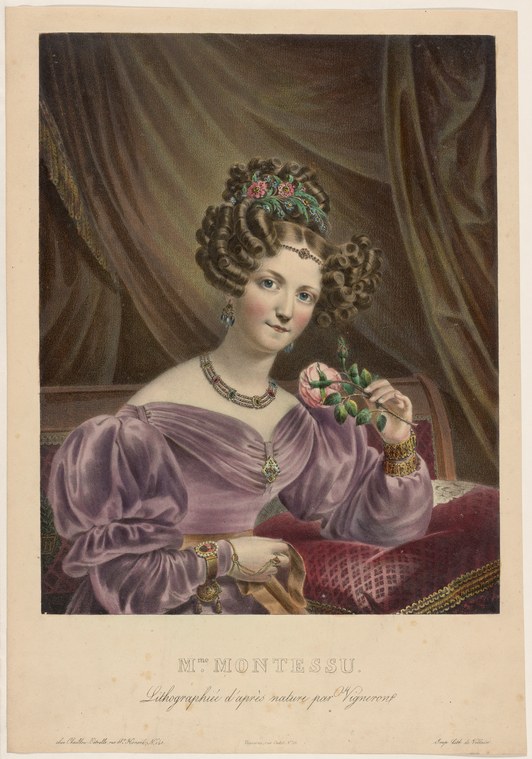
A young woman in an elegant purple silk gown is posed three-quarter length against a backdrop of heavy draped fabric in warm brown tones. She sits or reclines slightly on what appears to be a red cushioned surface, her body angled toward the viewer with her head tilted in a composed, graceful manner. Her elaborate dark hair is arranged in ringlets piled high on her head and crowned with a wreath of green leaves and small flowers. She wears a jeweled necklace and bracelets, and holds a rose in one hand. The lighting is soft and theatrical, illuminating her pale complexion and the lustrous folds of her gown while the background remains shadowed and atmospheric. The overall effect is one of refined leisure and romantic sentiment—she is presented as an object of beauty rather than in active movement.
The dancing
The single figure is motionless and posed rather than dancing. Her body is oriented in a classical three-quarter position, her weight resting rather than engaged. Her arms are relaxed and positioned to frame the body gracefully without tension or dynamic line. Her head is tilted in a contemplative angle. There is no suggestion of footwork, turnout, or the muscular engagement that would indicate active dance.
The dance depicted
This is not a depiction of dance in the active sense. It is a portrait of a woman identified as 'Montessu' in a romanticized pose that evokes theatrical or balletic aesthetics without representing any actual dance movement or technique. The work belongs to the tradition of theatrical portraiture—imagery celebrating performers or society women in roles or costume—but the figure is static and composed for contemplation rather than captured in motion.
How it was made
This is a hand-colored lithograph, a reproductive print technique that allowed wide circulation and affordable distribution in the 19th century. The subtle gradations of color, particularly in the fabric and skin tones, and the delicate rendering of detail suggest a skilled lithographer working from a painting or drawing. Lithography's capacity for soft tonal effects made it the preferred medium for theatrical and society portraiture of this era, allowing the romantic mood to be preserved across multiple impressions.
About this work
This is a romanticized theatrical portrait of a woman named Montessu, rendered as a hand-colored lithograph in the mode of 19th-century society and performance portraiture. The work celebrates feminine beauty and theatrical elegance through costume, pose, and setting rather than through the representation of dance itself. It belongs in a dance collection as evidence of how the image of the dancer—as refined, graceful, and decorative—was commodified and circulated in print culture, often divorced from the actual physical practice of dance.
How to look at it
Observe the tension between the theatrical costume and setting (which promise movement and performance) and the complete stillness and posed quality of the figure (which suggest a portrait meant to be admired rather than a captured moment of action). Notice how the artist has lavished attention on surface beauty—the texture of silk, the arrangement of curls, the jewels—at the expense of any suggestion of bodily engagement or physical effort. This is portraiture masquerading as dance imagery.
The artist
The artist is not recorded. The lithograph bears the inscription 'Lithographie d'après nature par Vigoureaux' (Lithography after nature by Vigoureaux), suggesting Vigoureaux produced the lithograph, though it is unclear whether this person designed the original composition or merely translated an existing work into lithographic form. The work is typical of commercial theatrical portraiture of the mid-to-late 19th century.
The period
This lithograph dates to an era when theatrical portraiture was a booming commercial enterprise, particularly in France and across Europe. The 1840s–1870s saw an explosion in colored lithographic prints of performers, dancers, and society women, circulated as collectible images. This coincided with the rise of Romantic ballet and the elevation of the ballerina as a symbol of ethereal, unattainable femininity. The costume and styling in this portrait—the elaborate coiffure, the luxurious fabric, the posed languor—reflect Romantic aesthetics, even as the figure remains frozen in a static, decorative pose.
Where it lives
The work is held in the New York Public Library's collection of prints depicting dance. It is a colored lithograph, a commercial reproductive print of the type widely circulated in the 19th century, suggesting this was a work of popular consumption rather than fine art.
Questions about this work
Is this woman actually a dancer?
The record identifies her only as 'Montessu' without specifying her profession. The theatrical costume and setting suggest she may have been a performer, but the portrait itself does not depict her dancing or engaged in any choreographed movement. It is a romanticized image of a woman in performance costume.
Why is this in a dance collection if she isn't dancing?
Theatrical portraiture of performers is part of dance history because it shaped how the public understood and imagined dance—as spectacle, beauty, and feminine charm. These images reveal the cultural values projected onto dancers, often replacing the reality of physical skill with fantasy.
What does the lithographic technique tell us about this work?
Lithography was a democratic medium that allowed images to be reproduced affordably and circulated widely. This portrait was likely produced as a commercial print for a popular market, part of the 19th-century culture of collecting theatrical and society portraits.
More dance artwork





