49 works in this view — arrow keys or swipe to move between them.
Dance in Art
French fashion plates
Unknown artist
- Collection:
- Prints depicting dance
- Source:
- New York Public Library
- Rights:
- Public domain — free to use, share and adapt.
- Recorded as:
- Public Domain
Fashion plates are crucial documents of dance history because they show how the body was shaped, supported, and displayed in the period when ballet, ballroom, and social dance were being codified. The silhouette of the dress—the compressed waist, the width of the skirt, the weight of the fabric—directly constrained and enabled the movement possible in waltz, quadrille, and Romantic ballet. Understanding what dancers wore, and how fashion idealized and advertised that wear, is essential to reconstructing the actual experience and appearance of dance.
What you are looking at
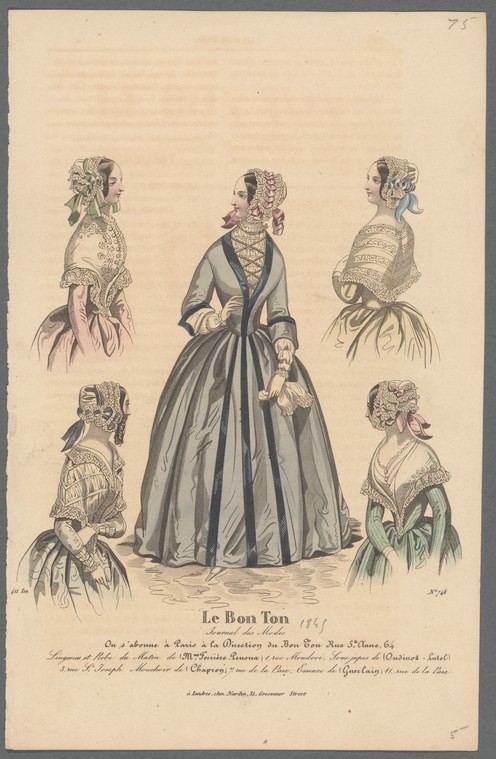
This is a French fashion plate titled *Le Bon Ton* (Good Taste), centered on a standing woman in formal dress who serves as the exemplar of fashionable style. She wears a dark bodice with a voluminous skirt of vertical striped silk or taffeta, and her hair is elaborately dressed and adorned with ribbons and ornaments. Surrounding her are four smaller figures—two at the top left and right, two at the bottom—each showing variations of the same fashionable silhouette from different angles and in different color schemes. The arrangement is typical of 19th-century fashion illustration: the central figure demonstrates the ideal, while the satellites show how the look translates into actual wear and individual interpretation. The background is plain, allowing the costumes to dominate the composition. All five figures are rendered in the refined hand-colored engraving technique characteristic of luxury fashion journals.
The dancing
All five figures stand in relaxed, posed positions typical of fashion display rather than active movement. The central woman stands with her weight on one leg in a graceful contrapposto stance, her skirts arranged to show the silhouette. The subsidiary figures adopt similar standing poses, slightly turned to reveal the dress from three-quarter or profile views. None of the figures are in dance hold or frame; their gestures are gentle and aristocratic—hands resting or delicately positioned to show the fall of sleeves or the line of the waist. This is costume display, not choreography.
The dance depicted
This image does not depict dance in the performance sense. It is a fashion illustration showing the ideal silhouette and dress conventions of a specific moment in 19th-century elite style. However, fashion plates of this era are closely linked to ballroom culture, courtship, and the social occasions where such dress was worn and displayed—the waltz, quadrille, and cotillion. The formal posture and elaborate grooming suggest preparation for such events, but no actual dancing or dance steps are represented.
How it was made
This is a hand-colored engraving, likely produced by a commercial fashion house or journal in early-to-mid 19th-century France. The precision of the line work, the subtle modeling of fabric, and the delicate application of watercolor or gouache indicate a professional print intended for circulation among fashionable women or the tailoring trade. Such plates were produced in series and distributed through fashion periodicals, making them among the most widely seen and influential images of their era. The medium's capacity for fine detail and the reproducibility of engravings made them ideal for transmitting fashion codes quickly across urban and aristocratic networks.
About this work
This is a French fashion plate from the early-to-mid 19th century, a type of commercial print designed to establish and display the ideal of fashionable dress for elite women. The work exemplifies the visual language of fashion authority in the period: a central exemplar surrounded by variations, rendered in the refined engraving technique that made such images accessible to a broad educated audience. While not depicting an actual dance, the image is inseparable from the ballroom culture and social ritual that occasioned such elaborate dress. Fashion plates are essential primary sources for understanding how dancers and dancers' audiences presented themselves, and they record the evolution of silhouette, movement, and the material conditions of performance.
How to look at it
Study the posture and the way the dress is arranged to be displayed rather than moved in: the skirts are spread for visibility, the arm gestures are static and show-like, and the body is organized for viewing rather than for action. Notice how the five figures allow the eye to rotate around the silhouette and understand its three-dimensional form. Compare this with images of dancers in motion: the difference reveals how fashion plates shaped the ideal body separate from the movements it would need to perform. The refinement of line and the precision of the engraving technique underscore that this is a luxury object meant for a highly educated and privileged audience.
The period
This plate belongs to the 1820s–1850s, the era of the Romantic silhouette in women's fashion and the dominance of the waltz and quadrille in ballroom culture. The elaborate upswept hairstyles, the high waistline, and the voluminous skirt are hallmarks of this period. Fashion plates were the chief visual medium for disseminating elite style; they preceded photography and were the primary means by which fashionable dress was standardized and circulated. In the context of dance, this silhouette enabled the swift, spinning movement of the waltz while the formal posture and heavy skirts required the upright carriage and smooth gliding characteristic of Regency and Romantic ballroom technique.
Where it lives
The work comes from the New York Public Library's collection of prints depicting dance. It is catalogued as a French fashion plate of unknown date and artist, but the style and subject matter place it confidently in the early-to-mid 19th century.
Questions about this work
Is this a dance image?
Not in the sense of depicting choreography or performance. But fashion plates are dance history because they record the dress, the body ideal, and the material conditions in which dancers moved. The elaborate costume shown here directly shaped the waltz and quadrille of the era.
Why are there five figures instead of one?
The central figure shows the ideal silhouette; the four surrounding figures display the same dress from different angles and in different fabrics or colors. This allowed the viewer to understand the three-dimensional form and how the style could be interpreted or varied.
Who wore this dress?
Elite and upper-middle-class women in France and throughout Europe. Such elaborate dress was for formal occasions—balls, soirées, the opera—where ballroom dancing was the primary social activity.
How were fashion plates used?
They were published in fashion journals and periodicals, circulated among affluent women and their dressmakers, and used to establish and standardize fashionable style. They were the primary visual medium for fashion before photography.
More dance artwork





