49 works in this view — arrow keys or swipe to move between them.
Dance in Art
French fashion plates
Unknown artist
- Collection:
- Prints depicting dance
- Source:
- New York Public Library
- Rights:
- Public domain — free to use, share and adapt.
- Recorded as:
- Public Domain
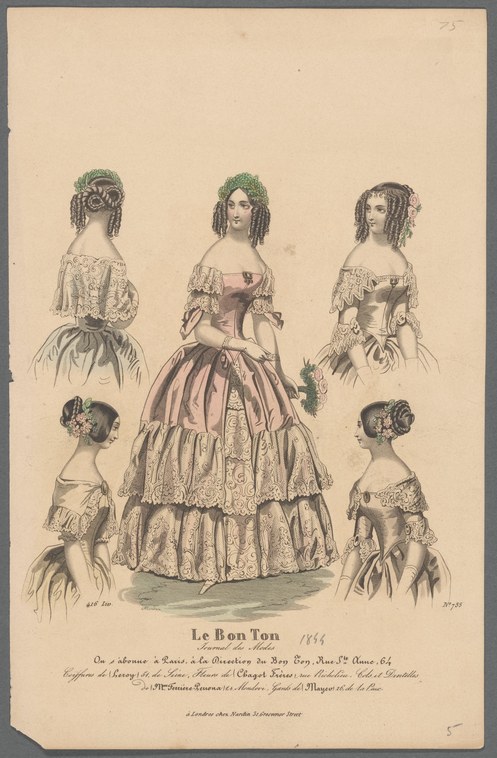
For historians of Romantic-era dance—whether social ballroom or early theatrical ballet—this plate is indispensable documentation of the actual garments dancers wore and how they were constructed. The voluminous skirt, the bare shoulders, the tight bodice, and the elaborate hairstyle are not background details; they are the physical reality that shaped the movement vocabulary of the 1840s. No description of how dancers moved during this period is complete without seeing what they wore.
What you are looking at
This is a fashion plate from the mid-nineteenth century showing six female figures arranged to display the fashionable silhouette and hairstyles of the period. A central standing figure dominates the composition, wearing a voluminous off-the-shoulder ball gown with a fitted bodice and dramatically gathered skirt falling to the floor, her dark hair arranged in long ringlets framing her face. She holds a small bouquet. Four bust-length figures surround her—two at the shoulders and two at the lower corners—showing variations of the same coiffure from different angles, with elaborate braiding, looping, and jeweled ornaments woven through the hair. A sixth smaller figure appears at the lower left. The setting is minimal: a plain background with subtle shading suggesting an interior, and a narrow line suggesting a floor. The title at the base reads "Le Bon Ton" (Good Style), with a subtitle in French describing the fashions shown. The entire composition is rendered in hand-colored engraving or lithograph, with soft tones of blue, pink, and brown establishing the fabrics and complexions.
The dancing
The central figure stands in a relaxed contrapposto pose, her weight settled and her posture upright but not stiff. Her arms hang naturally at her sides, one holding flowers. The surrounding busts are stationary studies in profile and three-quarter view, their necks and shoulders bare to display the hairstyling and the low neckline typical of the era. None of the figures are engaged in active movement or dance gesture; instead, they present themselves to the viewer as fashion specimens.
The dance depicted
This is not a depiction of dance. The figures are static fashion studies—a model and variations—showing ballroom dress of the period (c. 1840s). While the gown is the type worn to formal dances, and the hairstyle and jewelry suggest social occasions where dancing would occur, no dancing is actually depicted. The composition is a fashion plate, a commercial print genre designed to display current styles to a female readership.
How it was made
This appears to be a hand-colored lithograph or engraving, a mass-produced print typical of fashion journalism in the mid-nineteenth century. The process allowed for rapid dissemination of style information to dressmakers, tailors, and the fashion-conscious public, particularly women. The soft hand-coloring and fine linework are characteristic of commercial fashion publishing in Paris during the 1840s. The survival of such prints in holding collections reflects their original function as ephemeral guides to contemporary taste.
About this work
This is a French fashion plate from approximately 1840–1850, a commercial print circulated to display current ballroom dress to potential clients and makers. It belongs in a dance collection not as a depiction of dance itself, but as essential evidence of how dancers dressed during a specific period—the silhouettes, materials, and construction methods that constrained and enabled the movement of Romantic-era dancers. The off-the-shoulder ball gown shown here is the costume context for social and theatrical dance of this period; understanding what the body wore clarifies what the body could do. The central figure's relaxed stance and the care taken to show the gown from multiple viewpoints demonstrate how fashion plates functioned as technical documents, not merely decorative images.
How to look at it
Attend to the construction of the skirt: the gathers, the weight, the volume. This is not a simple draped fabric but a carefully structured garment, likely with layers of linen, horsehair, or crinoline beneath. Notice how the bodice is cut away to bare the shoulders entirely—this is not an accident of fashion but a deliberate exposure that would be shocking in any other context. Look at the hairstyle: the ringlets are not loose curls but carefully braided and looped and pinned, a style that would take hours to achieve and would require nightly maintenance. The flowers in the central figure's hand suggest a ballroom or formal social context. The plate's purpose was to communicate not just what to wear but how to wear it—the angle of the shoulders, the carriage of the head, the hand position that displays the jewelry and bouquet to advantage.
The artist
Unknown. The plate is signed "A. Lacalle fecit" (A. Lacalle made this) at the lower right, suggesting the print was engraved or lithographed by an artist or workshop of that name. Lacalle was one of many commercial printmakers producing fashion plates for Parisian publishers during the Second Empire and July Monarchy. Such prints were often collaborative: a fashion designer or journalist might conceive the design, a draftsman would draw it, and a craftsperson would execute the printing plate.
The period
This plate dates to the peak of the Romantic movement in European fashion and dance. The 1840s saw the apotheosis of the female ballroom and stage silhouette: the corseted waist, bare shoulders, and full skirt were at their most exaggerated. This was the costume of Romantic ballet (La Sylphide, 1832; Giselle, 1841), where the ethereal, weightless female body was the aesthetic ideal. At the same time, the commercial fashion press was exploding in Paris—illustrated journals like *Le Bon Ton* and *La Mode Illustrée* circulated weekly or monthly to middle and upper-class households, making fashion information immediate and accessible. The social dances of the period (the waltz, the polka, the quadrille) all took place in gowns like this one. The print is both a market document and a window into the material reality of Romantic-era movement.
Where it lives
Held by the New York Public Library's Prints collection under the heading "Prints depicting dance." The print is catalogued without an accession number or publication information in the provided record, suggesting it is one of many similar plates in the collection, possibly acquired as part of a larger fashion print archive. Fashion plates of this type are widely held in public collections as primary sources for costume history.
Questions about this work
Is this a dance picture?
Not strictly. No one is dancing. But it is essential to dance history because it shows what dancers actually wore. In the 1840s, whether you were waltzing at a ball or dancing Romantic ballet, you wore a gown like this. The silhouette shaped the movement. Fashion plates are costume documents.
Who was the artist?
The plate is signed "A. Lacalle fecit," but nothing more is known. Lacalle was one of many printmakers producing fashion plates for Parisian publishers in this era. The artist's identity mattered less than the commercial function: to show the latest style clearly and accessibly.
When was this made?
The style of the gown, hairstyle, and printing technique all point to the 1840s. The full skirt, bare shoulders, and ringlet hairstyle were at their peak during the Romantic period, roughly 1830–1850. The catalogue record lists the date as unknown, but the visual evidence is fairly specific.
Where would you have seen this?
Fashion plates like this were published in illustrated journals and sold separately to dressmakers and fashion-conscious women. They circulated in Paris and were distributed or reprinted across Europe. This one may have been published in *Le Bon Ton* or a similar journal, or sold as a standalone print.
More dance artwork





