49 works in this view — arrow keys or swipe to move between them.
Dance in Art
French fashion plates
Unknown artist
- Collection:
- Prints depicting dance
- Source:
- New York Public Library
- Rights:
- Public domain — free to use, share and adapt.
- Recorded as:
- Public Domain
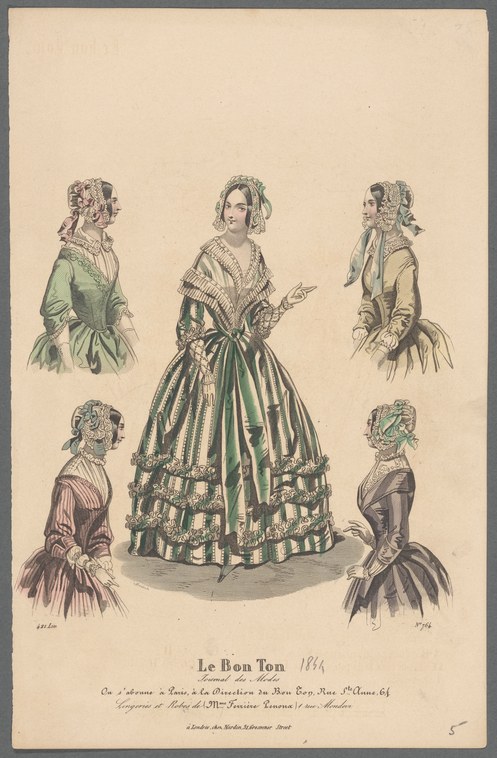
For dance historians, this image documents the silhouette, the corset-enforced posture, and the movement limitations imposed by fashion on women of the 1840s–1850s. Any study of how women danced in this period must account for the physical constraints and ideals of beauty visible here. The image also preserves the link between fashion, deportment, and social identity that governed all public movement—including dance—for women of this class.
What you are looking at
This is a fashion plate from *Le Bon Ton*, a 19th-century French periodical devoted to high fashion and social custom. The composition presents six female figures arranged around a central standing woman in an elaborate striped dress with voluminous skirts and deep lace flounces. The central figure wears an ornate bonnet with ribbons and holds a fan, her posture upright and composed. The five surrounding figures—shown in profile and three-quarter view—display variations of fashionable dress and coiffure of the same era, all elaborately detailed with bows, pleats, and decorative elements. The setting is plain and cream-colored, focusing entirely on the clothing and deportment of the figures. The engraving technique is fine and precise, with hand-coloring applied to the fabrics in green, pink, and brown tones. The composition is didactic rather than narrative: these are costume studies presented as a visual record of fashionable dress rather than a scene of social action.
The dancing
All six figures are shown standing with erect posture and composed bearing, characteristic of how women of genteel class presented themselves. The central figure's weight is evenly distributed, her arms held gracefully with the fan positioned in one hand. The surrounding figures are shown from various angles—profile, three-quarter view—to display the details of their bonnets, the fall of their skirts, and the arrangement of their hair and accessories. There is no physical contact between the figures, and no suggestion of movement or embrace. The poses are static and formal, designed to display the clothing to maximum advantage rather than to convey any gesture of social interaction.
The dance depicted
This image does not depict dance. While the figures are fashionably dressed women of the 19th century in poses of social composure, there is no evidence of dance movement, partnering, or the bodily vocabulary of any dance form. The print is a fashion plate—a guide to contemporary dress and deportment for women. The erect carriage and refined posture reflect the social ideal of feminine deportment in this period, which emphasized restraint and vertical alignment, but these are conventions of etiquette and posture, not choreography.
How it was made
This is a hand-colored engraving, a reproductive technique widely used in the 19th century for fashion journalism and costume documentation. Engraving allows fine linear detail, evident here in the meticulous rendering of lace, pleating, and bonnet trimmings. Hand-coloring applied after printing gave the image both documentary accuracy and commercial appeal. The technique implies circulation as a loose print or in a bound periodical, aimed at a middle- and upper-class female readership who used such plates as shopping references and aspirational style guides. The precision and cost of hand-coloring suggests a publication of some prestige.
About this work
This is a fashion plate from the 19th-century French periodical *Le Bon Ton*, presenting six fashionably dressed women as studies in contemporary dress and feminine deportment. It is not a dance image but a document of social custom and fashion history, included in a dance collection because it records the bodily ideals and costume conventions within which women of the period lived and moved. The erect, composed posture of these figures, and the enormous skirts that required a particular way of standing and walking, shaped how women inhabited their bodies in this era. For historians of dance, fashion, and gender, such images are essential records of the physical culture within which any dance of the period was performed.
How to look at it
Attend to the posture of the central figure: the vertical alignment of spine and neck, the positioning of the arms at rest, the way the massive skirt extends outward while the torso remains rigid. These are not natural or neutral positions but cultivated ideals. Notice also how the surrounding figures are angled to show the back, side, and front of the fashions—this is a technical drawing that uses multiple views to convey information, not a scene of social gathering. The presence of the fan in the central figure's hand is a reminder that even this smallest accessory carried codes of behavior and communication that women were expected to master.
The artist
The artist is not recorded. *Le Bon Ton* was produced by multiple engravers and colorists working in commercial fashion publishing. Such periodicals were industrial products, often unsigned, created by workshops rather than individual named artists. The signature or monogram visible on the print may identify one technician among many involved in its production.
The period
This plate dates to the 1840s–1850s, a period of rapid change in women's fashion and the rise of illustrated fashion journalism as a mass medium. The enormous crinoline skirts shown here—supported by horsehair, whalebone, and eventually the steel crinoline invented in the 1850s—became the defining silhouette of the Victorian era. At the same time, this was the era of Romantic ballet, when pointe work and ethereal tutus transformed the dancer's body into an ideal of weightlessness and grace. The contrast between the grounded, heavily structured silhouette of fashionable women in daily life and the weightless, corseted ideals of theatrical ballet dancers is one of the most striking contradictions of the period.
Where it lives
The work is held in the NYPL Prints collection, catalogued under "Prints depicting dance," though it is not itself a dance image. It appears to be a single sheet from *Le Bon Ton*, a French periodical of the 1840s–1850s, and enters this collection because the study of dance history requires understanding the costume, posture, and bodily ideals of the period in which dances were performed.
Questions about this work
Why is a fashion plate in a dance collection?
Dance cannot be separated from the bodies and costumes that perform it. To understand how women danced in the 1840s, historians must know what they wore, how their corsets and crinolines shaped their movement, and what posture was considered beautiful and proper. This plate documents all three. Fashion plates are primary sources for dance history.
What does the text at the bottom say?
The caption reads *Le Bon Ton* and identifies the publication and date. The smaller text likely credits the periodical's editors or publishers, though it is not fully legible in this reproduction.
When was this made?
The style of dress—the size of the skirts, the bonnet shapes, the shawl styles—dates this plate to the 1840s–1850s. The record does not provide a precise date, but the fashion is consistent with the mid-19th century.
Did women in those skirts actually dance?
Yes, though differently than modern dancers. Social dances of the ballroom era—quadrilles, cotillions, waltzes—were performed in evening dress much like this. The weight and volume of the skirt required dancers to develop particular footwork, frame, and momentum. Professional ballet dancers wore lighter tutus designed specifically for movement, but fashionable women in daily dress navigated these constraints.
More dance artwork





