49 works in this view — arrow keys or swipe to move between them.
Dance in Art
French fashion plates
Unknown artist
- Collection:
- Prints depicting dance
- Source:
- New York Public Library
- Rights:
- Public domain — free to use, share and adapt.
- Recorded as:
- Public Domain
Fashion plates are primary documents of historical dance costume and the material constraints on movement in formal ballroom dance. The weight, volume, and internal architecture of 1840s women's dress—visible here in precise detail—directly determined how a dancer could move, hold her frame, and execute figures. Understanding these garments is essential to understanding the physical reality of Romantic-era social and theatrical dance.
What you are looking at
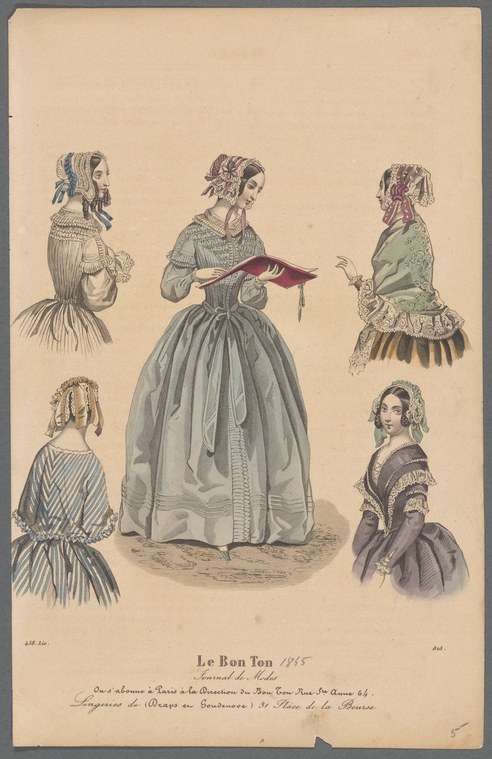
A fashion plate from the 1840s presenting five female figures arranged around a central standing woman in an elaborate ball gown. The central figure wears a voluminous skirt of pale silk gathered at the waist, a fitted bodice with horizontal striping, and carries a red fan or parasol. Four smaller heads are positioned around her—at upper left and right, and lower left and right—each displaying variations of the period's fashionable hairstyles: ringlets, braids, and elaborate coiffures typical of Romantic-era women's dress. All five wear the characteristic narrow shoulders and deep waistlines of the 1840s silhouette. The composition is set against a plain cream background typical of fashion-plate production, with the central figure presented as the primary exemplar and the surrounding heads as styling variations. A printed inscription runs along the bottom in French, identifying the publication and date.
The dancing
The central female figure stands in a static, frontal pose with her weight evenly distributed, arms held gracefully at her sides in the posture required for displaying garment construction. Her body is elongated vertically, with the enormous skirt dominating the composition. The surrounding head studies show no bodily engagement or movement—they are fashion details, not dancers. No weight transfer, no frame, no hold: all five figures exist as statuary display pieces for costume documentation rather than as moving bodies.
The dance depicted
This is not a dance scene. While the central figure's pose and the gathering of the skirt might superficially resemble ballroom dress of the Romantic era, the work is a fashion plate—a commercial garment illustration—not a record of dance. The figures are costumed displays, not dancers in action. The absence of partners, setting, or any suggestion of movement confirms this is sartorial documentation rather than choreographic representation.
How it was made
The work is a hand-colored engraving or lithograph, executed in the fashion-plate tradition of 1840s Paris. The technique—line engraving with selective coloring in watercolor or gouache—was standard for commercial fashion publishing and allowed for rapid reproduction and circulation. The fine detail of the central gown's fabric texture and the five distinct hairstyle studies suggest this served as a model sheet for millinery, dressmaking, and coiffure. The plain background and isolated presentation of figures is characteristic of the medium's functional purpose: to document and disseminate elite women's fashion across Europe.
About this work
This is a French fashion plate of the 1840s recording five variations of women's formal dress and hairstyling during the height of the Romantic period. The central figure models a ball gown with the exaggerated bell-shaped skirt (created by multiple petticoats) and narrow waist that defined elite women's silhouette in this era. Four auxiliary studies of the head and shoulders document the elaborate braiding, ringlets, and accessories that completed the fashionable appearance. The work is a commercial fashion document, not a representation of dance, but it preserves invaluable evidence of the garments worn by women—both dancers and non-dancers—in ballroom and theatrical contexts of the 1840s. The construction and volume of these skirts shaped movement fundamentally, constraining the torso and requiring the characteristic posture and stride of the period.
How to look at it
Examine the internal construction of the central gown—the horizontal striping indicates boning or structural seaming in the bodice, while the skirt's perfect bell shape required at least three layers of petticoat and likely some form of crinoline or framework underneath. The weight and volume of that skirt would have severely restricted a dancer's stride and required an entirely different technique from modern ballroom or theatrical movement. The five heads are not compositional elements but practical samples: look at how variation in hairstyle (ringlets vs. braids vs. sleek center parts) changes the overall silhouette and frame of the face within the fashionable narrow-shoulder line.
The artist
Unknown artist, but the work is a product of the French fashion-plate industry, which dominated European fashion publishing in the 1840s. Paris was the center of this production: specialized engravers and colorists worked for publishers and fashion journals to document and disseminate the latest styles from couturiers. The consistent quality and style suggest a professional atelier rather than an individual artist, and the work was likely produced for circulation in fashion journals or as a loose plate for collectors.
The period
In the 1840s, the Romantic era was at its peak in both dance and fashion. The silhouette visible here—the deep waist, sloped shoulders, and enormous crinoline-supported skirt—was standard dress for women in ballroom contexts and for Romantic ballet's female soloists. This was the era of La Sylphide (1832) and Giselle (1841), when the ethereal, weightless line created by pale skirts, pointe shoes, and constrained upper bodies became the ideal of female dance. The fashion plate documents not costume design but the everyday formal dress of the same era and class that attended and participated in these dances.
Where it lives
The work is held in the New York Public Library's print collection, specifically within a holdings category designated 'Prints depicting dance.' This classification reflects the library's recognition of fashion plates as documents relevant to dance history, even where the primary intention was commercial fashion documentation rather than choreographic or theatrical representation.
Questions about this work
Is this a dance costume or everyday dress?
Both and neither. This is formal evening dress for the 1840s—the kind worn to balls and social events—but not specialized theatrical costume. However, Romantic-era ballet dancers and ballroom dancers wore essentially identical garments for performances and social dance. The distinction between 'costume' and 'dress' barely existed for women's formal wear in this period. The construction and silhouette shown here is what dancers moved in.
Why is there no movement in this image if it's about dance?
This is not actually a dance image—it is a fashion plate, a commercial garment illustration. The NYPL has categorized it under 'Prints depicting dance' because fashion plates are valuable primary sources for understanding what dancers wore and therefore how they moved. The figure is posed statically to display the garment's cut, seams, and overall silhouette as clearly as possible.
What do the five heads around the main figure show?
These are hairstyle and accessory variations for the same outfit: different ways to arrange the hair (ringlets, braids, center parts) and different hat or bonnet options. For a commercial fashion plate, variations in hairstyle were as important as variations in garment construction. This format allowed customers to see multiple styling options from a single base outfit.
How would someone dance in a skirt this full?
With considerable restriction. The enormous bell-shaped skirt shown here was created by multiple layers of petticoats and required a completely different approach to movement than modern ballroom or ballet. Dancers had to keep their stride narrow and controlled, rise slightly onto their toes, and move from the hips rather than the legs. The skirt itself moved as a unit, creating the characteristic gliding, floating effect of Romantic-era dance.
More dance artwork





