49 works in this view — arrow keys or swipe to move between them.
Dance in Art
French fashion plates
Unknown artist
- Collection:
- Prints depicting dance
- Source:
- New York Public Library
- Rights:
- Public domain — free to use, share and adapt.
- Recorded as:
- Public Domain
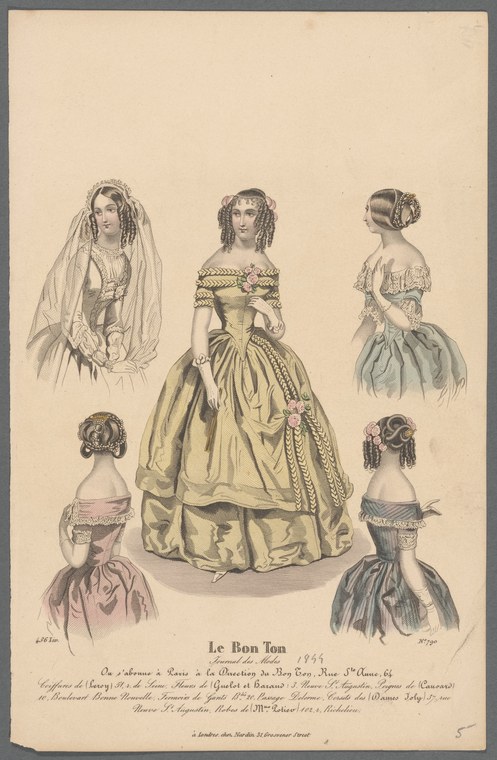
Fashion plates are essential primary sources for understanding the material conditions of dance in any era. The silhouette shown here—the narrowed waist, the massive skirt with its weight distributed away from the body, the off-shoulder sleeve—fundamentally altered how women could move, turn, and hold themselves in the ballroom. Dancers studying Romantic-era waltz, quadrille, or cotillion cannot understand the movement without seeing what the moving body wore.
What you are looking at
This is a fashion plate from the 1840s depicting women's evening wear and hairstyles arranged in a formal composition. A central standing figure in pale yellow silk dominates the page, her dress characterized by a dramatically wide skirt with deep pleats and gathered fabric, small puffed sleeves set off the shoulder, and a fitted bodice. She wears her hair elaborately coiffed with ringlets and a decorative net or snood. Around her are four smaller vignettes showing alternative views and styling options: a profile showing the back of an identical dress, a three-quarter view of a variant style, and two bust-length studies of women's heads showing different hairstyles and headdress treatments. The women are rendered in the refined stippled and linear engraving style typical of 1840s fashion illustration, with selective hand-coloring in yellow, pink, and blue. The composition is arranged as a technical study for dressmakers and their clients, not a scene of actual movement or social interaction.
The dancing
The figures are stationary and posed. The central woman stands in a static, formal presentation pose with arms at her sides or lightly holding her skirt—there is no dynamic movement or dance hold. The other figures are entirely static portrait studies. Their posture is upright and still, appropriate to the fashion-plate convention of displaying garment construction and drape rather than movement.
The dance depicted
This work does not depict dance. It is a fashion plate—a technical illustration produced for the garment industry and for consumers to study dress design, construction, and current styles. The French inscription at the bottom (Le Bon Ton) indicates it was published in a fashion journal. Although the women wear the formal evening wear of the period and adopt poses that could theoretically appear in a ballroom setting, the composition and purpose are entirely about garment display, not the documentation or celebration of dance itself.
How it was made
This is a hand-colored engraving or stipple-engraved fashion plate, a medium that dominated fashion publishing in the 1840s. The fine parallel lines and stippled shading visible in the rendering of fabric and hair are characteristic of steel-plate engraving, which allowed for mass reproduction and wide circulation through fashion journals and newspapers. The selective application of watercolor or gouache in yellow, pink, and blue highlights the most fashionable color choices. This technique was ideal for reaching both tailors and affluent women planning their wardrobes, making these plates central to the dissemination of style.
About this work
This is a French fashion plate from approximately the 1840s, likely published in the journal *Le Bon Ton*. It serves as a technical and commercial illustration of contemporary women's evening dress and coiffure, not as a document of dance itself. However, it is held in a collection of prints depicting dance, possibly because evening wear of this period was worn to balls and formal dances, or because the collection's catalogers recognized the aesthetic and social context of the era as inseparable from dance history. The work is valuable to dancers and historians not as evidence of how people danced, but as evidence of what dancers wore and how their bodies were constrained or enabled by fashion during the Romantic era.
How to look at it
Study the silhouette from the side and the back: the narrowness of the waist compared to the fullness of the skirt, and the way the fabric is gathered and pleated to create that volume without adding weight at the hip. Notice how the sleeve is positioned—set back and small—to expose the shoulder and lengthen the line of the neck and arm. These details are not arbitrary: they show what the fashionable moving body was supposed to look like. If you can imagine wearing this dress, and then imagine waltzing in it, you begin to understand what nineteenth-century social dance was.
The artist
The artist is not recorded. This work is typical of the anonymous labor of fashion-plate production in 1840s Paris, where accomplished but uncredited engravers and watercolorists produced hundreds of designs for fashion journals. The inscription *Le Bon Ton* suggests publication by that journal, which was one of the leading fashion periodicals of the period, distributed to an international readership of dressmakers and fashionable clients.
The period
The 1840s were the height of the Romantic era in fashion and in dance. The dress shown here—with its tiny waist and enormous bell-shaped skirt supported by multiple petticoats—is characteristic of the silhouette that dominated the ballroom during this decade. This was the era of the waltz's social dominance and the Romantic ballet's flowering in Paris, when ethereal, ghostly femininity became the aesthetic ideal. The fashion and the dance were deeply entangled: the skirt's width and weight made certain movements easier (the spin and glide of the waltz) and others harder (the articulation of footwork). At the same time, the ballet's aesthetic of weightlessness and elongation was influencing how fashionable women wanted their bodies to appear, even as street clothing made that appearance nearly impossible without the constraint of tight lacing.
Where it lives
This work is held in the New York Public Library's collection of prints depicting dance. Although it is a fashion plate and not a dance scene, it has been cataloged within this collection, likely because fashion and dance were inseparable in the ballroom culture of the 1840s.
Questions about this work
Is this actually a dance picture?
Not directly. It is a fashion plate—a commercial illustration made to sell dresses and show dressmakers how to construct them. However, it depicts the exact clothing worn by dancers at balls and in formal dance settings of the 1840s, so it is essential context for understanding what Romantic-era dancers wore and how their bodies were shaped by fashion.
What does 'Le Bon Ton' mean?
'Le Bon Ton' translates as 'good taste' or 'good tone,' and was the name of a Paris fashion journal of the period. The inscription indicates this plate was published as part of that journal's regular fashion coverage, distributed to subscribers across Europe and the Americas.
Could someone actually dance in a dress like this?
Yes, but with significant constraints. The narrow waist made bending difficult, and the wide skirt was heavy and restrictive. However, the construction was actually well-suited to the waltz, which relies on spinning and gliding rather than footwork articulation. The skirt's volume would create a dramatic visual effect as it swung outward during the turn—an aesthetic that ballroom dancers actively sought.
Why is this in a dance collection?
Because the history of dance is not only about movement—it is also about the bodies, clothes, and social contexts that made movement possible or desirable. Understanding what dancers wore is crucial to understanding how they moved and what the dance meant to them.
More dance artwork





