49 works in this view — arrow keys or swipe to move between them.
Dance in Art
French fashion plates
Unknown artist
- Collection:
- Prints depicting dance
- Source:
- New York Public Library
- Rights:
- Public domain — free to use, share and adapt.
- Recorded as:
- Public Domain
For dance historians, fashion plates are valuable evidence of how women's dress constrained or enabled movement during a given period, and how performance costume drew on or diverged from everyday fashion. This plate documents the silhouettes, bonnets, and layering systems that dancers and performers of the 1840s–1860s would have worn off-stage or in daytime roles, providing concrete visual information about the material environment of the body during this era.
What you are looking at
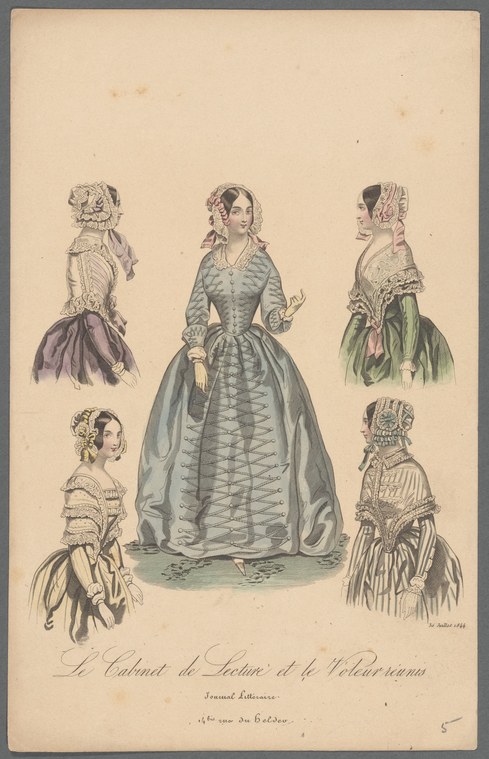
A French fashion plate from the 19th century presenting six female figures arranged around a central, fully-dressed woman in an elaborate dark gown. The central figure wears a fitted bodice with a full skirt featuring horizontal pleating or gathering, a draped shawl or cape falling from her shoulders, and an ornate bonnet with lace detailing. She stands in a composed, frontal pose with one arm at her side. Around her are five supplementary figures showing variations of bonnets, headdresses, and shoulder wraps—some in three-quarter view, others in profile—allowing the viewer to assess the ensemble from multiple angles. The background is plain cream, and fine line work in ink dominates the composition. The title inscribed at the base reads "Le Cabinet de Toilette et la Toilettieuse" (The Dressing Room and the Dressmaker), indicating this is a documentation of fashionable dress components and accessories of the period rather than an active scene.
The dancing
The central female figure stands in a static, display pose typical of fashion illustration—weight evenly distributed, torso upright, gaze toward the viewer. The five subsidiary figures are rendered in varied poses: some turn to show profile views of bonnets, others present three-quarter angles to display the arrangement of shawls and the back detail of headdresses. None of the figures are depicted in motion or engaged with one another. The poses are those of mannequins or models presenting garments rather than dancers; the body is a frame for textile display.
The dance depicted
This is not a dance image. Though six female figures are present and the composition recalls fashion plate conventions that sometimes appeared in satirical or theatrical contexts, no dancing posture, hold, movement quality, or dance context is evident. The figures do not interact choreographically; they are costume studies. The inscription confirms this is a documentation of toilette (dress) and the dressmaker's or wardrobe keeper's craft, not a theatrical or social dance scene.
How it was made
This is a hand-colored engraving or possibly a lithograph printed in black line on cream paper, with watercolor or gouache applied by hand to the bonnets and shawls. The fine linear work in the faces, dress, and decorative detail is characteristic of mid-19th-century fashion plate production. The technique allowed rapid circulation of fashion information across Europe through periodicals and fashion journals; each plate could be colored by workshop staff and distributed quickly, making fashionable dress knowledge available to dressmakers and affluent consumers far from Paris.
About this work
This is a French fashion plate—a commercial illustration documenting women's dress, bonnets, and accessories of the 1840s–1860s era. It serves as a record of high fashion rather than a depiction of dance or theatrical costume, though the language of pose and display draws on the conventions of portrait and figure studies. The work sits in the broader history of fashion journalism and the material culture of dress documentation. It belongs in LODance only as a contextual artifact: fashion plates sometimes depicted dancers or were used to document dancewear and theatrical costume, but this particular example is costume reference material unconnected to dance practice or performance.
How to look at it
Attend to the silhouette: the way the skirt falls in gathered or pleated vertical lines, the position of the waistline high and tight, the bulk of fabric at the hips. Notice the bonnet as an architectural object—its frame, lace edging, and the angle at which it sits on the head. The multiple views allow you to understand how the ensemble presented itself from different angles, as a dressmaker or the wearer herself would need to see it. The static poses are deliberate: this is not a moment of movement but a specification of form.
The artist
The artist is not recorded. Fashion plates of this period were typically produced by commercial publishing houses in Paris—the principal centers being Rue Vivienne and the Boulevard des Italiens. Many were created by teams of engravers and colorists whose individual names went unrecorded. The inscription "Le Cabinet de Toilette et la Toilettieuse" and the style suggest a plate from a major Paris fashion journal of the mid-19th century, possibly *La Mode* or *Le Journal des Demoiselles*.
The period
The 1840s–1860s in France saw the expansion of fashion journalism and the development of the fashion plate as a mass-circulation medium. Women's dress of this era was dominated by the corseted waist, full skirt supported by crinolines or multiple petticoats, and elaborate bonnets and headdresses. Simultaneously, Romantic ballet was at its height—works like *La Sylphide* (1832) and *Giselle* (1841) featured ethereal, lightweight tutus that contrasted sharply with the rigid, heavily structured silhouettes of everyday women's wear. Fashion plates rarely depicted dancers; they documented the dress of the fashionable woman, the actress in non-dance roles, and the wealthy patron.
Where it lives
The work is held by the New York Public Library in a collection labeled "Prints depicting dance." This labeling likely reflects a broad collection scope or cataloguing convention rather than an accurate description of the subject matter of this particular plate.
Questions about this work
Is this a dance image?
No. This is a fashion plate—a commercial illustration documenting women's dress, bonnets, and accessories. The figures are arranged as costume reference models, not as dancers. The inscription identifies the work as *Le Cabinet de Toilette* (The Dressing Room), confirming it is a study of garments and adornment rather than dance or performance.
Why would a dance collection hold a fashion plate?
Fashion plates are valuable contextual sources for dance historians because they show how ordinary women dressed during a given period, which constrains our understanding of what dancers wore off-stage and in non-dance roles. They also sometimes depict dancers or theatrical costume. This particular plate appears to have been catalogued broadly as a figure study rather than verified as a dance image.
What do the bonnets tell us about the period?
The elaborate bonnets with lace trim and careful framing were essential to fashionable women's dress in the 1840s–1860s. Their structure and positioning reveal the importance of the face and head as sites of display, and the labor involved in fashioning and maintaining such accessories. For dancers, bonnets would have been restrictive and rarely worn in performance, marking a clear divide between stage and street.
More dance artwork





