49 works in this view — arrow keys or swipe to move between them.
Dance in Art
French fashion plates
Unknown artist
- Collection:
- Prints depicting dance
- Source:
- New York Public Library
- Rights:
- Public domain — free to use, share and adapt.
- Recorded as:
- Public Domain
Fashion plates are invaluable documents of how bodies were expected to move and be positioned in social space. The careful attention to posture, arm placement, and the interplay of fabric and form reveals the physical culture of the ballroom and courtship—the refined carriage and restraint that women of the period had to master. For dance historians, these plates show the non-movement aspects of ballroom culture: the way a woman held herself, how she used her fan, the silhouette her dress created as she stood or turned.
What you are looking at
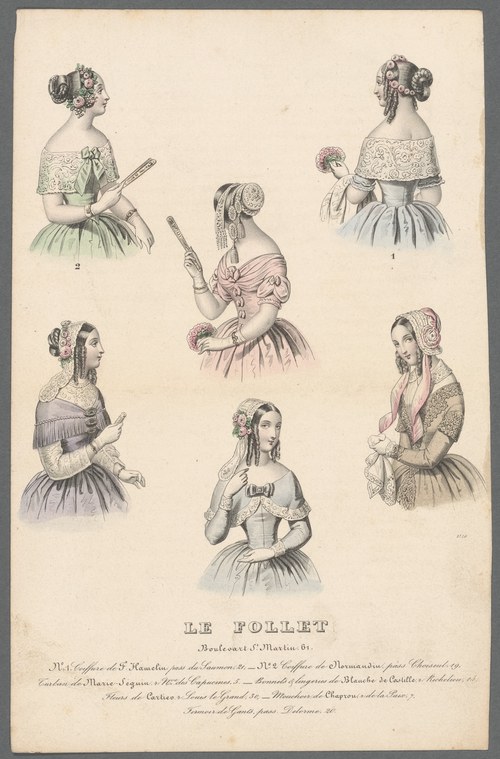
A French fashion plate from the 19th century showing seven female figures arranged to display fashionable dress and deportment. The composition centers a standing woman in the middle ground holding a fan, her body turned gracefully in profile. She wears a pink shawl draped across an off-shoulder white lace bodice and full skirt, her hair elaborately styled with ringlets and ornament. Around her are six other women in varying poses: two seated, two standing in three-quarter view, and two shown in profile. All wear the characteristic dress of the period—low-shouldered bodices, full skirts, and ornate hair arrangements with flowers, feathers, or jeweled combs. The women hold fans, handkerchiefs, or parasols as fashion accessories. The print is hand-colored in subtle pinks and greens, with fine engraved line-work defining the figures against a plain background. The title 'LE FOLLET' appears below, identifying this as from a fashion journal.
The dancing
The figures are posed rather than captured in motion; they display fashionable posture and carriage rather than executing any dance step. The central figure stands with weight evenly distributed, her torso erect and turned slightly, one arm extended to hold the fan—a gesture of refined bearing rather than dance movement. The seated women display elegant leg placement and arm positions that suggest correct deportment. No two figures repeat the same pose or arm position, allowing the viewer to assess the dress from multiple angles. The scale and spacing suggest these are fashion studies rather than a scene of interaction.
The dance depicted
While the figures are posed with the grace and refinement expected of ballroom culture, this is a fashion plate rather than a depiction of actual dance. The poses suggest the deportment and carriage that would be displayed *in* a dance or social setting—the upright posture, the arm positions, the turned-out stance—but no figures are shown in closed hold, executing steps, or moving together. The image documents fashionable dress and the bearing expected of women in polite society, not the performance of a specific dance. The aesthetic and restraint recall the Romantic period's ideals of feminine grace.
How it was made
This is a hand-colored engraving or lithograph, likely from a published fashion journal. The fine engraved lines define the figures and drapery with precision, while hand-coloring in watercolor or gouache adds subtle tints to fabrics, flowers, and accessories. The technique allowed for mass production and circulation through periodicals, making it accessible to a broad audience of middle and upper-class women seeking to understand current fashions. The combination of reproductive print and hand-finishing was standard for luxury fashion journals of the 1830s–1850s.
About this work
This is a fashion plate from *Le Follet*, a major Parisian fashion journal, showing seven women in contemporary dress arranged to display fashionable silhouettes, accessories, and deportment from multiple angles. Fashion plates functioned as the equivalent of fashion photography, circulating ideals of beauty, dress, and bodily bearing to a wide female audience. While not a scene of dance itself, the image documents the refined posture, arm carriage, and physical grace that were essential to ballroom culture and courtship rituals of the period. The women's erect spines, turned-out positions, and elegant gestures reflect the physical discipline and aesthetic values that underwrote both fashionable dress and social dancing.
How to look at it
Study the posture of each figure: the spinal alignment, the lift of the chest, the position of the arms and hands. Notice how the fan is held—not as a functional object but as an extension of refined gesture. Observe how the full skirt falls and moves around the body; in a waltz or quadrille, this fabric would billow and turn with the dancer. The ornate hair and jewelry emphasize the head and face, as these were paramount in courtship rituals. The variety of poses allows comparison of how the same fashionable dress could be worn and carried in different ways.
The artist
The artist is not recorded. Fashion plates of this quality and style were produced by teams of engravers and hand-colorists working for Paris fashion journals, which were the dominant publications in European fashion from the 1820s onward. *Le Follet* was founded in 1829 and was one of the most prestigious journals, employing skilled artists to capture the latest fashions from Paris couturiers and the salons.
The period
This plate dates to the 1830s–1850s, the height of the Romantic era in European culture and fashion. The full skirts, off-shoulder bodices, and emphasis on delicate femininity reflect the period's aesthetic ideals. This was the era of the waltz and quadrille in ballroom dancing—social dances that required women to maintain perfect posture and refined carriage while moving with their partners. Fashion plates circulated these ideals of feminine beauty and deportment across Europe, making Paris the arbiter of fashion for the entire continent.
Where it lives
This print is held by the New York Public Library in a collection of prints depicting dance. *Le Follet* fashion plates survive in many institutional collections, as they were widely distributed and valued as both fashion documents and works of artistic merit.
Questions about this work
Is this actually a picture of dancing?
Not in the sense of movement or execution of steps. This is a fashion plate—a pose study designed to show how fashionable dress looked on the body and how a well-dressed woman should carry herself in polite society. That said, the refinement of posture and the deportment shown here were essential to ballroom dancing and courtship, so the image documents the physical culture in which dancing took place.
What is *Le Follet*?
*Le Follet* was a prestigious Parisian fashion journal founded in 1829. It circulated monthly and featured hand-colored engravings of the latest fashions, hairstyles, and accessories. It was the dominant fashion publication in Europe during the 1830s–1850s and set the standard for how fashionable women should dress and present themselves.
Why do all the women have such upright posture?
Perfect posture was a sign of breeding and refinement in the 19th century. Women of the middle and upper classes were trained from girlhood to stand and move with an erect spine, lifted chest, and controlled arm positions. This carriage was essential not only to looking elegant in fashionable dress but also to performing social dances like the waltz and quadrille with grace and propriety.
What are the women holding?
Fans, handkerchiefs, and parasols—the essential accessories of fashionable dress in this period. The fan in particular was a sophisticated accessory that allowed women to gesture expressively while maintaining composure. How a woman held and used her fan was a sign of her education and social standing.
More dance artwork





