49 works in this view — arrow keys or swipe to move between them.
Dance in Art
French fashion plates
Unknown artist
- Collection:
- Prints depicting dance
- Source:
- New York Public Library
- Rights:
- Public domain — free to use, share and adapt.
- Recorded as:
- Public Domain
Fashion plates are evidence of the body culture that surrounded ballroom dance: they show what dancers wore, how they were groomed, and what posture and bearing were deemed attractive and appropriate. For historians of dance, dress, and gender in the nineteenth century, they document the material and social context in which the waltz, quadrille, and cotillion were performed and learned.
What you are looking at
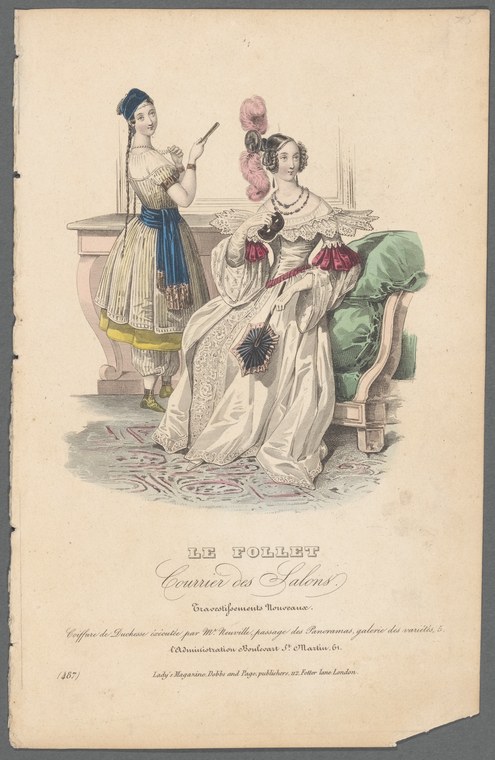
Two women in early nineteenth-century dress occupy an elegant interior. The standing figure, at left, wears a pale muslin gown with a dark blue sash and gold hem, her hair crowned with a tall feathered headdress; she holds a fan and gazes toward her seated companion. The seated woman, in flowing white drapery with magenta silk bows at the waist and shoulders, reclines in an upholstered chair with her weight sunk into the cushions; she too wears jewelry and a dark ornamental fan. The setting is a refined drawing room with classical architectural details—a tall mirror or window frame and draped curtains visible in soft background tones. The composition is one of studied leisure and social display: the standing figure presents herself while the seated woman observes, their interaction a tableau of fashionable society.
The dancing
The standing woman's posture is upright and self-presenting, her body aligned frontally with subtle contrapposto, her free arm (the one without fan) held at a gentle angle near her torso. The seated woman's body is fully relaxed into the chair, her spine curved, her legs extended beneath her gown in a posture of complete repose. Neither figure is actively dancing; both are posed in attitudes of social display and waiting. The distance between them—one standing, one sitting—creates a hierarchical relationship in the composition, suggesting the standing figure is the object of regard.
The dance depicted
This is not a depiction of dance in motion but rather a fashion plate, a genre of commercial illustration documenting contemporary dress and deportment. The title *Le Follet: Courrier des Salons* (The Fashion Gazette: Salon Courier) identifies it as such. The poses, though static, do convey something of the bodily ideal of the period—the erect, corseted carriage of the standing figure and the languid grace expected of fashionable women in repose. While not documenting an actual dance style, the image shows how the female body was displayed and moved within the social rituals of the ballroom and salon, where these garments would have been worn during social dances including the waltz and quadrille.
How it was made
This is a hand-colored engraving or lithograph, a technique standard for fashion plates in the early nineteenth century. The line work is precise and delicate, defining the architecture and the fall of fabric; the coloring—applied by hand or in separate passes—renders the satins, muslins, and silk ribbons with attention to shimmer and depth. This technique allowed rapid and affordable circulation of fashion information to middle- and upper-class readers, particularly women. The print comes from a bound periodical or series, as the title and publication mark make clear, meaning it reached its audience through subscription or newsstand sale rather than as a unique object.
About this work
This is a fashion plate from the early nineteenth-century French periodical *Le Follet*, documenting women's salon dress of circa 1827–1837. Though not a depiction of dancing itself, it sits at the intersection of fashion, deportment, and social dance: the women wear the exact garments in which they would have waltzed and quadrilled in the ballrooms of the period, and their posed bodies show the cultivated carriage and grace expected in these spaces. Fashion plates are primary documents of how people were meant to move and present themselves in social settings. This example is notable for its attention to the texture and weight of fabric, the jewels, and the elaborate hairdressing—all markers of status that framed participation in fashionable dances.
How to look at it
Attend first to the contrast in pose and posture: the standing figure's erect frame and forward-facing presentation versus the seated figure's languorous repose. This is not a moment of action but of display and leisure—the moment before or after dancing, or the moment of social observation at a ball. Note the precision with which the artist has rendered the construction of the gown: the placement of the sash, the fall of the skirt, the way the muslin clings and drapes. The feathered headdress and jewelry are equally carefully detailed, marking these as women of means. The composition tells us that looking—being looked at—was itself a key element of ballroom culture.
The artist
The artist is not recorded in the catalogue. However, the print bears the publication mark of *Le Follet*, a leading Parisian fashion periodical founded in 1829 and published by Émile de Richement and others. The journal employed a stable of talented engravers and colorists who worked from designs by fashion artists. The quality of line and coloring suggests a professional hand trained in the fashion-plate tradition.
The period
The 1827–1837 decade was the height of the Romantic era in Europe, marked by a taste for elegance, delicacy, and refined sensibility. In dance, the waltz had become the dominant ballroom form, having won social acceptance in the 1810s–1820s despite initial scandal. The quadrille remained popular, and the cotillion continued as a courtship ritual. Women's dress in this period was characterized by high waistlines (descended from the Empire silhouette), narrow shoulders, and increasingly voluminous skirts—ideal for the spinning motion of the waltz. Fashion plates proliferated as the middle class expanded and as printing technology allowed cheaper, faster production. They functioned as both aspiration and instruction, teaching women how to dress and carry themselves in public and private social spaces.
Where it lives
This is a single page or plate from *Le Follet: Courrier des Salons*, a French fashion periodical published in Paris from 1829 onward. The holding institution is the New York Public Library. The object is a commercial periodical print, intended for circulation among fashion-conscious readers, primarily women, and represents a form of mass-produced visual culture specific to the nineteenth century.
Questions about this work
Is this a picture of an actual dance?
No—it is a fashion plate, a genre of commercial illustration showing contemporary dress. However, it documents the exact clothing worn to ballroom dances of the period, and the poses suggest the cultivated carriage and grace expected in those spaces. For historians, fashion plates are primary sources for understanding how dancers dressed and carried their bodies.
What dances would these women have danced in these garments?
Primarily the waltz, which had become fashionable in this period, along with the quadrille and cotillion. The narrow waist, the light muslin, and the voluminous but not-yet-crinoline skirt were ideal for the spinning and gliding motion of the waltz. The hairstyle and jewelry mark these as women of the ballroom-going class.
How does this compare to earlier or later fashion plates?
Fashion plates evolved throughout the nineteenth century as dress changed. This example, from the 1830s, shows the high waist and narrow shoulder line of the Romantic period. Later plates (1850s onward) show increasingly wide, crinoline-supported skirts. Earlier plates (1810s–1820s) show the neoclassical silhouette still dominant after the Empire period.
Was *Le Follet* a real publication?
Yes—it was one of the leading Parisian fashion periodicals of the nineteenth century, founded in 1829 and widely circulated. It combined hand-colored engravings or lithographs with text describing fashions, social events, and cultural news, making it a key source for understanding urban, upper-middle-class life and taste.
More dance artwork





