49 works in this view — arrow keys or swipe to move between them.
Dance in Art
French fashion plates
Unknown artist
- Collection:
- Prints depicting dance
- Source:
- New York Public Library
- Rights:
- Public domain — free to use, share and adapt.
- Recorded as:
- Public Domain
Fashion plates reveal how dance and dress were integrated: the postures and carriage taught through dance training became the standard for fashionable presentation, and fashion plates immortalized these ideals in widely circulated images. For historians of dance, this image documents the physical aesthetic of the Regency ballroom—the upright torso, the refined gesture, the careful turning of the body—as it appeared in daily life and formal presentation.
What you are looking at
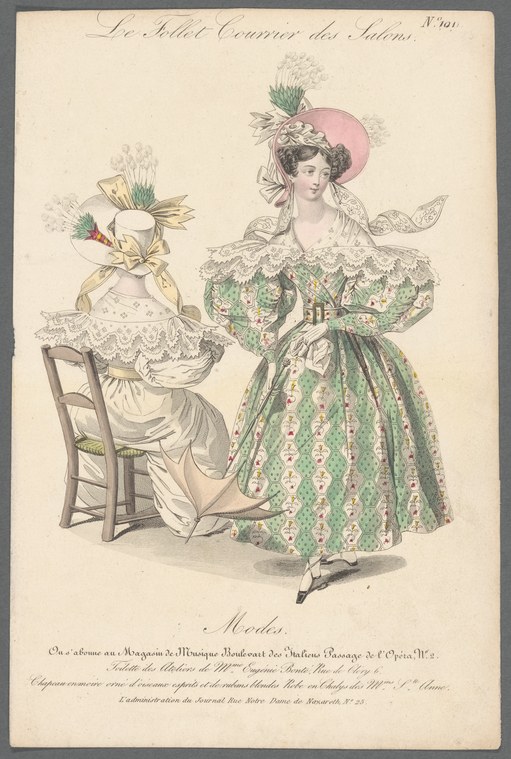
A hand-colored engraving depicting two fashionably dressed women in a salon setting, likely from the late 18th century. The woman on the left sits in a rush-seated chair, her body angled to face the standing figure on the right. She wears a pale yellow or cream gown with elaborate lace trim and a matching feathered bonnet adorned with green plumes and pink silk ribbons. The standing woman on the right wears a striking green patterned dress with delicate floral motifs, white lace fichu, and a large pink hat topped with white ostrich feathers and silk bows. Both figures display the exaggerated postures and refined gestures characteristic of Regency-era presentation. The composition captures a moment of social interaction—the seated woman gestures toward her companion while the standing woman adopts a formal, slightly turned pose. The sparse background and focus on dress and deportment suggest this is a fashion plate rather than a narrative scene.
The dancing
Both figures maintain the upright, corseted posture typical of aristocratic bearing in this period. The seated woman leans slightly forward with her arm extended in a graceful gesture, her weight settled on the chair, while the standing woman holds herself in a composed contrapposto stance with one foot slightly advanced. Neither figure engages in active movement—their postures are static and presentational, designed to display the garments and the ideal feminine form of the era. The interaction is one of social presentation rather than dance; the bodies are arranged to show both frontal and three-quarter views of the elaborate clothing.
The dance depicted
This is not a depiction of dance, though it is grouped in a collection of prints relating to dance and movement. The image is a fashion plate, a commercial engraving made to circulate patterns and styles of dress among the fashionable classes. Fashion plates of this period often employed the aesthetic language of grace and movement—the elongated poses, the elegant carriage, the studied gestures—that derive from court dance and ballroom etiquette. The women's postures reflect the physical ideals cultivated through dance training, but they are static demonstrations of costume rather than representations of actual choreography.
How it was made
This is a hand-colored engraving, as evidenced by the fine line work, the plate-mark visible at the edges, and the application of watercolor or gouache over a printed base. The delicate linear details of lace, feathers, and facial features are rendered through engraved lines, while the color—particularly the vivid greens, pinks, and yellows of the fabrics—has been applied by hand afterward. This method of production was standard for fashion plates in the late 18th and early 19th centuries and allowed for rapid circulation among a wealthy, fashion-conscious audience. The engraved surface could be reprinted while new hand-coloring was applied to each impression, making fashion plates simultaneously reproducible and luxury objects.
About this work
This hand-colored engraving is a fashion plate from the Regency or early 19th-century French fashion press, documenting the silhouettes, trims, and accessories worn by fashionable women. It belongs in a gallery of dance imagery because fashion plates of this era inhabited the same aesthetic world as ballroom culture: the poses, the refined carriage, the gestures all derive from the bodily ideals cultivated through dance training and courtly movement. The elegance and restraint in these figures' presentation reflect the influence of the minuet and the quadrille on how women of fashion were expected to carry themselves. The work is also historically significant as a record of how dress shaped and communicated bodily behavior in this period.
How to look at it
Attend to the postures and carriage of both figures: note how the standing woman's contrapposto stance and the seated woman's forward lean create the appearance of graceful, controlled movement even in stillness. Observe how the garments are draped to suggest the body beneath—the high waistline, the fluid skirts—and how this silhouette would have facilitated the light, rapid footwork of the quadrille and cotillion. The emphasis on the head, the angle of the bonnets, and the precision of the features suggest that the face and its expression were as important to fashionable presentation as the dress itself. Consider how thoroughly the body is shaped by the costume: the rigid corsetry and high waistline are not obstacles to movement but rather define what movement looked like in this period.
The period
This plate dates to the height of the fashion plate industry in early 19th-century Europe, when Paris was the dominant center of fashion design and reproduction. During this period, the quadrille and cotillion were the dominant social dances of the ballroom, and the female ideal was one of grace, lightness, and controlled elegance. Fashion plates were primary vehicles for the dissemination of style and served as templates for dressmakers and as aspirational images for readers. The hand-colored engraving was the most prestigious and expensive form of fashion illustration, suggesting this plate was aimed at a wealthy, urban, fashion-conscious audience. The aesthetic of the standing figure—the elongated proportions, the lightness suggested by the pose, the emphasis on the drape and movement of fabric—echoes the bodily ideals of Romantic-era ballet, which was emerging as the dominant theatrical dance form during this decade.
Where it lives
This work is part of a collection of prints relating to dance held by the New York Public Library. The inscription at the top reads 'Le Petit Courrier des Salons' ('The Little Salon Courier'), identifying it as part of a fashion periodical. The engraving is accompanied by a publication notation indicating it appeared in a specific issue of this journal.
Questions about this work
Is this a dance image or a fashion image?
Both. While the figures are not actively dancing, they embody the physical ideals of ballroom culture and are posed in the graceful, upright manner taught through dance training. Fashion plates of this era were documents of how danced bodies moved and held themselves in social space. The aesthetic language is drawn from dance even though the moment depicted is static presentation.
Why are the women posed this way?
The poses serve multiple purposes: they display the garments from advantageous angles (front and three-quarter views), they demonstrate the refined carriage expected of fashionable women, and they suggest grace and movement even in stillness. The seated-standing pairing was a common compositional strategy in fashion plates, allowing the artist to show how the dress appeared both seated and standing.
What can this tell us about Regency dance?
The upright carriage, the raised shoulders, the careful arm positions, and the refined hand gestures all reflect the physical training and aesthetic of the ballroom dances of this period. The silhouette—the high waist, the fluid skirts, the absence of heavy ornamentation at the hips—was designed to facilitate the light, rapid footwork of the cotillion and quadrille. Fashion plates preserve the bodily ideals of their era in ways that written descriptions cannot.
How were fashion plates made and distributed?
Fashion plates were hand-colored engravings, a labor-intensive but prestigious process. A copper plate was engraved with fine lines to render the garment details and facial features, then printed, and each impression was hand-colored with watercolor or gouache. They were published in fashion journals that circulated among wealthy, urban readers and served as templates for dressmakers. The high cost meant they reached only affluent audiences.
More dance artwork





