49 works in this view — arrow keys or swipe to move between them.
Dance in Art
Persian dancers
Unknown artist
- Collection:
- Prints depicting dance
- Source:
- New York Public Library
- Rights:
- Public domain — free to use, share and adapt.
- Recorded as:
- Public Domain
This print preserves a visual record of a dance tradition that would otherwise be known to us only through written description. It shows how 18th- and 19th-century European printmakers engaged with non-Western dance forms and how those forms were disseminated and understood within European contexts. For historians of Persian, Caucasian, or Central Asian performance, it is a rare contemporary visual document; for historians of European art and collecting, it reveals the boundaries and interests of the theatrical and ethnographic imagination of the period.
What you are looking at
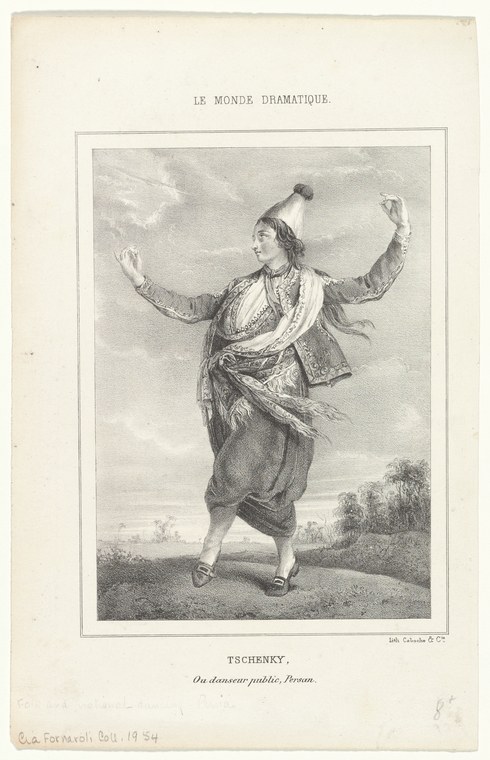
A single figure in Persian or Central Asian dress stands in a theatrical pose against a luminous sky, captured mid-gesture in what appears to be a moment of emotional or dramatic expression. The dancer wears a fitted tunic or robe with decorative embroidery or brocade work, cinched at the waist, with voluminous trousers beneath. A tall pointed hat or headdress crowns the figure, and a shawl or draped fabric is loosely wrapped around the torso. The pose is open and expansive: both arms are raised to roughly shoulder height with palms facing outward or slightly rotated, the body is turned slightly in profile, and the weight appears lifted and buoyant. The setting is spare—a flat landscape with distant trees visible on the right—which focuses all attention on the figure. The engraving technique gives the image a soft, atmospheric quality with skillful hatching to model the fabric folds and create depth.
The dancing
The single dancer occupies the entire composition, freed from any partner or formation. The raised arms, open chest, and lifted bearing suggest a vocabulary of expression rather than footwork-driven technique. The weight appears balanced and alert rather than grounded; the posture conveys openness, perhaps entreaty or proclamation. The costume is fully integrated into the movement—the drape of the shawl, the fall of the trousers, and the silhouette of the headdress all contribute to the overall line. There is no visible foot position that would anchor the viewer's reading to a specific technical tradition, leaving the exact dance form ambiguous.
The dance depicted
This appears to document a Persian or Central Asian dance tradition, most likely from the 18th or 19th century, though the exact style is difficult to name with certainty from the image alone. The costume—the fitted robe, draped shawl, and tall hat—is consistent with Persian or Caucasian regional dress of the period. The open, expressive arm carriage and upright posture suggest a theatrical or courtly dance tradition in which torso and arms carry primary expressive weight. The solitary, frontal or near-frontal presentation suggests this may be a solo performance piece, possibly from a court or aristocratic context. Without ethnographic documentation or inscription, the specific regional origin and precise nomenclature remain uncertain.
How it was made
This is an engraving, likely steel or copper, produced using line and cross-hatching to achieve tonal modeling and atmospheric effect. The technique allows for the fine rendering of textile detail—the embroidery and fabric texture are precise and visible—and the soft gradation of the sky suggests skilled use of the needle to build tone. The engraving medium was the standard for theatrical and dance documentation in the 18th and 19th centuries, allowing for reproducible prints suitable for circulation in periodicals, collections, and archives. The quality and finish of this print suggest it was intended for an educated or theatrical audience familiar with such works.
About this work
This engraving documents a solitary Persian dancer in mid-performance, captured in an open, expansive pose that emphasizes expressive arm work and emotional bearing over footwork. The figure's costume and posture place it within a Central Asian or Persian theatrical tradition, likely of the 18th or 19th century. The image is held in the New York Public Library's collection of prints depicting dance, where it serves as evidence of the circulation and documentation of non-European dance forms within European collecting and publishing networks of the period. It belongs in a gallery of dance art both as a technical study of a specific tradition and as a window into how European institutions encountered and recorded the performance cultures of other regions.
How to look at it
Observe the moment the artist has chosen to freeze: not a climactic leap or turn, but a moment of stillness and open emotional expression. The raised arms and open posture suggest a pause in the dance—perhaps a moment of invocation, proclamation, or emotional intensity—rather than active propulsive movement. Notice how the costume is integral to the image: the engraver has taken care to render the texture and fall of each layer of fabric, and the silhouette they create is part of what defines the movement as foreign and theatrical to a European viewer. The spare landscape and soft atmospheric effect isolate the figure and emphasize individual artistry and expression over narrative or corps formation—a very different frame from contemporary European theatrical dance.
The artist
The artist is not recorded. The print bears a signature or mark at the bottom left ("Sold Colonna" or similar) and a plate number, but the engraver's or designer's identity has not been preserved in the catalogue. The work's inclusion in a periodical or collection dedicated to dramatic dance (suggested by the title heading "LE MONDE DRAMATIQUE") implies it was produced for a publication aimed at a theatre-going or culturally educated audience. The competent handling of the engraving technique and the subject's theatrical framing suggest a professional atelier or publishing house with access to both skilled engravers and source material on foreign performance traditions.
The period
This print dates to a period of intense European interest in exotic and oriental performance traditions, particularly following increased diplomatic and trade contact with the Ottoman Empire, Persia, and Central Asia. The late 18th and 19th centuries saw the rise of orientalism in European visual and theatrical culture, manifested in ballet (such as orientalist scenes in Romantic ballet), opera, and theatrical prints and publications. Dance documentation through engravings was a standard practice for recording theatrical performances and training dancers. This work sits within that broader apparatus of theatrical documentation and orientalist fascination, capturing and codifying non-European movement for European consumption and study.
Where it lives
The print is held in the New York Public Library's collection of prints depicting dance. It bears a page heading "LE MONDE DRAMATIQUE" (The Dramatic World), suggesting it came from a periodical or publication devoted to theatrical subjects. The inscription below the image reads "TSCHENKY, / Un danseur public, Persan" (Tschenky, / A public dancer, Persian), linking the figure to a known Persian dancer of the period, though without additional documentary context the identity remains provisional.
Dance in this work
Questions about this work
Is this a specific named dance or a generic representation of Persian dance?
The inscription identifies the figure as 'Tschenky, a Persian public dancer,' suggesting it may document a specific historical performer rather than a generic or archetypal figure. However, without further research into Persian theatrical records or European archives, it is not possible to establish which specific named dance tradition or regional style Tschenky performed. The costume and pose are consistent with Persian courtly or theatrical traditions of the period, but the image alone does not reveal the precise style or nomenclature.
How was this print made and circulated?
This is an engraving, a technique in which an image is incised into a metal plate with a needle, inked, and then printed. Engravings were among the most reproducible and widely circulated images of the 18th and 19th centuries and were a standard medium for documenting theatrical performances, dancers, and exotic subjects. This print's inclusion in a publication called 'Le Monde Dramatique' suggests it was part of a periodical or collection aimed at theatre-goers and the culturally educated public, allowing knowledge of foreign performance traditions to circulate beyond those who could see live performances.
What does this tell us about how Europeans saw non-Western dance?
The framing—a single, exoticized figure in costume, removed from narrative or social context and presented as a theatrical spectacle—reflects the orientalist perspective common in 19th-century European culture. The care taken to document the costume and the individual dancer suggests respect for the artistry, but the isolation of the figure from any historical, social, or cultural context transforms the dance into an object of aesthetic contemplation for a European viewer. It is both a record of actual performance and a product of the European imagination.
More dance artwork





