49 works in this view — arrow keys or swipe to move between them.
Dance in Art
French fashion plates
Unknown artist
- Collection:
- Prints depicting dance
- Source:
- New York Public Library
- Rights:
- Public domain — free to use, share and adapt.
- Recorded as:
- Public Domain
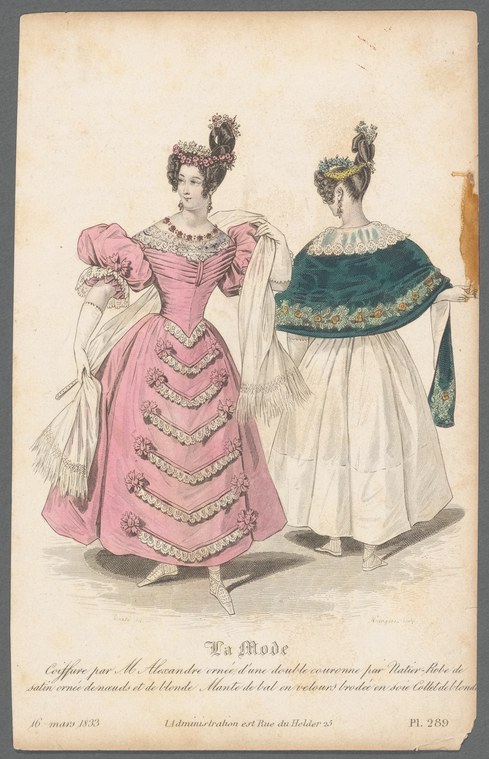
This print provides precise visual evidence of the silhouette, construction, and ornament of fashionable dress in which social dancing was performed in the 1830s. Dancers, costume historians, and social historians rely on such plates to understand the constraints and possibilities of movement in period garments, and to reconstruct historical dress for performance.
What you are looking at
Two fashionably dressed women stand in profile or three-quarter view against a plain background, their bodies positioned as if presenting garments for inspection rather than engaging in social interaction. The figure on the left wears a striking pink silk gown with dramatically puffed sleeves and an off-shoulder neckline trimmed in elaborate beaded swags that cascade down the bodice and skirt in geometric patterns. Her hair is swept up into an ornate arrangement crowned with feathers or plumes. The figure on the right wears a white chemise or undergarment beneath a deep green velvet cape or shawl embroidered with gold ornament along the edges; her hair is similarly arranged with decorative elements. The composition is that of a fashion plate—a commercial print made to circulate designs to dressmakers and wealthy clients—rather than a genre scene or narrative moment. The women stand as dress-forms made animate, their bodies primarily vehicles for displaying textiles and construction techniques.
The dancing
Both figures stand in upright, formal poses with minimal bodily engagement; their arms hang naturally or rest lightly at their sides in attitudes of repose rather than dance. The bodies are depicted with the elongated proportions typical of fashion illustration, exaggerating the smallness of the waist and the vertical line of the silhouette. There is no partnering, no weight-sharing, no frame or hold. The stance is presentational—a display position—rather than one that suggests movement or social contact between the figures.
The dance depicted
This is not a depiction of dance. The women are modelling fashionable dress; their bodies are static and formal, positioned to showcase garment construction. Fashion plates from this period often depicted evening wear suitable for ballrooms and social gatherings, and the formality of dress and posture might evoke the social context in which such clothing would be worn (the Regency ball, the court, the assembly room), but the image itself documents costume, not choreography or movement.
How it was made
This is a hand-coloured engraving or aquatint, identifiable by the fine linear detail in the hair, feathers, and decorative elements, and the subtle tonal modulation in the fabrics and shadows. The text at the lower margin—"La Mode" and a publication credit—is consistent with commercial fashion periodicals of the 1830s that issued weekly or monthly coloured prints. The technique of hand-colouring allowed for accurate reproduction of textile colour and ornament, making these prints valuable as shopping references; the fine detail and careful finish indicate production for a literate, affluent audience.
About this work
This is a fashion plate—a commercial print documenting women's dress of the early 1830s—rather than a dance image. It shows two fashionably attired women in formal presentation poses, their bodies and garments rendered with the precision of an haute-couture publication. Fashion plates are housed in dance collections when they document ball dress, court dress, or costumes worn in the ballroom or theatre, serving as evidence of what dancers and dancers' partners wore. This plate documents elite women's evening wear of the Regency and early Victorian period, the dress in which they would have participated in the cotillions, quadrilles, and contra-dances of formal society.
How to look at it
Attend to the construction of the garments: the seams, the pleating, the method of attachment of ornament, the weight and fall of the fabrics. The exaggerated proportions of the figure—the tiny waist, the long vertical line from shoulder to hem—are conventions of fashion-plate drawing, not realistic body proportions; the artists of fashion plates distorted the body to emphasize the silhouette the garment created. Notice how the puffed sleeve of the pink gown stands away from the arm, and how the skirt is supported by multiple layers of muslin or linen beneath (not visible but implied by its sculptural volume). These details tell you what a dancer wore and how it moved.
The artist
The artist is not recorded in the catalogue. Fashion plates of this period were produced by commercial publishing houses—likely Parisian, given the French text and the 'La Mode' credit—and were often unsigned or credited only to the publisher. The level of finish and the hand-colouring suggest production by an established fashion periodical with a skilled atelier of engravers and colourists.
The period
The 1830s saw the full flowering of the Romantic silhouette: the waist dropped and cinched, the skirt widened and lengthened, and the shoulder pushed back and down, creating the distinctive S-curve of the decade. This silhouette is visible in the pink gown on the left. Simultaneously, the quadrille, cotillion, and contra-dances of Regency society remained central to elite social life, and such formal dress was worn in the ballroom. Fashion plates proliferated as a medium in the early 19th century, following improvements in colour-printing technology and the rise of fashion journalism. They were produced in Paris, London, and other capitals, and circulated among dressmakers and fashionable women as shopping guides and status symbols.
Where it lives
The plate is held in the New York Public Library's collection of prints depicting dance. The catalogue reference (PL. 289, dated 10 mars 1833) and the publication credit at the lower margin indicate this was issued as part of a fashion periodical in Paris in March 1833.
Questions about this work
Why is a fashion plate in a dance collection?
Fashion plates document the dress worn in ballrooms and at social dances. They are evidence of what dancers looked like, how their garments moved, what the silhouette permitted, and what conventions governed appearance in formal social dancing. Costume historians and dancers use them to reconstruct historical dress and to understand the embodied experience of dancing in period costume.
Are these women dancing?
No. They are standing in static, presentational poses to display garments for sale or reference. The image documents clothing, not movement or social interaction. The formal, upright posture is a convention of fashion-plate drawing designed to show the garment clearly without distortion.
What kind of dancing would have been done in dress like this?
The formal, high-waisted evening gowns shown here were worn in the ballroom for the quadrille, cotillion, contra-dance, and waltz of the 1830s. The tight waist and long skirt constrained torso mobility and required an upright, dignified carriage. The movement was primarily in the legs and feet, with restrained arm work; the skirt swayed and swept rather than twirled dramatically.
More dance artwork





