49 works in this view — arrow keys or swipe to move between them.
Dance in Art
Arbre de la liberté
Unknown artist
- Collection:
- Prints depicting dance
- Source:
- New York Public Library
- Rights:
- Public domain — free to use, share and adapt.
- Recorded as:
- Public Domain
For dance historians, this image documents the somatic vocabulary of popular political ritual—how revolutionary fervor was expressed through body movement before and outside the context of formalized dance. It shows a moment when movement, gathering, and gesture became tools of political expression and collective identity-making among ordinary people.
What you are looking at
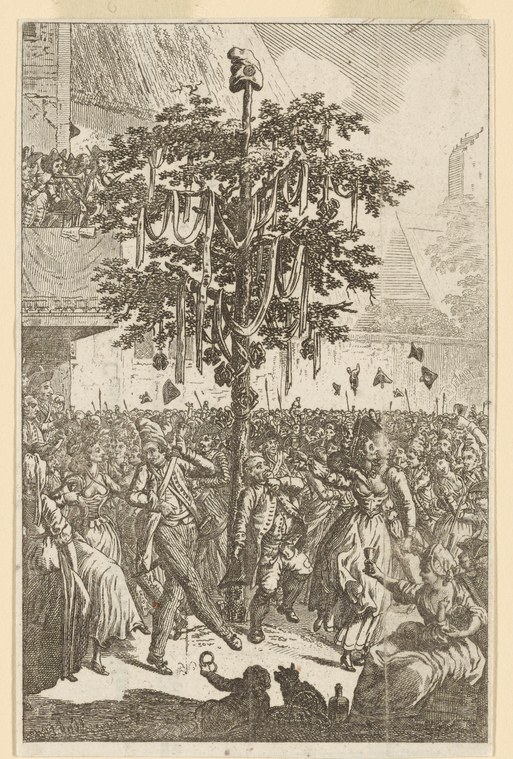
A dense crowd of figures gathers in a public square or street, their attention fixed upward on a tall pole or mast at the center of the composition. The pole is draped with garlands or ribbons and topped with what appears to be a Phrygian cap—the symbol of liberty during the French Revolution. Figures in the crowd wear the dress of the late 18th century: long coats, breeches, and hats for the men; long gowns for the women. The engraving's technique creates a flickering, animated quality through fine parallel lines (hatching), giving the crowd a sense of movement and energy. The setting is urban and monumental; buildings frame the scene on either side, and the sky above is rendered in dense diagonal lines that suggest gathering clouds or heightened emotion. This is a public ceremony or celebration of revolutionary ideals, not a formal dance performance, yet the figures below the pole appear to be moving in an organized, rhythmic manner.
The dancing
The crowd is arranged in loose formation around the central pole, with no clear paired or coupled dancers. Individual figures gesture upward with raised arms—some pointing, some in attitudes of reverence or acclamation. The bodies are rendered in varying degrees of clarity; some are fully articulated, others emerge only partially from the crowd. The overall posture is one of collective enthusiasm rather than coordinated dance technique: arms raised, bodies turned toward the center, heads tilted back. There is no evidence of formal hold, frame, or balletic alignment; instead, the movement suggested is popular, spontaneous, and communal.
The dance depicted
This appears to document a Revolutionary-era civic ceremony centered on the planting or dedication of a Liberty Tree (Arbre de la Liberté)—a practice widespread in France between 1789 and the early 19th century. The 'dancing' here, if it can be called that, is not a discrete dance form but rather the movement of popular celebration and political gathering. Crowds at liberty tree ceremonies engaged in singing, processions, and informal group movement as expressions of civic participation and revolutionary solidarity. The image captures a moment of collective physical expression—raised arms, gathered bodies, upward gazes—that functioned as a form of political theater and popular ritual. This is vernacular movement, not choreographed dance.
How it was made
This is a copper engraving, executed in the late 18th century (likely 1790s based on subject matter). The technique is line engraving, using fine parallel hatching to create tone and shadow; the densest lines appear in the sky and crowd, while the pole and cap are left relatively clear. Engraving allowed for rapid mass reproduction, making this image a likely candidate for distribution as a popular print—a propaganda tool or commemorative broadsheet documenting a Revolutionary ceremony. The technique's precision and popularity for political imagery suggest this was both widely circulated and intended as a public record of a significant civic moment.
About this work
This engraving documents a Liberty Tree ceremony from the French Revolutionary period, depicting a gathered crowd in spontaneous collective movement beneath a pole crowned with a Phrygian cap. Rather than representing a formalized dance practice, it captures the popular, improvised physicality of revolutionary civic ritual—the raised arms, gathered bodies, and upward gazes of a crowd united in political expression. The work belongs in a dance archive not because it depicts a recognized dance form, but because it is a historical record of how ordinary people used coordinated body movement to express political solidarity and collective identity. The Liberty Tree ceremony was itself a kind of embodied ritual, a physical manifestation of revolutionary ideology performed by and for the crowd.
How to look at it
Attend to the raised arms and upturned faces of the crowd—this is the visual language of popular celebration and political acclamation, not balletic or courtly movement. The engraver has chosen a moment of collective heightened emotion, with the pole and Phrygian cap as the focal point drawing all bodies and gazes upward. Notice how the hatching technique creates a sense of animation and energy rather than static form; the crowd seems to pulse and move across the page. The composition itself—radiating outward and upward from the central symbol—mirrors the physical and emotional energy of the crowd, making the image a record of how revolutionary fervor was literally embodied.
The period
The Liberty Tree ceremonies of revolutionary France (1789–1810s) were performative civic rituals that combined elements of popular festivity, religious procession, and political demonstration. They typically featured singing, processions, and communal gathering around a symbolically planted tree. These ceremonies were choreographed by revolutionary committees to instill civic virtue and solidarity, yet they relied on the spontaneous participation and embodied enthusiasm of crowds. Concurrent with the professionalization of ballet in the aristocratic theater, these ceremonies represent an alternative genealogy of coordinated human movement—one rooted in popular participation rather than trained technique. The engraving medium allowed such events to be circulated as images of Revolutionary authenticity and popular will.
Where it lives
This engraving is held in the New York Public Library's collection of prints depicting dance and popular celebration. As a mass-produced print, it would have been distributed during or shortly after the event it documents, functioning simultaneously as commemorative record, political propaganda, and popular entertainment.
Dance in this work
Questions about this work
Is this a formal dance?
No. This documents a civic ceremony and crowd gathering, not a choreographed or trained dance form. However, the organized collective movement—the raised arms, procession, and rhythmic gathering—functions as a form of popular ritual performance and political expression through embodied action.
What is the Phrygian cap on the pole?
The Phrygian cap (bonnet rouge) became the symbol of liberty and republican virtue during the French Revolution. Its placement atop the Liberty Tree made the pole itself into a monument of revolutionary ideology, and the crowd's gathering around it was an act of political devotion and collective citizenship.
Why would a dance archive hold this?
While not a dance in the formal sense, Liberty Tree ceremonies represent an important historical moment when movement, gesture, and gathering became tools of political expression and collective identity. Understanding how ordinary people used their bodies to perform political solidarity is part of dance history's broader study of human movement and ritual.
More dance artwork





