49 works in this view — arrow keys or swipe to move between them.
Dance in Art
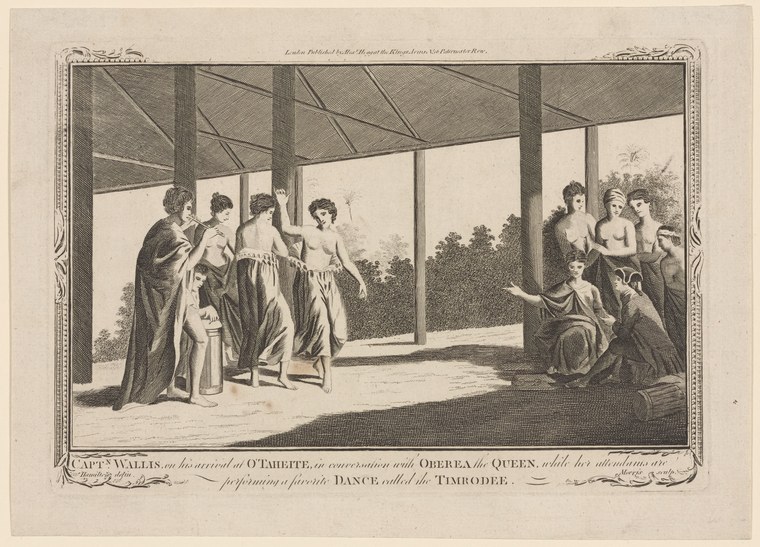
Captain Wallis, on his arrival at O'Taheite, in conversation with Oberea the queen, while her attendants are performing a favorite dance called the timrodee
Unknown artist
- Collection:
- Prints depicting dance
- Source:
- New York Public Library
- Rights:
- Public domain — free to use, share and adapt.
- Recorded as:
- Public Domain
This is a rare and early European visual record of Tahitian dance, made at the moment of first sustained contact and filtered through the conventions of European courtly spectacle. It shows how European artists struggled to render unfamiliar bodies, rhythms, and movement values—and how they used the representation of dance to mediate the encounter between cultures. The image reveals the timrodee and its performers to a European public, but it also reveals European anxiety about Islander bodies, movement, and civilization itself.
What you are looking at
This engraving depicts a moment of first contact between European and Pacific Islander cultures, staged as a formal social encounter. The composition is divided into two groups within a large open pavilion or meeting house with a deep thatched roof supported by substantial posts. On the left, Captain Wallis stands with several European companions in long coats and breeches, their silhouettes stiff and formal. On the right, Queen Oberea is seated or reclining, surrounded by attendants in draped fabrics. Between them, a group of at least five figures—identified as Oberea's attendants—perform the timrodee, a Tahitian dance. The performers are bare-chested or lightly draped, with bodies bent and animated, in sharp contrast to the static European figures. The print employs careful linear perspective to draw the eye toward the background landscape visible through the open pavilion, and the contrast between European vertical postures and Islander fluid, horizontal movement is visually acute.
The dancing
The dancers of the timrodee occupy the center of the composition, their bodies compressed into a bent, forward-leaning carriage quite unlike the upright European stance. At least five figures move together; their arms and legs are engaged in a coordinated pattern that the engraver has rendered with curved, flowing lines. The poses suggest a collective, repetitive movement—possibly a rhythmic swaying or stepping—rather than paired or processional formation. The contrast between the dancers' fluid, low-centered postures and the formal verticality of the European observers is the image's dominant visual statement. No musical instruments are visible, though the caption identifies this as a 'favorite dance,' implying music accompanies it.
The dance depicted
The timrodee is identified here as a favorite dance of Queen Oberea, performed by her attendants in a formal diplomatic context. Little is known from this source alone about the precise choreography, but the visual evidence suggests a low, collective, undulating movement quite foreign to European ballroom conventions of the period. The dancers appear to move as a group without hierarchical distinction, and their bare or lightly clothed bodies are a marked departure from European modesty codes. This is one of the earliest European visual records of Tahitian dance and reflects the intense curiosity about Pacific Islander bodies and customs that animated European travel narratives in the late eighteenth century. The dance is presented here not as spectacle but as a formal courtesy—part of diplomatic ritual and the demonstration of local culture to foreign visitors.
How it was made
This is an engraving, a medium well suited to wide circulation in print form. The fine parallel lines (hatching and cross-hatching) create tonal variation and modeling of form, particularly in the rendering of fabric, skin, and architectural shadow. The technique allowed for precise linear perspective and an architectural clarity that emphasized the pavilion's structure and the spatial separation of the groups. Engravings of this type were typically hand-colored after printing, though this example may or may not be colored in its holding state. The medium speaks to a European audience educated enough to read complex spatial and cultural scenes; such prints were collected, bound into travel narratives, and circulated among educated households and institutions. The inscription in the cartouche below the image provides both title and explicit cultural framing, making this a form of visual reportage designed for instruction as well as aesthetic consumption.
About this work
This engraving documents a moment of early European contact with Tahitian culture, capturing the diplomatic performance of a local dance before Captain Wallis and his party. It is a crucial historical record of Tahitian dance as it was witnessed and filtered through European visual conventions in the late eighteenth century. The work belongs to the large body of travel art and ethnographic print that shaped European understanding of the Pacific, and it reveals as much about European attitudes toward Islander bodies and movement as it does about Tahitian practice. For dance historians, it is significant as one of the earliest European attempts to document and reproduce an Islander dance in visual form, even as the engraver's technique and European aesthetic choices have necessarily transformed what was seen.
How to look at it
Note the engraver's deliberate contrast between the vertical, rigid postures of the European men and the bent, flowing carriage of the Tahitian dancers. The dancers occupy the spatial and moral center of the scene, yet are visually and narratively subordinate to the seated Queen and standing Captain. The architectural frame—the deep pavilion with its strong perspective lines—creates a stage-like setting that Europeans would have recognized, even as the dance itself remains visually foreign. Pay attention to how the engraver has rendered the dancers' bare or minimal clothing, their collective movement, and their apparent lack of individual distinction. This is a moment of cultural display; the artist has chosen to freeze the dance mid-performance, offering a static rendering of movement meant to be fluid and rhythmic.
The period
This engraving dates to the period of intensified European exploration of the Pacific, following mid-century voyages of discovery and the growth of travel literature as a dominant literary form. Captain James Wallis's expedition to Tahiti took place in 1767, and this print likely circulated as part of the published account or as a standalone popular print in the years following. The late eighteenth century saw a boom in ethnographic engravings based on travel narratives—visual documents that aimed to satisfy European curiosity about distant lands and peoples. At the same time, European dance was becoming increasingly codified and systematized (the rise of ballet technique and the dominance of the ballroom waltz and quadrille), making the representation of non-European movement particularly striking and disorienting to European viewers. The print captures a moment when the Pacific was being visually annexed to European knowledge and when dance—as a marker of civilization, refinement, and cultural difference—was becoming a central way of interpreting colonial encounters.
Where it lives
This work is held in the New York Public Library's collection of prints depicting dance. It is a historical engraving, likely produced in the late eighteenth century as part of a larger body of travel and exploration imagery circulating in European print culture.
Dance in this work
Questions about this work
What was the timrodee?
The timrodee is identified here as a favorite dance of Queen Oberea and her attendants in Tahiti, performed during the visit of Captain Wallis in 1767. This engraving is one of the earliest European visual records of the dance. Little detail about its structure or meaning survives in European accounts, but the image suggests a low, collective, undulating movement performed by multiple dancers moving in coordination.
Is this an accurate representation of Tahitian dance?
This is a representation filtered through European artistic conventions, technical limitations, and cultural assumptions. The engraver clearly struggled to render unfamiliar bodies and movement values. The pavilion is rendered in European perspective, and the contrast between European and Islander figures reflects European anxiety about bodily difference and civilization. The image is valuable as a historical record of how Europeans saw and represented Islander dance, not as an unmediated document of Tahitian practice.
Why does the artist contrast the Europeans and the dancers so sharply?
The vertical, rigid postures of the European men—hands at their sides, bodies upright—embody the European ideal of restrained civility. The bent, fluid, low-centered movement of the Tahitian dancers embodies European assumptions about Islander bodies as less controlled, more natural, and less civilized. This is not a neutral observation but a statement about cultural hierarchy, communicated through bodily carriage and posture.
More dance artwork





