49 works in this view — arrow keys or swipe to move between them.
Dance in Art
The prospect before us
Unknown artist
- Collection:
- Prints depicting dance
- Source:
- New York Public Library
- Rights:
- Public domain — free to use, share and adapt.
- Recorded as:
- Public Domain
This work illustrates the cultural anxieties surrounding public performance and bodily display in the early 19th century, showing that not all movement imagery celebrated dance—some satirized it as a marker of social decay. For historians of Regency culture and the performance body, it is evidence of how dance and theatrical excess were weaponized in visual satire to police morality and ridicule those who transgressed decorum.
What you are looking at
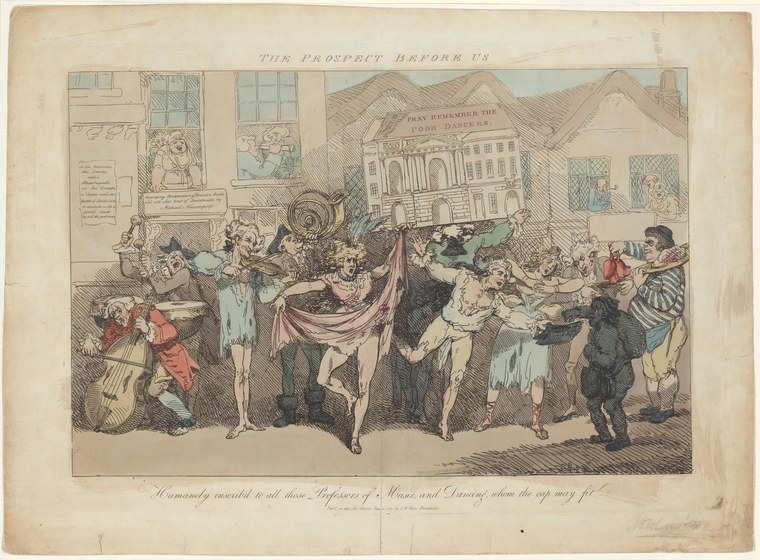
A satirical engraving showing a crowded indoor scene of social chaos and spectacle. In the foreground, a group of figures—some clothed, some partially nude or in theatrical dress—are arranged in a loose, energetic formation. A central male figure stands nearly nude with arms raised, while others around him gesture wildly, point, laugh, and interact with theatrical exaggeration. The composition is dense and cacophonous, with multiple overlapping bodies and gestures. At the left, a woman in red sits or reclines; on the right, figures in dark coats observe or participate in the tumult. The background shows a grand building with classical proportions and a large window through which additional spectators peer. The entire scene is rendered in the sharp lines and careful cross-hatching typical of 18th-century satirical prints, with warm hand-coloring applied to clothing and architectural details. The title "The Prospect Before Us" appears at the top, and a caption at the bottom provides moral commentary on the scene.
The dancing
The figures are posed in exaggerated, unstable attitudes characteristic of Regency-era satirical art. Bodies are contorted and off-balance; arms are flung outward in emphatic gestures of surprise, mockery, or invitation. There is no partnered hold or formation; instead, the composition suggests chaos and disconnection, with some figures turned inward toward the central nude male while others face outward toward the viewer or toward windows. The bodies lack the controlled frame or alignment of formal dance—they suggest instead a moment of social disorder or theatrical burlesque, with weight shifted unpredictably and limbs akimbo.
The dance depicted
This is not a depiction of formal dance instruction or performance, but rather a satirical representation of social chaos and theatrical excess, possibly reflecting anxieties about public spectacle, nudity, or sexual impropriety in Regency society. The near-naked central figure and the surrounding crowd suggest a burlesque or carnival atmosphere rather than ballroom dancing. The exaggerated, disjointed body language and the jeering or astonished expressions of onlookers indicate mockery of bodily display rather than admiration for skill. If dance is present, it is dance as transgression or spectacle—entertainment outside the bounds of propriety—rather than as a recognized social or theatrical form.
How it was made
This is a hand-colored engraving, executed with the fine linear detail and cross-hatching characteristic of satirical prints of the late 18th or early 19th century. The line work is precise and expressive, using varied mark-making to suggest texture, shadow, and movement. The hand-coloring—visible in the red dress, blue-grey architectural forms, and flesh tones—indicates a print made for a literate, urban audience able to afford colored impressions. The technique allowed for mass reproduction and distribution of social commentary, making this a form of popular visual satire aimed at mocking contemporary manners and public behavior.
About this work
This is a satirical engraving that uses bodily excess and disorder to critique social spectacle, likely from the Regency period. Rather than depicting a recognizable dance form, it stages a scene of transgressive performance—nudity, crowd behavior, and theatrical confusion—as a subject of ridicule. The work belongs in a gallery of dance in art not because it shows dance as a refined practice, but because it reveals how dance, or the fear of its debasement into burlesque and carnival, functioned as a site of moral anxiety in Regency culture. The engraving is a document of how contemporary viewers understood the boundaries between acceptable social movement and dangerous bodily display.
How to look at it
Attend to the deliberate instability and asymmetry of the composition: no figure is balanced or at rest; all are caught in exaggerated, unsustainable positions. Notice the contrast between the orderly architecture of the building and the disorder of the human figures within it—this spatial and social opposition is the work's central satire. The expressions on the onlookers' faces—sneering, shocked, amused—tell you that the viewer is meant to laugh at, not admire, the spectacle of the body on display. The near-nakedness of the central figure was itself transgressive and ridiculous by the standards of the time.
The artist
The artist is not recorded in the catalogue. The print is executed in the style of Regency-era satirical engravers, a tradition that included figures such as James Gillray and Thomas Rowlandson. These artists used etching and engraving combined with hand-coloring to produce biting social commentary on politics, manners, and public life, distributing their work through printsellers in London. The fine technique and the sophisticated layering of textual and visual satire suggest a trained professional working in a well-established tradition of visual mockery.
The period
In the Regency period (roughly 1811–1820), satirical prints were a dominant form of political and social commentary. The era saw intense debates about propriety, the role of women in public life, and the boundaries of acceptable entertainment. Regency ballrooms were sites of careful choreography and social regulation, while the streets and theaters offered opportunities for less controlled, more transgressive forms of bodily display. This engraving likely responds to anxieties about theatrical performance, burlesque, and the visibility of the body in public space—concerns that were being negotiated through visual satire.
Where it lives
This work is held in the NYPL's collection of prints depicting dance. It is catalogued with minimal metadata, suggesting it may have been acquired as part of a larger collection of satirical or social commentary prints rather than as a celebrated named work.
Questions about this work
Is this actually a dance scene?
Not in the formal sense. It is a satirical engraving that uses bodily excess and disorder to mock social spectacle and transgression. It shows the fear of dance as burlesque or carnival—uncontrolled, undressed, and ridiculous—rather than the grace of ballroom or theatrical dance. It tells us as much about what Regency society feared in the body as about what it admired.
Why would this be in a collection of dance imagery?
Because it documents how dance and bodily display were understood and contested in a specific historical moment. Satirical prints like this one are evidence of the moral and social boundaries around the dancing body—they show us not what dance was supposed to be, but what it was feared to become.
Who is the naked man in the center?
The catalogue does not identify him, and the print does not include a caption explaining his character. He may represent a specific public figure or type—a charlatan, an actor, a would-be aristocrat—but his identity is not recoverable from the image alone. His nakedness and his central position make him the target of the satire.
More dance artwork





