49 works in this view — arrow keys or swipe to move between them.
Dance in Art
André-Jean-Jacques Deshayes
Unknown artist
- Collection:
- Prints depicting dance
- Source:
- New York Public Library
- Rights:
- Public domain — free to use, share and adapt.
- Recorded as:
- Public Domain
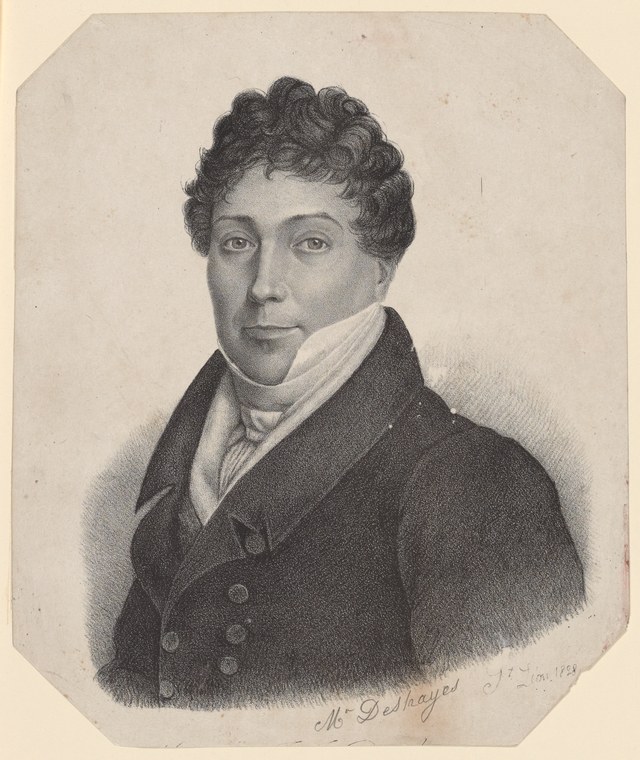
Deshayes was one of the most respected male ballet dancers of his time, a period when male dancers were beginning to recede from prominence as the Romantic movement elevated the ballerina. This portrait preserves the likeness of a transitional figure whose work bridged Classical and Romantic ballet aesthetics. For historians and dancers, the image serves as direct evidence of how a celebrated 19th-century male dancer presented himself in his professional prime.
What you are looking at
This is a formal portrait of a man, presented in three-quarter view against a plain background. He is dressed in early 19th-century attire: a dark double-breasted coat with visible buttons, a white or cream cravat tied at the neck, and what appears to be a white shirt front. His dark hair is styled in the Romantic era fashion, brushed upward and back with natural waves. The man's expression is direct and composed, gazing toward the viewer with a neutral, professional demeanor. The portrait is rendered as an engraving or lithograph in black and white, with careful attention to shading and modelling of the face and fabric. The signature or inscription appears at the bottom of the image, though it is partially legible. The work shows the refined technique of early 19th-century portraiture, with subtle gradations of tone creating dimension in the clothing and face.
The dancing
The subject is a single male figure shown from the waist up, positioned frontally with a slight turn of the shoulders. The body is relaxed and stationary, not engaged in movement. His arms are not visible, being positioned behind the frame or resting naturally at his sides. The head is held upright with good posture, the gaze direct. There is no indication of dance or physical exertion; this is a portrait of stillness and formal presentation.
The dance depicted
The catalogue identifies this as a portrait of André-Jean-Jacques Deshayes, a significant figure in 19th-century dance. Deshayes (1797–1842) was a celebrated French ballet dancer, choreographer, and ballet master who worked at major European opera houses including the Paris Opéra and Her Majesty's Theatre in London. He was known for his classical training and his work in the Romantic ballet movement. However, the portrait itself does not depict dance or movement—it is a formal portrait of the man as a public figure. The image preserves his likeness for documentary and biographical purposes rather than capturing him in performance.
How it was made
This is an engraving or lithograph, rendered in black and white with fine linear hatching and tonal modeling to create dimension and texture. The technique allows for the precise rendering of fabric surfaces and facial features characteristic of early 19th-century reproductive printmaking. Such portraits were produced in quantity for distribution to the public, theatre patrons, and archives, making them important historical documents of the era's prominent performers. The refined execution indicates this was a professional commission, likely created during or shortly after Deshayes's period of greatest prominence.
About this work
This is a formal portrait engraving of André-Jean-Jacques Deshayes, a major French ballet dancer and choreographer of the Romantic era. Created in the early 19th century, it documents the appearance of one of the period's most influential figures in classical and Romantic ballet. While the image itself shows no dance movement, it is an essential historical record of a person whose work shaped European ballet practice and whose legacy directly influences ballet training and performance today. The portrait belongs in a dance gallery not as a depiction of dance, but as a crucial documentary image of a foundational figure in the art form.
How to look at it
Observe the formal conventions of early 19th-century professional portraiture: the direct gaze, the refined dress marking the subject's social status, the plain background that directs all attention to the figure. This is not a casual image but a carefully composed statement of professional identity and respectability. The precision of the engraving technique and the fineness of detail suggest this was created as an official or widely circulated portrait, intended to be recognizable and reproducible. The signature and inscription at the bottom, though partially faded, would have identified Deshayes by name to contemporary viewers.
The artist
The artist is not recorded in the catalogue. The work is a professional engraving or lithograph, likely executed by a printmaker attached to a major European theatre or publishing house. Early 19th-century theatrical portraiture was a specialized commercial practice; such prints were sold to the public and distributed widely, creating demand for skilled reproductive printmakers. The unsigned or partially legible signature suggests this may have been a collaborative production typical of theatrical print publishing.
The period
This portrait was created during the height of French Romantic ballet, a period of enormous innovation in dance choreography and performance. The 1820s and 1830s saw the rise of the ballerina as the dominant figure on stage, with works like La Sylphide (1832) establishing new aesthetic values. Male dancers, who had been central to 18th-century ballet, were gradually repositioned as partners and background figures. Deshayes's career spanned this transition; he was trained in the Classical tradition but worked extensively in Romantic productions, adapting his practice to changing expectations. In visual culture, Romantic-era theatre portraiture became an important medium for preserving the likeness of celebrated performers, feeding the era's intense audience interest in theatre personalities.
Where it lives
The work is held in the NYPL's collection of prints depicting dance, catalogued as part of their theatrical history materials. It is a formal reproductive engraving or lithograph, typical of the commercial theatrical portraiture produced for performers, theatres, and the paying public during the Romantic era.
Questions about this work
Was Deshayes actually a dancer, or is this portrait of an impresario?
Deshayes was a celebrated performing dancer and also a choreographer and ballet master. He danced principal roles in major European opera houses throughout the 1820s and 1830s, and later directed ballet companies. His work as a choreographer was significant, but his early reputation rested on his skill as a performer in the classical tradition. This portrait was likely created during his active performing years.
Why is a portrait with no visible dance included in a dance gallery?
Portraits of dancers are documents of dance history even when they do not depict movement. They preserve the likeness of artists whose work shaped the art form, provide evidence of how dancers presented themselves professionally, and often carry inscriptions or context that illuminate performance history. This portrait of Deshayes is historically important because he was a significant figure in the transition from Classical to Romantic ballet, and his likeness had been widely circulated to the public of his era.
What technique was used to create this image?
This is an engraving or lithograph—a reproductive print technique that allowed multiple copies to be produced from a single prepared surface. The fine lines and careful tonal gradations visible in the image are characteristic of professional theatrical printmaking of the early 19th century. Such prints were sold to theatre patrons and the general public, making them important documents of the era's star system.
More dance artwork





