49 works in this view — arrow keys or swipe to move between them.
Dance in Art
Maria Giuri
Unknown artist
- Collection:
- Prints depicting dance
- Source:
- New York Public Library
- Rights:
- Public domain — free to use, share and adapt.
- Recorded as:
- Public Domain
This work documents the visual culture of theatrical celebrity and the ways in which dancers were represented and honored in the late 19th century. It shows that professional dancers were subjects worthy of formal portraiture and elaborate commemorative prints, and that their images circulated as cultural artifacts. The print provides evidence of how the dance world and the visual arts intersected in creating and sustaining the public image of performers.
What you are looking at
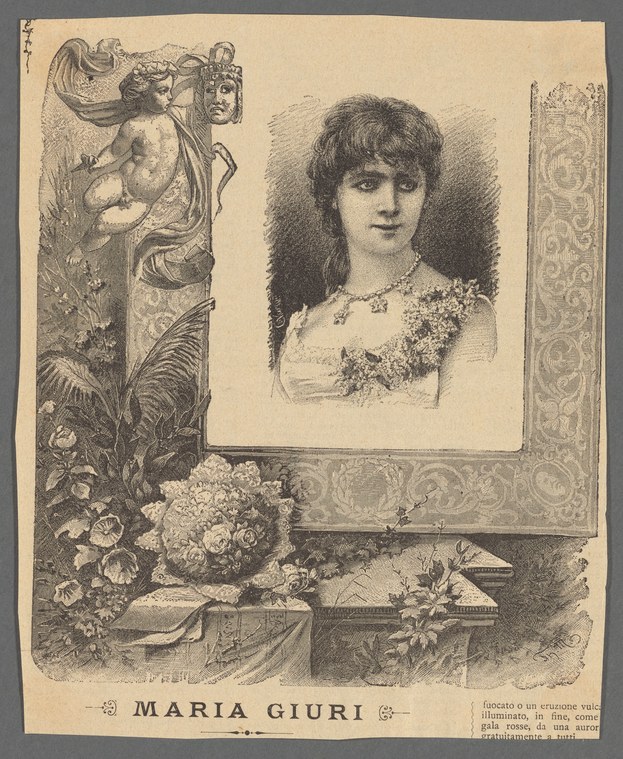
A portrait of a young woman, identified as Maria Giuri, set within an elaborate decorative frame. She is shown in three-quarter view, facing slightly left, with long dark hair and a gentle expression. She wears what appears to be a light-colored dress with delicate floral embellishments at the neckline. The frame surrounding her portrait is ornate and theatrical: to the left stands a classical winged figure (possibly an allegorical representation of dance, fame, or the muses) in flowing drapery, rendered in a lighter engraved style. The left border is decorated with elaborate scrollwork, acanthus leaves, and other classical ornamental motifs. Below the portrait are rendered flowers—primarily roses—arranged as if placed at the foot of the frame, suggesting tribute or commemoration. The right border contains similar classical decorative patterning. The entire composition has the character of a commemorative or honorific print, with the sitter presented as a figure of cultural or artistic significance. The background is plain, allowing the frame and its decorative elements to dominate.
The dancing
The woman's posture is upright and composed, with her shoulders relaxed and turned slightly toward the viewer. Her gaze is direct but soft, meeting the viewer's eye with a calm, dignified expression. There is no indication of active dance movement or pose—the figure is stationary, presented for viewing as a portrait subject rather than captured mid-movement. Her hands are not visible in the portrait. The allegorical winged figure on the left is rendered in a classical contrapposto stance, appearing to float or recline, draped in flowing fabric typical of neoclassical representation.
The dance depicted
This is not a depiction of dance in action. The portrait is a commemorative print of Maria Giuri, likely a dancer or performer of the late 19th or early 20th century, but the image itself shows only her face and bust in formal portraiture. The allegorical framing—with the classical winged figure and elaborate ornamental borders—suggests she was a celebrated performer, and the floral tribute at the base is consistent with commemorative prints honoring theatrical artists. Without additional documentation, it is not possible to identify the specific dance styles in which Giuri performed, or the precise nature of her artistic practice. The print appears to be a promotional or memorial image rather than a record of performance.
How it was made
This is an engraving or possibly a photogravure, identifiable by the fine cross-hatching, delicate line work, and tonal gradations achieved through the engraving technique. The portrait itself appears to have been created from a photograph—the soft, naturalistic modeling of the face and the precision of the likeness suggest photographic source material—while the decorative frame is hand-engraved. This combination of photographic portraiture with engraved allegorical ornament was typical of late 19th-century theatrical commemorative prints, which circulated widely and democratically among audiences. The technique allowed for relatively inexpensive reproduction and distribution, making such prints popular souvenirs of celebrated performers.
About this work
This is a commemorative engraved portrait of Maria Giuri, a performer whose name and image were considered worthy of theatrical publication and circulation. The portrait does not depict dance itself but rather serves as a formal record of a dancer or theatrical artist, presented with the allegorical and decorative apparatus typical of honor prints from the theatrical world. The work belongs in a gallery of dance in art because it documents the cultural presence and celebrity of a performer, even though it does not show the performer in action; it reveals how dancers were memorialized and circulated as images, and what visual language was used to mark them as significant cultural figures.
The print's placement within a rich allegorical frame—complete with a classical winged muse, scrollwork, and flowers—suggests that Giuri held a position of some prominence. The formal, dignified presentation and the care taken in the engraving indicate that this was not a casual image but a deliberately crafted memorial or promotional print, the kind that would have been sold at theaters, collected by fans, or distributed to commemorate a performance or career milestone.
How to look at it
Attend to the formal, dignified presentation of the sitter and the deliberate care taken in the engraved ornamental frame. The portrait itself is composed and still—there is no suggestion of movement or performance—yet the allegorical frame positions the sitter as a figure of cultural significance. The viewer should consider what the formal apparatus of commemoration tells us about Giuri's status and the value placed on her by the theater world. The contrast between the photographic naturalism of the portrait and the classical artificiality of the frame is itself instructive: it shows how theatrical culture positioned itself at the intersection of modern technology and classical ideals.
The period
This print dates to the late 19th or early 20th century, an era of theatrical florescence in Europe and a period when photographic technology was being married to engraving techniques to create inexpensive, widely distributed images of theatrical stars. The allegorical and neoclassical decorative language used here—the winged figure, the classical ornament—reflects the aesthetic conventions of the period, in which theatrical culture was often presented through references to classical antiquity and high art. This was also the era in which the theater photograph and the theatrical print became primary tools for building and managing a performer's public image and celebrity.
Where it lives
The print is held in the New York Public Library's collection of prints depicting dance, part of a broader archive of theatrical and dance imagery. Such prints typically circulated as souvenirs, promotional materials, or collected images within theatrical and fan communities.
Questions about this work
Is Maria Giuri shown dancing in this image?
No. This is a formal portrait—a head-and-shoulders likeness—not a depiction of Giuri in performance or in a dance pose. The print is commemorative in nature, using allegorical and decorative elements to honor her as a performer, but the image itself shows her as a seated or stationary portrait subject.
What dance style did Maria Giuri perform?
The image does not provide that information. The allegorical framing and the style of the print suggest she was a celebrated theatrical performer of the late 19th or early 20th century, but the specific genres or styles in which she danced cannot be determined from the portrait alone.
Why is there a winged figure in the frame?
The winged figure is likely an allegorical representation—possibly of Dance, the Muses, Fame, or artistic inspiration. Such figures were conventional in commemorative and honorific prints, serving to elevate the sitter's status by associating her with classical ideals and the realm of high art and culture.
What are the flowers at the bottom of the frame?
The roses suggest tribute and commemoration, consistent with the practice of presenting flowers to performers after a significant performance or as a mark of respect. Their inclusion in the engraved print transforms this gesture into a permanent memorial.
More dance artwork





