49 works in this view — arrow keys or swipe to move between them.
Dance in Art
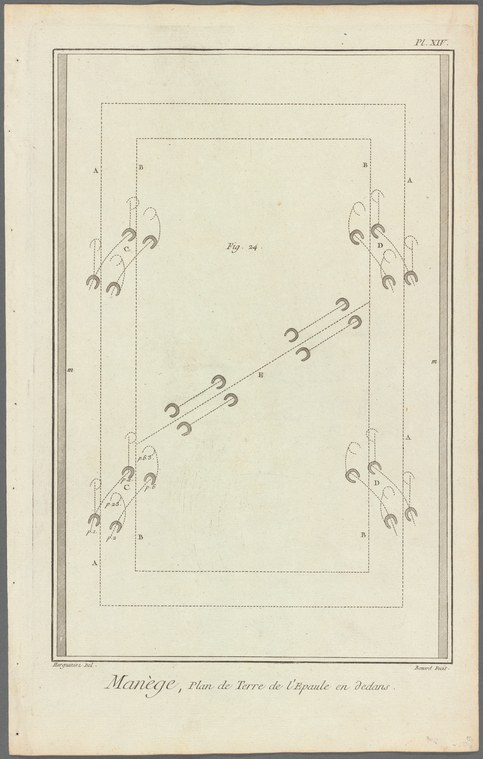
Manège, plan de terre de l'epaule en dedans
Unknown artist
- Collection:
- Prints depicting dance
- Source:
- New York Public Library
- Rights:
- Public domain — free to use, share and adapt.
- Recorded as:
- Public Domain
This work documents the deep historical relationship between dance and equestrian art in court culture—both were disciplines of bodily control and courtly display, often taught in tandem and performed before the same audiences. The diagrammatic method used here to teach riding technique parallels the notation systems (such as Beauchamp-Feuillet notation) being developed simultaneously to record and transmit dance, revealing a shared intellectual framework for analyzing and preserving movement in the pre-modern period.
What you are looking at
This is a didactic diagram illustrating the classical dressage movement known as *épaule en dedans* (shoulder inward), as indicated by the French title. The print shows a rectangular arena or riding space viewed from above, with four clusters of paired footprints marking the positions of horse and rider at successive stages of the movement. The footprints are arranged diagonally across the space, progressing from lower left to upper right, demonstrating the path the horse traces. At the center of the composition, a single diagonal line with two small parallel marks indicates the direction and axis of the horse's body during the movement. The layout is schematic and instructional rather than narrative—it is designed to teach the geometry and progression of a specific equestrian technique through visual abstraction rather than to depict a naturalistic scene. The fine lines and precise rendering suggest this is a technical manual or treatise on horsemanship.
The dancing
The diagram presents no human dancer but instead records the movement of a horse and rider through footprint notation. Each pair of prints shows the placement of the horse's hooves and the rider's position at four points in the sequence. The diagonal arrangement and the marked center line indicate the horse's collection and lateral displacement—the defining feature of *épaule en dedans*, in which the horse moves forward while angled slightly inward. The parallelism of the paired marks at each station suggests the rider maintains a consistent posture and seat throughout, controlling the horse's trajectory with precision.
The dance depicted
This is not a depiction of human dance but of equestrian haute école—the classical dressage tradition that descended from 16th-century Italian riding schools and was perfected in the European court tradition, particularly in Austria, Spain, and France. *Épaule en dedans* is an intermediate collected movement in which the horse advances along a straight line while positioned at a slight angle, with the forehand inset from the hindquarters. The image is pedagogical: it teaches through geometric notation rather than through representation. Such diagrams were essential to the transmission of riding technique in the 17th and 18th centuries, when dressage was considered a fundamental accomplishment of aristocratic education alongside dance itself. The movement requires extreme precision, collection, and the invisible communication between horse and rider—qualities that link it conceptually to the formality and control valued in court dance.
How it was made
This is an engraving or etching on paper, printed as a plan or diagram rather than as a representational image. The fine, regular lines suggest copper-plate engraving, which was the standard medium for technical and scientific illustration of the period. The schematic approach—using footprints and directional marks rather than perspective or figuration—indicates this was intended for a technical manual or treatise, where clarity and repeatability mattered more than aesthetic appeal. The medium allowed for precise reproduction and wide circulation among an educated audience of riding masters, noblemen, and military officers.
About this work
This is a technical diagram from a classical equestrian treatise, illustrating the dressage movement *épaule en dedans*. Though it depicts horsemanship rather than human dance, it belongs in a dance archive because haute école was an essential component of aristocratic courtly culture and shared identical values—precision, control, geometry, and the bodily discipline of the social elite. Like dance, dressage was a performance art rooted in court ritual; like dancers, riders trained in schools and competed in public spectacle. The diagram exemplifies the visual grammar by which 17th- and 18th-century horsemanship was taught and theorized, using the language of geometry and notation that was also emerging in dance notation of the same period.
How to look at it
Attend to the footprint notation: each pair shows where horse and rider were positioned at one moment in a continuous movement. The diagonal progression across the page shows the forward motion; the angle between forehand and hindquarters (marked by the central line and its offset) shows the lateral displacement that defines the movement. The regularity of the spacing suggests controlled, measured execution—the opposite of wild or naturalistic movement. Recognize this as a teaching tool: the artist is not trying to show what it *looks like* to watch a horse and rider perform *épaule en dedans*, but rather to explain how to *do* it by recording the mathematical facts of position and trajectory.
The period
This engraving dates from the period of classical dressage's greatest influence in European court culture, likely the 17th or 18th century. By this time, riding schools had been formalized and theorized with the same rigor applied to dance; famous schools existed in Naples, Vienna, Versailles, and Madrid. The geometric and notational approach to movement analysis was characteristic of Enlightenment thought, which sought to codify and systematize all disciplines. Equestrian treatises were luxury publications aimed at nobles and military officers; they sat on shelves alongside dance manuals and fencing treatises. The pedagogical method—isolating a single movement and recording its geometry—reflects the same analytical approach seen in contemporary dance notation and anatomical studies.
Where it lives
This engraving is held by the New York Public Library in its collection of prints depicting dance. It is catalogued as a didactic illustration, likely from a published equestrian treatise, though the specific edition and date are not recorded in the current catalogue entry.
Questions about this work
Is this actually dance?
Not human dance, but equestrian dressage—haute école. It belongs here because dressage and dance were inseparable disciplines in court culture, taught in the same schools, performed before the same audiences, and analyzed using the same emerging language of geometric notation and bodily precision. Both are choreographed movement, controlled by invisible technique.
What is épaule en dedans?
A classical dressage movement in which the horse advances forward while positioned at a slight angle inward—the forehand set in slightly from the hindquarters. It requires extreme collection (compression of the horse's gait) and is usually performed at the walk or trot. It remains part of the repertoire of competitive dressage today.
How should I read the diagram?
Each pair of small prints represents the placement of horse and rider at one moment. The four pairs show the progression of the movement across the arena. The diagonal line through the center marks the intended path; the offset angle shows the horse's body position. This is a top-down view, as if looking down at the arena from above.
When was this made?
The exact date is unknown, but the style suggests 17th or 18th century. This was the golden age of classical dressage treatises in Europe, especially in France, Austria, and Spain. The engraving technique and diagrammatic method are consistent with technical illustration of that period.
More dance artwork





