49 works in this view — arrow keys or swipe to move between them.
Dance in Art
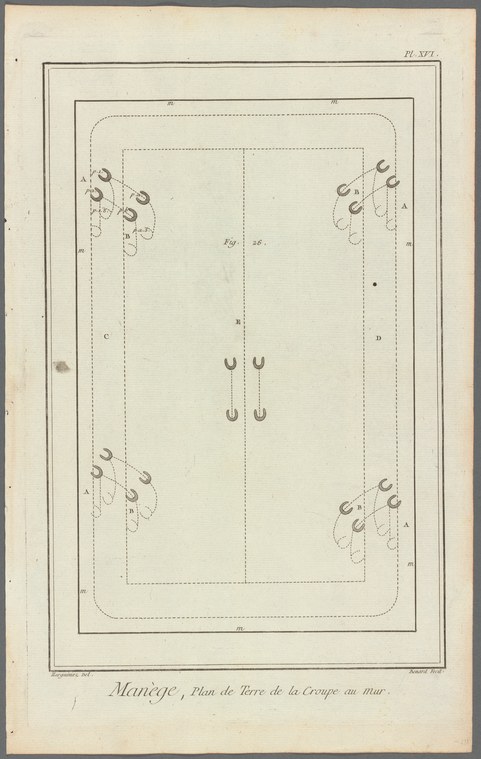
Manège, plan de terre de la croupe au mur
Unknown artist
- Collection:
- Prints depicting dance
- Source:
- New York Public Library
- Rights:
- Public domain — free to use, share and adapt.
- Recorded as:
- Public Domain
This diagram illuminates the physical and conceptual space within which high-school riding was taught and performed, offering a rare ground-level view of an educational institution. It shows how movement practice was spatially organized in the early modern and Enlightenment periods, revealing the geometric rationality applied to bodily disciplines in court culture.
What you are looking at
This is a plan or top-down diagram of an indoor riding school or manège, rendered as an engraving. The rectangular space is bounded by a double-lined border and features four corner ornaments that appear to be hitching posts or decorative elements with scrollwork. The interior floor plan shows four U-shaped symbols arranged in two rows along the center axis of the space, oriented toward the walls. These U-forms likely represent horses or their positions. The labels "A" and "D" appear on the left and right sides respectively, and "C" and what may be additional directional markers appear elsewhere. The composition suggests this is a teaching or performance space designed for organized movement of mounted figures.
The dancing
This is not a dance composition in the conventional sense but rather an architectural or instructional diagram. There are no human figures depicted with bodily gesture or positioning. The U-shaped marks, if representing horses, show no dynamic movement or interaction. This is a spatial plan, not a choreographic record.
The dance depicted
The title *Manège, plan de terre de la croupe au mur* translates as 'Manège, ground plan of the croup to the wall'—a reference to classical haute école or High School horsemanship. A manège is a formal riding school; this diagram appears to be a plan for teaching or demonstrating specific positions or movements within that space. This is equestrian instruction, not human dance, though classical riding shares with dance the concerns of disciplined body control, spatial positioning, and choreographed movement. The work documents the spatial organization of a riding discipline rather than depicting dance performance.
How it was made
The work is an engraving, identifiable by its fine-line linear style, careful cross-hatching, and precise geometric construction. The technique allowed the mass production of instructional diagrams and made them available to riding schools and instructors across Europe. Engravings of this type were often bound into technical manuals for equestrian instruction and were valued for their clarity and reproducibility. The medium's precision and consistency suited the didactic purpose—communicating exact spatial relationships and positions to practitioners.
About this work
This is a technical diagram from a manual of haute école (classical horsemanship), presented as an engraved plan of a manège or riding school interior. It records not dance but the related discipline of High School riding, in which horses and riders perform choreographed movements in a formal space under strict geometric rules. It belongs in a collection documenting dance-adjacent practices because classical riding instruction, manège work, and theatrical horsemanship were closely related to Renaissance and Baroque court spectacle and because the principles of spatial organization, formation, and choreographed movement connect it to the history of staged ensemble work. The manège itself was sometimes the site of court celebrations that blended riding, music, and dance.
How to look at it
Read this diagram as you would a stage plan or seating chart: the orientation and the labeled points tell you where the instructor, riders, or audience members would be positioned. The four U-marks show the standard formation or repeated position being taught. The double border and measured space indicate that this is a controlled, formal environment—not a natural landscape but a bounded, governed space where movement could be precisely repeated and observed. The simplicity of the image is its strength: it reduces the manège to pure geometry, revealing the underlying structure of the discipline.
The period
Haute école as a formal discipline developed during the Renaissance and flourished throughout the Baroque and into the Enlightenment. By the 18th century (when this engraving likely dates, based on style), riding schools were major institutions in European court culture, particularly in Vienna, Paris, and Naples. The publication of technical manuals with engraved diagrams became standard practice. The Baroque period saw the manège not merely as a utilitarian space but as a theater for displaying disciplined movement, often incorporating music and formal choreography. This intersection with dance and pageantry was deliberate: court spectacles routinely combined dancing horses, mounted performers, and human dancers in unified compositions.
Where it lives
The work is held in the Prints collection at the New York Public Library, which houses technical and instructional engravings from European manuals. It is catalogued as part of a broader collection of dance-related prints and documents.
Questions about this work
Why is an equestrian diagram in a dance collection?
Classical riding (haute école) was closely integrated with court dance in the Renaissance and Baroque periods. Manège performances were choreographed spectacles that shared principles with dance: geometric formations, musical accompaniment, and the display of disciplined bodily movement. Modern dance history recognizes riding instruction as a related courtly practice and sometimes a source of movement vocabulary.
What is a manège?
A manège is a formal riding school, usually a rectangular indoor or outdoor space with careful proportions. It is where horses and riders learn and perform high-school movements—collected gaits, levades, courbettes, and other movements that display control and training. The manège is to horsemanship what a studio or ballroom is to dance.
What do the U-shapes represent?
The U-shaped marks most likely indicate the position or formation of horses within the manège space, repeated at different points. They may show where horses stand or move during instruction or demonstration, or they may indicate a standard pattern to be practiced. Without the full text of the manual this diagram came from, the exact meaning cannot be certain.
When was this made?
The catalogue record does not provide a date. The style of the engraving, the format, and the typography suggest an 18th-century origin, but this cannot be confirmed from the image alone. Such diagrams were produced throughout the 17th and 18th centuries as equestrian manuals were repeatedly published and reprinted.
More dance artwork





