49 works in this view — arrow keys or swipe to move between them.
Dance in Art
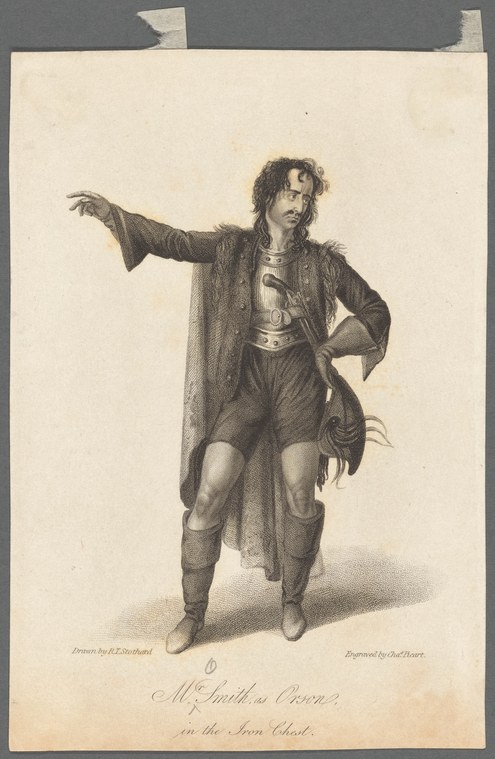
Mr. Smith as Orson in the Iron Chest
Unknown artist
- Collection:
- Prints depicting dance
- Source:
- New York Public Library
- Rights:
- Public domain — free to use, share and adapt.
- Recorded as:
- Public Domain
This image is evidence of how theatre, gesture, and the moving body were understood and documented in the late 18th century. It shows the formal, sculptural quality expected of serious tragic acting in this period—a style that influenced dance vocabulary and theatrical presentation. For dance historians, it illuminates the aesthetic context in which dancers performed, the ideals of body control and dramatic expression that shaped performance across genres, and how theatrical images functioned as currency in popular culture.
What you are looking at
A single male figure occupies the entire composition, posed against a plain cream background. He stands in a dramatic contrapposto stance, weight on his back leg, body angled to the left while his right arm extends downward in a gesture of pointing or dismissal. His left arm bends at the elbow, hand raised near his torso. He wears a dark velvet coat or tunic with a fur collar that drapes to mid-calf, revealing breeches and legs in dark stockings; a short sword hangs at his side. His hair is dark and curled, and his facial expression is intense and brooding. The overall impression is of a tragic or dramatic theatrical moment—a character in crisis or conflict, frozen mid-gesture.
The dancing
One male figure dominates the frame in a strongly asymmetrical pose. The weight is held on the back leg while the torso twists forward slightly, creating an S-curve from hip to head. The extended right arm and gesture of the pointing hand suggest appeal, accusation, or renunciation; the left arm at the body provides balance. This is not a dance posture but a rhetorical theatrical stance—the body is held as instrument of dramatic expression rather than locomotion or partnered interaction.
The dance depicted
This is not a depiction of social or stage dance as a movement practice. The image documents a moment of theatrical acting—specifically a dramatic soliloquy or crisis moment from a play. The inscription names the character (Orson) and the play (The Iron Chest), and the pose is the formal language of 18th-century and early 19th-century tragic acting, where the body holds a symbolic pose and the gesture communicates emotion to the audience. This is theatrical gesture within the conventions of dramatic performance, not choreographed dance.
How it was made
This is an engraving, printed from an incised copper plate; the inscription credits both the artist who drew it (Drawn by E. Woodward) and the engraver (Engraved by S. Posselwhite). The medium—a black-and-white line engraving with cross-hatching for shadow—was the standard mechanism for circulating theatrical imagery in the 18th and 19th centuries. Such prints were affordable, portable, and reproducible, and they typically documented famous actors in celebrated roles, circulating to audiences who had or hoped to see the performance.
About this work
This is a portrait engraving of the actor Mr. Smith performing the role of Orson in the 1796 play *The Iron Chest* by George Colman the Younger. The work documents a moment of theatrical drama rendered as a formal, posed image—not choreographed dance but the rhetorical gesture and bodily stillness of tragic acting. The engraving circulated as a theatrical souvenir and promotional document, one of hundreds of such prints that reproduced famous performances for audiences who consumed theatre through both live performance and collected prints. While not depicting dance per se, it belongs in a dance archive because it records the movement language, posture, and bodily convention of theatre in the Romantic era—a period when theatrical spectacle, movement vocabulary, and dramatic gesture were closely studied and highly valued as an art form.
How to look at it
Attend to the formality and stillness of the pose. The artist has not captured motion but rather a frozen moment of dramatic intensity—the kind of emblematic attitude that a trained actor would hold to communicate character and emotion to a theatre audience. Notice how the asymmetrical twist of the body, the downward gesture, and the brooding expression work together to signal conflict or despair. The precision of the engraving—the dark lines of the costume, the careful cross-hatching for shadow, the clarity of the face—was designed to preserve the actor's likeness and the exact pose for viewers who were not present at the performance.
The artist
E. Woodward and S. Posselwhite are credited as draughtsman and engraver respectively, but neither is otherwise identified in the record. Theatre portrait engravings of this period were often collaborative commercial projects produced by publishing houses rather than individually authored artworks. The division between 'drawn by' (the design) and 'engraved by' (the execution in copper) was standard practice.
The period
This print dates to the period of Romantic theatre and the rise of theatrical celebrity culture in Britain. *The Iron Chest* premiered at Drury Lane in 1796 and was a major success; the play dealt with Gothic themes of guilt, mystery, and moral conflict—hallmarks of the era. The late 18th and early 19th centuries saw an explosion in theatrical portraiture, as improved printing technology and growing middle-class audiences created a market for affordable images of celebrated actors and scenes. These prints shaped how theatre was consumed and remembered by the public, functioning as both souvenirs and advertisements. This was also a period when formal dramatic training emphasized sculptural, pose-based acting—the actor as a series of significant attitudes rather than naturalistic behavior—which contrasts sharply with later developments in theatre and dance.
Where it lives
This is a theatrical portrait engraving held in the NYPL Prints collection. The record identifies it only as a print depicting dance, but it is more accurately a theatre portrait—one of a vast body of such commercial engravings produced in Britain and circulated as theatrical ephemera.
Questions about this work
Is this actually a picture of dance?
Not dance as choreographed movement, but theatrical gesture and the movement language of dramatic acting. Theatre and dance were closely related practices in this period, and actors' movement vocabulary influenced dancers and vice versa. The image documents the formal, sculptural conventions of acting style that shaped the physical vocabulary of performance.
Who was Mr. Smith?
The record does not identify which Mr. Smith this is. Theatre portrait prints of this era sometimes name only the character, not the actor. Multiple actors may have played Orson in different productions.
What is The Iron Chest?
A Gothic melodrama written by George Colman the Younger that premiered at Drury Lane in 1796. It concerns a mystery surrounding a mysterious iron chest and deals with themes of guilt, secrets, and moral conflict—typical of Romantic-era theatre.
Why do these theatre prints belong in a dance collection?
Dance and theatre shared performers, audiences, venues, and aesthetic principles in this period. Images of actors' poses, gesture, and movement convey the physical vocabulary and bodily ideals that dancers learned and embodied. Theatre portraits thus document not just drama but the broader movement culture in which dance existed.
More dance artwork





