49 works in this view — arrow keys or swipe to move between them.
Dance in Art
Teresa Heberle
Unknown artist
- Collection:
- Prints depicting dance
- Source:
- New York Public Library
- Rights:
- Public domain — free to use, share and adapt.
- Recorded as:
- Public Domain
For historians of early modern performance, this engraving is a primary source for the costume, bearing, and visual presentation of court entertainers. It demonstrates that dance in this period was inseparable from sumptuary display and formal bodily discipline. The work survives as evidence of a specific person's status and role, captured in a medium designed to last and to circulate.
What you are looking at
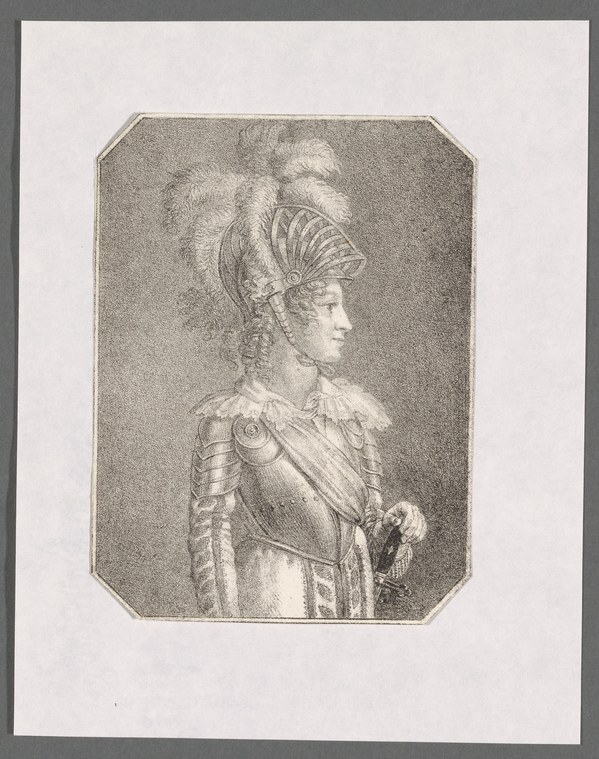
A woman in elaborate court dress stands in profile against a dark background, her body angled toward the right. She wears a richly decorated costume with a fitted bodice adorned with ornamental detail, including what appears to be a breastplate or corselet with raised circular bosses. Her skirt falls in gathered folds, and she holds her gloved hand before her at waist height with fingers delicately positioned. Her headdress is architectural and distinctive—a tall, fan-shaped construction that rises vertically from the crown of her head, suggesting a ruff or pleated collar standing upright. Her face is turned in strict profile, gazing upward and to the right. The composition is intimate, a portrait study rather than a scene of active movement, rendered in fine stippled engraving that creates subtle gradations of light across fabric and skin.
The dancing
A single standing female figure, posed in static profile with elegant restraint. The weight appears evenly distributed on both feet, and the posture is upright and formal. Her arms are not in a dance hold but in courtly repose, with one hand held gracefully at mid-body. The positioning is hieratic rather than dynamic—a display of dress and bearing rather than a captured moment of movement. There is no evidence of weight transfer, elevation, or the kind of articulated movement that would characterize active dance.
The dance depicted
This appears to be a portrait of a court dancer or performer, documenting costume rather than capturing dance in motion. The image records the dress, bearing, and formal presentation of a woman of rank or professional status, possibly a court entertainer. The static pose, careful profile view, and monumental headdress suggest the work was created to preserve a record of theatrical or ceremonial dress worn in the early 17th century, when such elaborate headdresses and corseted silhouettes were fashionable. Without evidence of active movement or a named dance form, this should be classified as a figure of dancerelated context rather than a depiction of dance itself.
How it was made
This is an engraving, rendered in fine dotted or stippled lines typical of early modern reproductive printmaking. The technique allows precise rendering of textile detail and architectural headdress construction while maintaining fine tonal gradation. The engraving's formal finish and attention to costume detail suggest it was intended for circulation among the educated or courtly classes, possibly as documentation of court dress or as a portrait of a notable performer. The technique and presentation indicate this was a work of some expense and prestige.
About this work
This engraving documents a woman in the formal dress of the early 17th century, standing in profile with the upright posture and elaborate costume befitting a court performer or woman of high status. The work is primarily a portrait and a record of historical dress rather than a depiction of active dance. Yet it belongs in a dance collection because it preserves the material culture of the early modern stage and court—the headdresses, silhouettes, and formal bearing that shaped how dancers moved and were seen. It offers evidence of how bodies were constrained and ornamented in an era when dance was inseparable from costume, hierarchy, and spectacle.
The image is valuable as a historical document of embodied presentation. Early modern dance occurred within rigid conventions of dress and decorum; understanding what a dancer wore and how she held herself in that costume is essential to understanding the dance itself. This portrait shows neither movement nor a named dance, but it shows the physical grammar within which court dance happened.
How to look at it
Attend to the precision with which the artist has rendered the headdress and the construction of the bodice—these details record actual garments and the engineering that went into their making. Note how the formal profile view presents the figure as a monument to dress and status rather than as a moving body. The upright stance and composed gesture are themselves performance: this is how a court performer was expected to stand and hold herself. The engraving technique, with its fine stippled lines, creates an illusion of luminosity and texture that would have made this a luxury object, circulated among the educated elite.
The artist
The artist is not recorded in the catalogue. The work is identified by subject only (Teresa Heberle), and no signature or attribution mark is visible in the image. The fine quality of the engraving suggests a skilled reproductive printmaker, likely working in the early 17th century or possibly later in retrospective documentation of an earlier costume. Without further evidence, the maker cannot be established.
The period
This work dates to an era when court dance in Europe was reaching new heights of elaboration and formality. The tight-laced corset, gathered skirts, and monumental headdress visible here are characteristic of fashion in the 1610s–1630s across northern European courts. Dance in this period was a demonstration of courtly refinement, physical control, and access to sumptuary luxury. Women dancers in court ballets and masques performed in costumes of extraordinary complexity, which restricted movement to small, precise, controlled gestures. The engraving medium was the dominant form for circulating images of court dress and notable performers, making such portraits essential records of a visual culture that no longer survives in material form.
Where it lives
The work is held in the New York Public Library as part of a broader collection of prints depicting dance. It is catalogued by subject name only, with no artist or date recorded, suggesting it entered the collection as a fragment of a larger portfolio or print series. The catalogue record is minimal, making the image itself the primary historical document.
Questions about this work
Is this a picture of someone dancing?
No, this is a portrait in profile showing a woman in formal court dress standing still. It documents costume and bearing rather than capturing dance in motion. However, it belongs in a dance collection because it shows how dancers were dressed and how they held themselves in the early modern period.
Who was Teresa Heberle?
The catalogue record does not identify her beyond the name. She was likely a court performer or woman of rank in the early 17th century whose portrait was engraved, possibly for circulation among the educated classes. The bare cataloguing suggests little additional documentation has survived.
What is that tall thing on her head?
It is a fashionable headdress of the 1610s–1630s, a standing collar or pleated ruff construction that rose vertically from the crown. Such headdresses were expensive, required skill to construct and maintain, and were a status symbol. They severely restricted the wearer's movement and visibility, shaping how a performer could move on stage.
How do you know this was made by engraving?
The technique is visible in the image: the fine parallel and dotted lines that build tone and texture are characteristic of early modern engraving. No original record of medium survives in the catalogue, but the visual evidence makes the technique clear.
More dance artwork





