49 works in this view — arrow keys or swipe to move between them.
Dance in Art
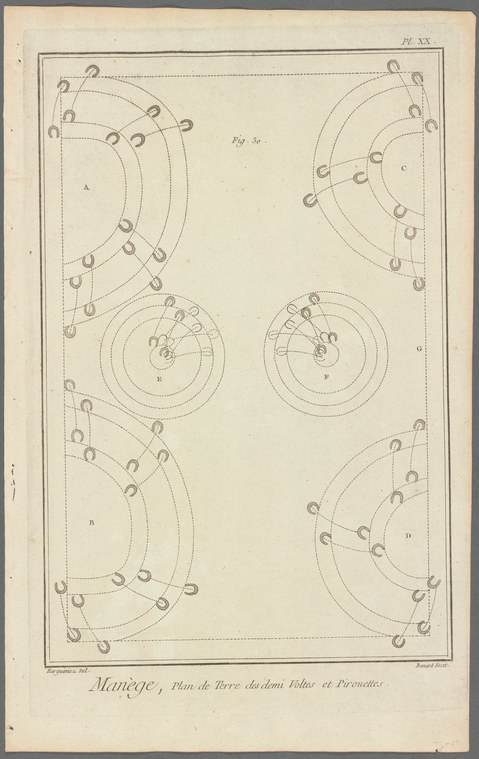
Manège, plan de terre des demi voltes et pirouettes
Unknown artist
- Collection:
- Prints depicting dance
- Source:
- New York Public Library
- Rights:
- Public domain — free to use, share and adapt.
- Recorded as:
- Public Domain
This work demonstrates that "dance" in the early modern courtly context extended metaphorically to animal movement and military precision. The diagram's use of dance terminology for equestrian maneuvers shows how deeply choreographic language was embedded in aristocratic culture, and how instruction—whether of human or animal body—was systematized through geometric means. For dance historians, it reveals the courtly aesthetic that valued symmetry, control, and ornamental precision in all forms of movement.
What you are looking at
This is a technical diagram of equestrian dressage, not a dance instruction or artistic representation. Six separate panels show overhead plans of a horse and rider executing classical maneuvers. Each panel contains concentric circles marking the arena or ground space, with a small circle at center representing the horse and small marks around it indicating the rider or points of reference. The panels are arranged in two columns of three, showing the progression and geometry of different movement patterns. The title indicates these are plans of "demi-voltes" (half-turns) and "pirouettes" (spins)—classical haute école movements where the horse rotates in place or executes sharp turning patterns. There is no visible perspective, no indication of actual human dancers, and no theatrical context. The style is purely diagrammatic, using dotted lines to show the path traced and circles to denote the horse's position at different points in the movement.
The dancing
Each diagram shows a single horse and rider viewed from directly above. The horse is represented as a small circle, with position markers (likely indicating the rider or specific body points) distributed around it. Dotted lines trace the path of movement through the arena space defined by concentric circles. The geometric precision and overhead view eliminate any sense of human bodily gesture; this is architectural instruction rather than artistic representation of movement.
The dance depicted
This is not a dance document. The work depicts classical equestrian dressage—the training of a horse to execute precise, controlled movements. The title's reference to "voltes" and "pirouettes" uses terminology borrowed from dance, but the subject is horsemanship. Dressage was a military and aristocratic pursuit in European courts from the Renaissance through the 18th century, and instruction manuals used both text and diagrams to teach these movements. The work belongs to the tradition of equestrian training treatises, not dance instruction.
How it was made
This is an engraving on paper, identifiable by the fine hatching, dotted lines, and precision of the printed lines—characteristic of intaglio printing. The numbered and labeled arrangement of diagrams suggests it is a page from a printed treatise, likely French given the French title and terminology. Engravings allowed for the precise geometric rendering necessary for technical instruction and enabled mass circulation of training manuals to military academies and aristocratic stables across Europe. The durability and clarity of the medium made it ideal for reference material intended for repeated study.
About this work
This is a technical diagram from a classical horsemanship manual, showing the ground patterns of dressage movements from an overhead perspective. It documents haute école—the high art of equestrian training that flourished in 16th–18th-century European courts and military institutions. Although the title uses dance terminology (volte, pirouette), the subject is the systematic instruction of a horse's movement, rendered through geometric diagrams rather than artistic representation. The work belongs in an art and dance archive only as evidence of the shared vocabulary and courtly aesthetics that united dance and horsemanship as complementary aristocratic accomplishments.
How to look at it
The reader should observe how the concentric circles define the arena as a measurable space, and how the dotted lines trace the exact path the horse must follow. Each diagram captures the horse at a discrete moment within a continuous movement, allowing a trainer to verify the correctness of the maneuver against a template. The overhead view—rare in artistic representation but essential for technical instruction—makes clear that these are working documents, not aesthetic objects. The comparison between the six panels shows the progression of the movement and the precision required at each phase.
The artist
Unknown. The engraving is unsigned and unattributed in the catalogue record. The style and precision suggest a professional military or technical illustrator working for a French court or riding academy, likely in the 17th or early 18th century. Such manuals were typically produced by teams of engravers and authors rather than individual artists; attribution would require comparison with known treatise illustrations from the period.
The period
Classical dressage manuals flourished in the 16th–18th centuries, particularly in France, Italy, and the Holy Roman Empire. Authors such as Federico Grisone, Antoine de Pluvinel, and François Robichon de la Guérinière published increasingly systematic treatises on the training of haute école horses. This period saw the militarization of dressage (as part of cavalry training) and its simultaneous refinement as courtly spectacle. Baroque court culture treated both human and animal movement as arts to be perfected and displayed; the language of dance—volte, pirouette, cadence—was applied to horses because both were understood as expressions of disciplined grace. The geometric diagrams reflect the Enlightenment's impulse to systematize and rationalize knowledge through visual and mathematical means.
Where it lives
This engraving is held by the New York Public Library in its collection of historical prints depicting dance and related performance. It is catalogued as a page from a French equestrian training manual, date and author unknown. The work entered the collection as part of the library's broad acquisition of European instructional and recreational prints.
Questions about this work
Why is this in a dance collection?
Because the title uses dance terminology (volte, pirouette) and because the collection includes allied courtly arts. In Renaissance and Baroque culture, dressage and dance shared language, aesthetics, and social function. But this is a horsemanship manual, not a dance document. Its presence flags the historical overlap between disciplines.
What are voltes and pirouettes in dressage?
A volte is a small circular path on which the horse moves at a controlled gait; a pirouette is a full rotation on the haunches, with the horse's hindquarters stationary. Both are classical movements taught in haute école. The terms were borrowed from dance because the movements share the quality of controlled, ornamental precision.
How would a rider use this diagram?
A trainer would use it as a reference to mark out the correct path on the ground or to visualize the horse's position at each stage of the maneuver. The overhead perspective makes it clear whether the horse has traced the correct arc or circle. The diagram would be studied before riding, much as a choreographic notation might be studied before dancing.
When was this printed?
The catalogue record does not specify a date. The style and technique suggest the 17th or early 18th century, when dressage manuals were at their height, but confirmation would require comparison with dated editions and expert analysis of the engraving technique.
More dance artwork





