49 works in this view — arrow keys or swipe to move between them.
Dance in Art
Masquerades and fancy-dress balls in prints
Unknown artist
- Collection:
- Prints depicting dance
- Source:
- New York Public Library
- Rights:
- Public domain — free to use, share and adapt.
- Recorded as:
- Public Domain
Masquerade balls represent a crucial moment in European social dance history when the ballroom became a space for theatrical transgression and social mixing. This print documents that world from inside—it is not a later artist's interpretation but a direct record of how such events were promoted and remembered by their participants. For historians of dance, it shows the genres that occupied aristocratic and bourgeois leisure: not ballet but the social forms—waltzes, quadrilles, contradances—that actually dominated how people danced together.
What you are looking at
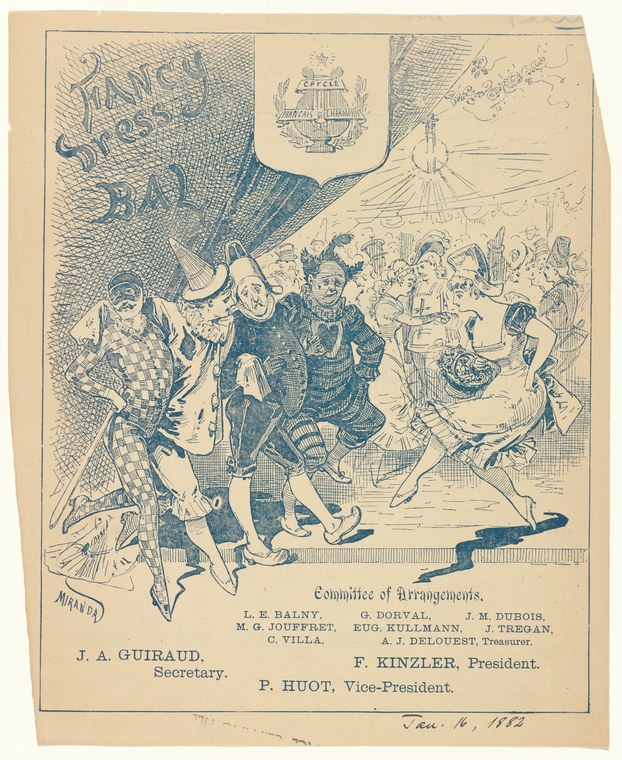
A lively masquerade ball or fancy-dress gathering rendered in blue pen and ink on cream paper. The composition is densely populated with figures in elaborate costumes—elaborate feathered headdresses, patterned clothing, and theatrical dress dominate. At left, a large parasol or fan structure rises diagonally, its crosshatched surface suggesting volume and depth. The right side opens into a crowd of dancers and revelers in various states of animated movement. Above, a heraldic emblem featuring an ornate baroque crown or urn sits centered, flanked by smaller architectural sketches. The artist has used rapid, energetic linework throughout, creating a sense of bustle and social chaos characteristic of carnival or masquerade scenes. The lower margin bears the artist's signature and committee information, suggesting this was a formal program or commemorative print.
The dancing
The figures are rendered in a loose, gestural style that prioritizes silhouette and costume over anatomical precision. Bodies are frequently captured mid-turn or mid-gesture, with raised arms, extended limbs, and tilted torsos suggesting rapid movement and social interaction. Several couples appear to be in close proximity, consistent with ballroom or salon dancing, though the precise hold is difficult to discern at this scale and in this rendering style. The figures range from roughly the same height, suggesting a mix of men and women in period dress, many wearing masks or headdresses that obscure their faces.
The dance depicted
This depicts a masquerade ball or fancy-dress social dance event, a form of aristocratic entertainment popular across Europe in the 18th and 19th centuries. The print shows the social and theatrical nature of such gatherings rather than a specific choreographed dance style. Masquerade balls combined elements of ballroom dance—waltzes, contradances, quadrilles—with theatrical presentation and costume. The image captures the spectacle and social mingling rather than precise footwork or technique, which was characteristic of how such events were documented and remembered: as moments of theatrical release, flirtation, and social transgression afforded by costume and mask.
How it was made
This is a pen-and-ink drawing or engraving, likely produced for publication as a program or commemorative print. The artist has used parallel hatching and cross-hatching to create tone and texture, a technique economical for reproduction and capable of quick execution. The signature "MIRANDA" at lower left and the printed text identifying committee members and officers suggest this was a formal, possibly official document for a specific event. The style and technique indicate circulation among a literate, urban audience familiar with such entertainments.
About this work
This is a commemorative print documenting a masquerade ball or fancy-dress entertainment, likely from the 19th century, produced for an identified committee overseeing the event. The print captures not a single choreographed dance but the social theater of masquerade itself—the costume, the mingling, the theatrical release that such events afforded. It belongs in a dance gallery as evidence of how social dance was experienced and represented in its moment: not as isolated technical achievement but as spectacle, courtship, and social play. The work shows the masquerade as a distinct cultural form that combined ballroom dancing with costume, mask, and theatrical presentation.
How to look at it
The viewer should attend to the layering of the composition: the formal heraldic emblems above establish this as an official, sanctioned entertainment, while the dense, chaotic figuration below shows the social reality of such events. Notice how costume and mask dominate over the clarity of individual bodies—this is not a ballet image where line and form are paramount, but a social document where theatrical dress and the energy of movement matter more than precise technique. The artist has frozen a moment not of perfect balletic line but of mingling, flirtation, and carnival release.
The artist
The artist signs as "MIRANDA," likely a professional illustrator or engraver working in Paris or another major European city in the 19th century. The competent draughtsmanship and the commercial purpose of the print suggest a career in theatrical and social documentation, a common specialization in the period. No further biographical information is currently recorded.
The period
The masquerade ball reached its height as a form of upper-class entertainment in the 18th and early 19th centuries, though the tradition persisted well into the Victorian era. These events blended formal ballroom dancing with costume theater, offering participants anonymity and the social permission to transgress ordinary hierarchies and proprieties. In the 19th century, masquerade balls were celebrated in literature, visual art, and music as sites of romance, intrigue, and social liberation. The print's style and technique—its rapid, expressive linework—reflect the period's taste for documenting fashionable life and theatrical entertainment through illustrated programs and satirical prints.
Where it lives
This print is held by the New York Public Library in a collection of prints depicting dance and masquerade. It is a commemorative or program document, identified by printed text naming the committee of arrangements responsible for the event, suggesting it was distributed to attendees or announced the occasion.
Dance in this work
Questions about this work
What is a masquerade ball?
A masquerade ball is a formal social dance event where guests wear masks and elaborate costumes, traditionally allowing for social mixing and temporary anonymity. Such events were popular in European aristocratic and upper-middle-class circles from the 18th century onward. They combined ballroom dancing—waltzes, quadrilles, contradances—with theatrical dress and the freedom that costume afforded from ordinary social constraint.
What dances would have been performed at such an event?
The specific dances are not identifiable from this print, but masquerade balls typically featured the ballroom standards of their era: waltzes, quadrilles, contradances, and cotillions. These were partner dances or group formations that occupied most of the evening. The print documents the social spectacle rather than any particular choreography.
Why is this a print rather than a painting?
This was likely an engraving or lithograph made for distribution as a program or commemorative document announcing or celebrating a specific masquerade event. Prints were far cheaper and faster to produce than paintings, making them ideal for such commercial and social purposes. The printed committee names and artist signature confirm its role as an official document.
Is this a historical record of an actual event?
The printed committee information and signatures suggest this documents a specific, real masquerade event. However, the artistic rendering is stylized and expressive rather than documentary in the photographic sense. It captures the atmosphere and spectacle of such events as they were experienced and remembered rather than serving as a strict record of costume or choreography.
More dance artwork





