49 works in this view — arrow keys or swipe to move between them.
Dance in Art
Augusta Nielsen
Unknown artist
- Collection:
- Prints depicting dance
- Source:
- New York Public Library
- Rights:
- Public domain — free to use, share and adapt.
- Recorded as:
- Public Domain
For dance historians, the work is valuable not as a record of choreography or technique, but as documentary evidence of how 19th-century dancers or performers were visually presented and commemorated through prints. The inscription anchors the image to a specific named individual, making it useful for recovering biographical information about historical performance culture and the professional networks in which dancers moved.
What you are looking at
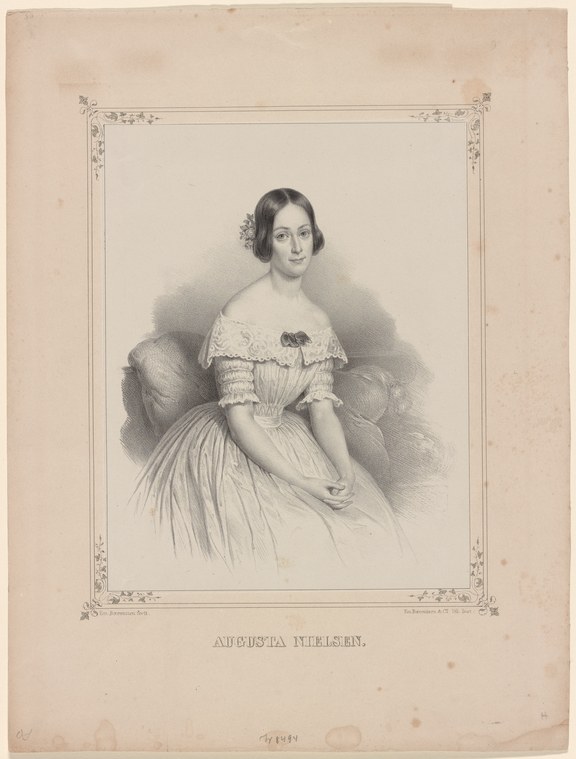
A three-quarter-length portrait of a young woman in an elegant off-shoulder ball gown, rendered in stippled engraving. She wears a pale, full-skirted dress with short puffed sleeves and delicate lace detail at the neckline, typical of mid-19th-century formal wear. Her dark hair is parted in the center and adorned with flowers or ornamental combs. She gazes directly outward with a serene expression, one arm resting lightly across her body while the other hangs at her side. The figure is set against a soft, atmospheric background created through careful tonal gradation, with an ornamental border frame featuring delicate floral corner ornaments. The entire composition conveys the refined elegance of a professional society or theatrical portrait.
The dancing
A single standing figure in a relaxed, frontal pose. Her weight appears evenly distributed, her posture upright but natural rather than rigidly formal. The arm position is modest and composed—one hand rests near her waist, the other hangs naturally—suggesting stillness and repose rather than active movement. The shoulders are open and drawn back slightly, and her gaze is direct and calm. There is no indication of active dance or weight transfer; this is a posed, stationary portrait.
The dance depicted
This is not a dance scene but a professional portrait of an individual, likely a performer or public figure given the quality of the engraving and theatrical styling. The subject's identity as "Augusta Nielsen" is inscribed below. The formal dress, direct gaze, and professional presentation suggest this may be a theatrical or society portrait from the mid-19th century, but no active dance movement is depicted. The work documents the appearance and presentation of a named individual rather than the choreography or practice of a dance style.
How it was made
This is a stipple engraving, a technique that builds tone and form through thousands of small dots rather than lines. Stipple engraving allowed for fine tonal gradation and was prized for producing refined, elegant effects suitable for society and theatrical portraits. The decorative border and careful handling of light and shadow suggest professional production for circulation among the educated public, likely as a print to be collected, framed, or included in theatrical programs or society publications. The technique's labor-intensive nature indicates the subject was considered worthy of significant artistic investment.
About this work
This is a mid-19th-century stipple engraving portraying a named individual—Augusta Nielsen—in formal theatrical or society dress. While the subject's identity and profession are documented through inscription, the work itself is not a representation of dance in action, but rather a portrait that may commemorate a performer or public figure. Its inclusion in a dance-focused collection likely reflects either the subject's known role as a dancer or the context in which the print was originally circulated, such as within theatrical or performance networks of the period. The refined technique and presentation indicate it was a professional, published work intended for an educated audience.
How to look at it
Attend to the inscription identifying the subject by name—this grounds the image as a historical document tied to a specific person. Observe the care taken in rendering fabric texture, the play of light on the skin, and the refined atmospheric background; these details reveal the professional status of both artist and subject. The direct gaze and composed posture are conventions of mid-19th-century portraiture designed to convey dignity and public presence. The ornamental border emphasizes the work as a finished, framed object intended for display or collection.
The artist
The artist is not recorded in the catalogue information provided. The quality and technique of the engraving suggests professional training, and the work's appearance in a prints collection dedicated to dance indicates it was created within or for that professional context. The decorative border and refined handling are consistent with mid-19th-century printmaking standards.
The period
In the mid-19th century, theatrical and society portraits were a major market for engravers. Theatrical prints served multiple purposes: they advertised performers, were sold at venues as souvenirs, and were collected as records of celebrated artists. The formal off-shoulder gown and styling are consistent with 1840s–1860s fashion and theatrical presentation. This period saw growing professionalization of dance and theater, with named performers becoming increasingly celebrated and their likenesses circulated in print form. Stipple engraving was a leading technique for high-quality portraiture, competing with and later being superseded by photographic processes.
Where it lives
The work is held in the New York Public Library's prints collection, catalogued within the section "Prints depicting dance." It is a published engraving, likely produced and distributed in the mid-19th century, though the exact date of creation and printing remains unrecorded.
Questions about this work
Is this a picture of a dance?
No. This is a portrait of a person, not a representation of active dancing. The subject stands in a calm, posed position with no indication of movement, weight transfer, or choreography. It likely commemorates a theatrical performer or public figure, but documents appearance rather than technique.
Who was Augusta Nielsen?
The inscription identifies the subject by name, but the catalogue provides no additional biographical information. To learn about her, you would need to consult historical theater records, dance historiography, or period newspapers and programs. Her inclusion in a dance prints collection suggests she was known as a performer, but the nature and scale of her career are not recoverable from this image alone.
How was this print made?
This is a stipple engraving, a technique in which tiny dots create tone and form. It is an intaglio process—the image is incised into metal (usually copper or steel), inked, and printed. Stipple engraving was laborious but produced refined, soft effects ideal for portraiture and was widely used for theatrical and society prints in the 19th century.
More dance artwork





