49 works in this view — arrow keys or swipe to move between them.
Dance in Art
Serge Lifar
Unknown artist
- Collection:
- Prints depicting dance
- Source:
- New York Public Library
- Rights:
- Public domain — free to use, share and adapt.
- Recorded as:
- Public Domain
Lifar was one of the most important male ballet dancers of the 20th century and a choreographer whose work shaped modern ballet. A portrait study of his body is a document of a particular moment in the history of the male dancer's status and visibility in European high culture, when a male performer's likeness could be circulated as a serious art object.
What you are looking at
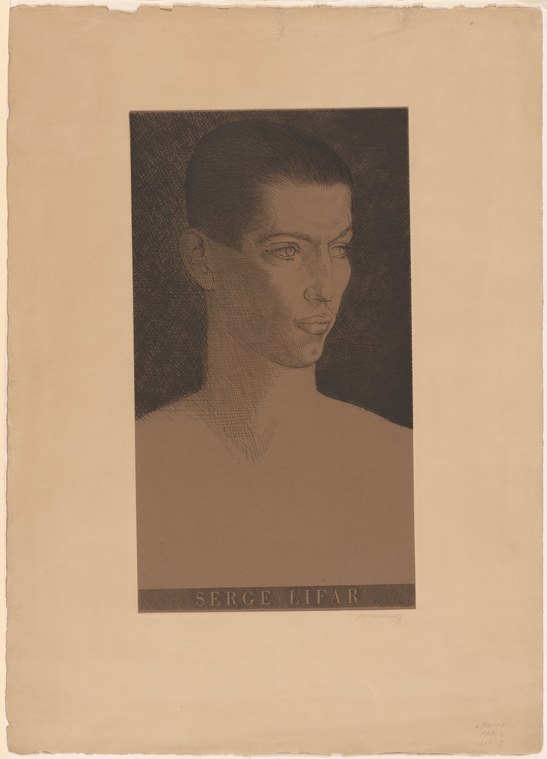
A portrait study of a male figure shown in three-quarter profile against a dark background. The subject is rendered in soft modeling with careful attention to facial structure and musculature. The figure is bare-shouldered, presented in a classical manner typical of academic figure studies. The composition is frontal and direct—a straightforward presentation of the body rather than a moment of movement or dance. The printing technique creates subtle gradations of tone, with careful hatching visible in the shadow areas, particularly the dark background that throws the figure into relief. The name "SERGE LIFAR" is printed in capitals at the bottom of the composition.
The dancing
The figure stands upright with relaxed posture and neutral expression. The shoulders are square and level, the neck extended naturally. The face is asymmetrically modeled with particular attention to the profile line of the nose and the definition of the cheekbone. The arms are not visible or are cropped below the frame. There is no indication of movement, weight shift, or the dynamic tension characteristic of a dancer in action.
The dance depicted
This is not a depiction of dance in motion. It is a formal portrait study of Serge Lifar, the principal dancer and choreographer of the Ballets Russes. Lifar was one of the most celebrated male ballet dancers of the early 20th century, succeeding Vaslav Nijinsky in prominence. The portrait shows him in the academic tradition of figure studies—a presentation of the body as an object of formal study rather than as a performing instrument. The artist has chosen to emphasize the classical proportions and architectural quality of the body rather than its capacity for movement.
How it was made
This is an engraving or etching—a print made from an incised metal plate. The technique is visible in the linear hatching used to model form and create shadow, particularly dense in the background. The paper is aged cream, and the plate impression is crisp. The formal presentation and classical handling suggest this is a mid-20th century production portrait, likely produced for circulation in arts publications or as a keepsake for collectors and dance enthusiasts. The technique allowed for multiple impressions and relatively wide distribution compared to a unique drawing or painting.
About this work
This is a formal portrait study of Serge Lifar inscribed with his name. It presents the celebrated Russian-born ballet dancer and choreographer in the academic tradition of figure study—a classical presentation of the male form at rest rather than in performance. The work belongs in a gallery of dance imagery because Lifar was a central figure in 20th-century ballet, a dancer of historic importance whose body was an instrument of artistic innovation. The portrait captures him as a subject of study rather than as a moving performer, reflecting the way his reputation extended beyond the stage into the broader culture of elite European art.
How to look at it
Attend to the formal precision of the portrait: the artist has rendered Lifar as a classical subject, with the careful proportions and restrained presentation of Renaissance and neoclassical portraiture. The dark background is not a theatrical setting but a studio convention designed to isolate and dignify the figure. The engraving technique—visible in the fine parallel lines that build shadow and form—creates an effect of timelessness and permanence, suggesting that this is not a temporary performance but a durable historical record of an important artistic figure.
The period
Serge Lifar danced with the Ballets Russes from 1923 until the company's dissolution in 1929, and later became ballet master of the Paris Opéra. This portrait likely dates from his period of greatest prominence in the 1920s or 1930s, when the Ballets Russes had transformed European attitudes toward dance and the male dancer. The academic style of the portrait—a formal bust study in the neoclassical manner—reflects a broader turn in European culture away from the experimental modernism of the 1910s toward a more consolidated, monumental aesthetic. The decision to circulate Lifar's portrait as a printed study positions him alongside visual artists and composers as a figure of cultural authority.
Where it lives
The work is held as part of the New York Public Library's collection of prints depicting dance. The inscription of Lifar's name and the formal presentation suggest this was an official or authorized portrait, likely produced and distributed during or shortly after his period as a leading dancer.
Questions about this work
Is this a portrait of Serge Lifar the dancer?
Yes. The name "SERGE LIFAR" is inscribed at the bottom. Lifar was the principal male dancer of the Ballets Russes from 1923 to 1929 and one of the most celebrated dancers of his era. He later became ballet master of the Paris Opéra.
Why is this a portrait and not a dance scene?
The artist chose to present Lifar in the academic tradition of figure study—as a subject of formal portraiture rather than as a performer in motion. This reflects Lifar's status as a major cultural figure whose importance extended beyond the stage.
What dance style did Lifar perform?
Lifar was a classical ballet dancer trained in the Russian Imperial Ballet tradition. He performed leading roles in ballets by Fokine, Massine, and Balanchine with the Ballets Russes, and later choreographed his own works for the Paris Opéra.
More dance artwork





