49 works in this view — arrow keys or swipe to move between them.
Dance in Art
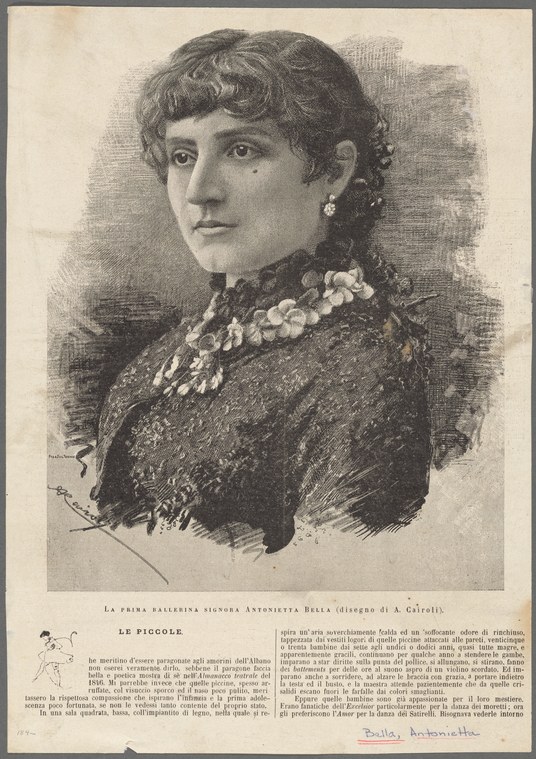
La prima ballerina Signora Antonietta [sic] Bella
Unknown artist
- Collection:
- Prints depicting dance
- Source:
- New York Public Library
- Rights:
- Public domain — free to use, share and adapt.
- Recorded as:
- Public Domain
This portrait documents the public visibility and social standing of a professional ballet dancer in the early 20th century, at a moment when ballet was establishing itself as a prestigious theatrical art in Europe. It shows how dancers were marketed to the public through their appearance and bearing, inviting viewers to see in them not only artists but women of fashion and cultivation.
What you are looking at
A three-quarter portrait of a young woman, shown from roughly the waist up, facing slightly left toward the viewer. She is rendered in a soft tonal engraving or lithograph, with careful cross-hatching and shading that gives the face and neck a luminous quality. The woman wears an elaborately decorated dress with a patterned dark fabric (possibly silk or brocade) visible at the shoulder and breast, and a striking collar or choker of white flowers—likely camellias or gardenias—that frames her neck and jawline. Her dark hair is arranged in an early 20th-century style, waved and pinned up, with soft ringlets framing her face. The background is kept deliberately indistinct, rendered in loose shading that makes the figure emerge from the page. The work is signed in the lower left, and there is Italian caption text beneath identifying her as a prima ballerina.
The dancing
The figure's posture is formal and composed, the head held with the slight lift and angle characteristic of studio portraiture. There is no depiction of the body in motion or a dance pose; this is a portrait made for display and recognition rather than a record of performance. The neck is extended and graceful, as might be expected of a trained dancer, but the gesture is one of serene composure rather than active dancing.
The dance depicted
The caption identifies this subject as 'La prima ballerina Signora Antonietta [sic] Bella,' establishing this as a portrait of a professional ballet dancer of some prominence. The work documents her as a performer of rank (prima ballerina), but the image itself contains no information about her technique, repertoire, or style. The absence of pointe shoes, tutu, or any stage setting suggests this is a portrait made for circulation in society or in the press rather than a record of her performance. The formal dress and jeweled choker indicate her status as a celebrated public figure rather than the theatrical costume that would appear in a stage portrait.
How it was made
This is a tonal engraving or possibly a lithograph, judging by the soft gradations of light and dark, the fineness of the line work, and the way the image is registered on paper. The technique creates an image suitable for reproduction and mass circulation—such portraits were commonly published in illustrated papers and journals to publicize performers. The skill evident in the rendering of flesh tones and the delicate play of light on the face suggests a trained and accomplished hand, and the image has the character of a professional studio work intended for wide distribution.
About this work
This is a portrait of a professional ballet dancer, Antonietta Bella, made in the early years of the 20th century. It belongs to a large tradition of publicity portraits of celebrated performers—images made to circulate in the press and among the public, establishing the dancer's fame and social standing. The work shows us how ballet dancers of the era were marketed and remembered: not always in the theatrical costume and artificial pose of stage portraiture, but sometimes in fashionable society dress, posed as a lady of accomplishment and refinement. The presence of such a portrait in a collection of dance imagery reflects the fact that dancers of the period were public celebrities whose likenesses were in demand.
How to look at it
Notice how the artist has composed the portrait to emphasize the dancer's status and femininity rather than her physicality or technical skill. The face is the clear focal point, rendered with great delicacy, while the dress and jewels signal her place in fashionable society. The soft focus of the background and the careful management of light across the features are conventions of early 20th-century celebrity portraiture, designed to flatter the sitter while also establishing her as a public figure worthy of attention. The white flowers at her throat add an almost pastoral note, softening what might otherwise be a severe or austere composition.
The artist
The artist is not identified in the catalogue record. The quality of the work and its professional finish suggest a studio photographer or printmaker working in the commercial portrait trade in Italy or another major European city. The signature, which may be visible in the lower left, is the primary clue to attribution, but without further research it cannot be confirmed from the image alone.
The period
This portrait was likely made in the first two decades of the 20th century, when illustrated journals and photogravure technology made it possible to circulate high-quality portraits of performers to a wide audience. Ballet in this period was experiencing a remarkable renaissance, especially in Europe, with impresarios like Sergei Diaghilev promoting Russian and European dancers to an enthusiastic public. The early 20th century saw the rise of the star system in ballet, in which individual dancers—particularly prima ballerinas—became celebrities whose images and personalities were cultivated and sold. The formal social dress and refined presentation visible here reflect the cultural status that ballet had by then achieved.
Where it lives
This print is held in the New York Public Library's collection of prints depicting dance. It is a historical document of theatrical publicity and the public circulation of dancer imagery in the early 20th century.
Questions about this work
Who was Antonietta Bella?
The image and caption identify her as a prima ballerina—a dancer of the highest rank—but the catalogue record provides no further biographical information. Further research in ballet histories and in Italian theatrical archives would be needed to establish her career dates, repertoire, and significance. The portrait is evidence that she was celebrated enough to merit professional portraiture and wider circulation.
Why is she not shown dancing?
Portraits of performers in the early 20th century were often made in street dress or society costume rather than theatrical dress, especially for publication in journals and newspapers. This format allowed the dancer to be presented as a person of fashion and refinement, which was part of establishing her social and cultural status. Stage portraits, in costume and in posed theatrical positions, served a different purpose.
What do the flowers mean?
The elaborate choker of white flowers is a deliberate choice by the artist or the patron, likely intended to underscore the dancer's femininity and beauty. Flowers were a common embellishment in society portraiture of the period. Whether these were worn by Bella herself or added for the portrait cannot be determined from the image alone.
More dance artwork





