49 works in this view — arrow keys or swipe to move between them.
Dance in Art
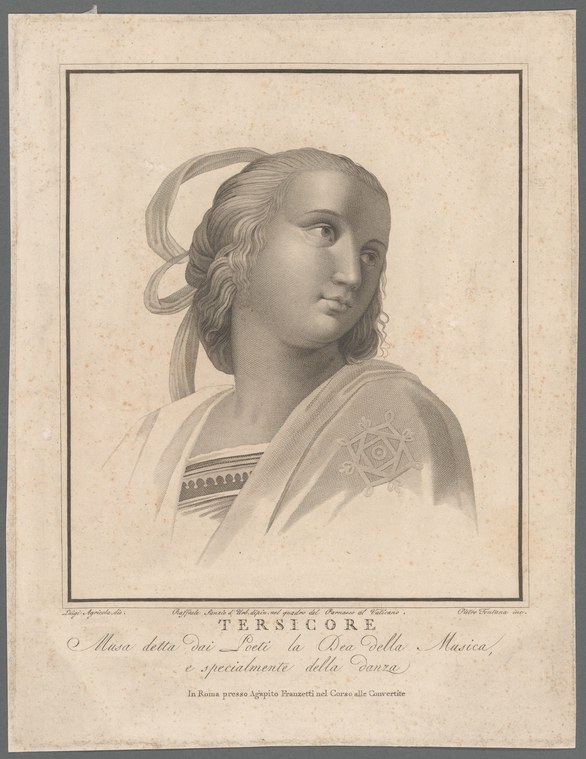
Tersicore: Musa detta dai Poeti la Dea della Musica, e specialmente della danza
Unknown artist
- Collection:
- Prints depicting dance
- Source:
- New York Public Library
- Rights:
- Public domain — free to use, share and adapt.
- Recorded as:
- Public Domain
This work reveals a critical dimension of dance history: the gap between how dance was practiced and how it was represented in high art. The image shows that print culture, unlike performance, could only capture dance as concept, ideal, or memory—never as the lived, embodied practice. Understanding this distinction is essential to interpreting all allegorical dance imagery and recognizing what historical documents can and cannot tell us about how people actually danced.
What you are looking at
A three-quarter-length portrait of a young woman rendered in fine engraving. She is shown from approximately the shoulders up, her body angled slightly to the left while her head turns to gaze toward the viewer with a serene, distant expression. Her hair is arranged in long, wavy tresses gathered loosely at the back with a delicate ribbon or band; a few strands fall softly around her face. She wears a classical drapery—a light garment with a decorative border at the chest featuring a geometric pattern. The background is plain and neutral, allowing the figure to command full attention. The line work is precise and consistent, with careful hatching used to model the contours of her face, the volume of her hair, and the fall of fabric. The engraving technique creates a luminous, almost ethereal quality through the contrast between the fine lines and reserved white of the paper.
The dancing
The woman's posture is upright and frontal, with no active dance position visible. Her shoulders are relaxed and squared; her arms are not shown. The pose is contemplative and static—this is a portrait attitude rather than a captured moment of movement. The gentle turn of the head and the soft fall of hair suggest a moment of repose or reverie rather than physical exertion.
The dance depicted
This is not an image of dance in action but an allegorical portrait. The title identifies the figure as Terpsichore, the muse of dance and music in classical mythology, but the engraving shows her in a timeless, iconic pose conventional to allegorical portraiture rather than depicting the practice of dance itself. She represents the concept and ideal of dance rather than its performance. The figure conforms to Renaissance and classical revival conventions for representing the muses—idealized, elegant, and divorced from the specific physical vocabulary of any dance style.
How it was made
This is an engraving on paper, recognizable from the fine parallel lines (hatching) and the characteristic sharp, controlled line work of the intaglio process. The technique allowed for wide circulation through multiple prints from the same plate and created an aesthetic of refinement and permanence valued for didactic and commemorative subjects. The inscription at the base suggests this is from a series of prints, likely part of a larger project documenting classical iconography or allegorical figures.
About this work
This engraving presents Terpsichore, the classical muse of dance, as an idealized female figure in the style of Renaissance and neoclassical portraiture. It is not a documentation of dance practice but rather a visual invocation of the concept and cultural status of dance through the language of allegorical representation. The work belongs in a dance gallery as evidence of how dance was understood and visualized in learned and artistic culture—not as action but as an elevated abstraction embodied in a beautiful, knowing face. This print is part of the long visual tradition of representing dance through mythology and ideal beauty rather than through the actual bodies and movements of dancers.
How to look at it
Attend to the face and expression: Terpsichore is not rapturous or ecstatic but calm and introspective, gazing somewhere beyond the viewer. This is not the expression of performance but of contemplation—the muse as source and inspiration rather than performer. Notice the soft materiality of the hair and drapery and how the fine engraving technique creates an almost luminous quality, elevating the figure into the realm of the ideal. The absence of any props, setting, or indication of movement is the point: this is dance distilled to its essence as a concept embodied in beauty and nobility.
The artist
The artist is not recorded in the catalogue. The style and inscription suggest this is a European engraving, likely 18th century, from a series of classical or allegorical subjects. The competence of the line work and the refinement of the print suggest a professional engraver working within the academic tradition of reproducing classical iconography.
The period
This print emerges from a period in which neoclassicism was reshaping European art and taste, particularly in the 18th century. Dance itself was undergoing transformation—aristocratic court dance was giving way to ballroom fashion and the emergence of theatrical ballet as a defined art form. Yet in print culture, the classical muses remained the primary visual language for representing dance conceptually. The print reflects the learned, mythologically educated audience for such works, for whom Terpsichore would have been immediately recognizable and would evoke both classical antiquity and the idealized status of dance in contemporary culture.
Where it lives
The work is catalogued as part of the New York Public Library's collection of prints depicting dance. The inscription at the base indicates this is part of a larger series, but the complete context and publisher information are not recorded in the catalogue.
Questions about this work
Is this a picture of someone actually dancing?
No. This is an allegorical portrait of Terpsichore, the classical muse of dance and music. It represents the concept of dance through an idealized figure rather than depicting dance as a physical practice. The figure is static and contemplative, not in motion.
Who was Terpsichore?
In classical Greek mythology, Terpsichore was one of the nine Muses and the patron of dance and choral song. She was conventionally depicted in Renaissance and neoclassical art as a beautiful, idealized woman, often with attributes like a lyre or wreath. Her image became a standard symbol for dance in educated visual culture.
Why is an allegorical figure included in a gallery of dance in art?
Allegorical representations reveal how dance was understood, valued, and communicated in a given period. This engraving shows that in 18th-century learned and artistic culture, dance was represented not through the actual bodies and movements of dancers but through classical mythology and idealized beauty. Understanding this gap is essential to interpreting historical visual sources about dance.
What technique was used to make this print?
This is an engraving, an intaglio printmaking technique in which an image is incised into a metal plate. The fine parallel lines (hatching) visible throughout create tone and volume through accumulated line work. Engravings could be printed many times from the same plate, making them efficient for distributing images to educated audiences.
More dance artwork





