49 works in this view — arrow keys or swipe to move between them.
Dance in Art
Quadrille Albanais
Unknown artist
- Collection:
- Prints depicting dance
- Source:
- New York Public Library
- Rights:
- Public domain — free to use, share and adapt.
- Recorded as:
- Public Domain
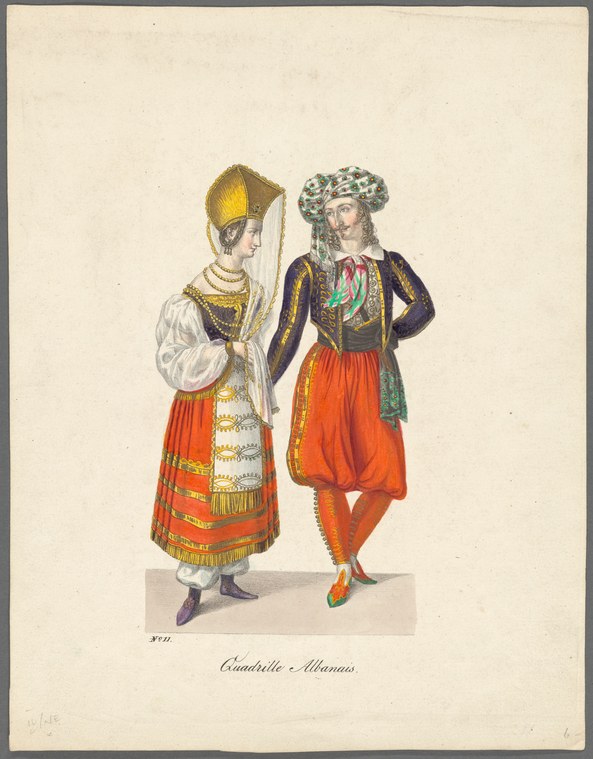
This image reveals how 19th-century European audiences encountered dance from the wider world: through ethnographic prints that prioritized costume over movement, exoticism over lived practice. It demonstrates the role of visual media in constructing and marketing 'folk' and 'national' dance identities to metropolitan viewers.
What you are looking at
Two figures in full-length view stand against a plain background, identified by inscription as 'Quadrille Albanais.' On the left, a woman wears a tall cylindrical headdress (kokoshnik) in gold, a white embroidered shirt with long sleeves, and a red skirt with decorative green and gold trim at the hem. Gold chains ornament her neck and chest. She holds a long staff or rod vertically. On the right, a man wears a colorful patterned cap, a dark jacket with gold braiding and decorative green elements, and bright red baggy breeches. Both figures are rendered in hand-colored engraving with careful attention to textile pattern and ethnic costume detail. The composition is formal and symmetrical, presenting the two dancers as specimens of a national dress tradition rather than capturing movement in progress.
The dancing
Neither figure is shown in active dance position. Both stand upright and frontal, with arms at rest or holding the staff; there is no closed hold, no partnering frame, and no indication of weight transfer or footwork. The man's stance is relaxed and conversational—he appears to gesture with one hand. The woman is static and formal. The positioning suggests these are costume studies or ethnographic illustrations rather than a moment extracted from actual dancing.
The dance depicted
The title and costume identify this as the 'Quadrille Albanais'—a quadrille in the Albanian style. Quadrilles were fashionable partner dances of the 18th and 19th centuries, performed in ballrooms and at formal events across Europe and its colonies. However, this image shows no quadrille choreography or hold; it appears instead to be a costume documentation, presenting Albanian dance dress as exotic ethnographic material for European consumption. The staff held by the woman may be a traditional Albanian dance implement, but its purpose and use are not demonstrated here.
How it was made
Hand-colored engraving on paper, likely 19th century based on the printing technique and costume style. The fine linear work and the capacity for precise detail in embroidery, braiding, and ornament are characteristic of engraving. The hand coloring—applied after printing—allows subtle gradation in the fabric dyes and metallic accents. This combination of techniques was typical of fashion plates, ethnographic documentation, and souvenir prints circulating widely among European audiences interested in folk costume and exotica.
About this work
This is an ethnographic costume print presenting two dancers or dance figures in Albanian national dress, likely created in the 19th century for a European audience curious about non-Western performance traditions. It documents dress rather than choreography, functioning as both a record of material culture and an exotic spectacle. The 'quadrille' in the title may indicate the dance's adoption into ballroom practice or simply serve as a marker of its national origin. The work belongs in a dance gallery because it shows how European visual culture consumed, classified, and displayed non-European dance traditions—often flattening living practice into static costume display.
How to look at it
Note that this is not a dance scene but a portrait of costume. The formal, frontal presentation and the absence of any partnering, frame, or dynamic posture signal that the artist's concern is documentation of dress rather than capture of movement. The staff and headdress are rendered with ethnographic precision; the bodies exist primarily to display them. This was typical of such costume prints, which presented non-European dance as material culture for European collectors.
The period
The 19th century saw a European appetite for ethnographic and folk imagery, driven by imperial expansion and Romanticism's interest in 'authentic' cultural forms. Costume prints and character dances in the quadrille format became fashionable in ballrooms, where European dancers performed stylized versions of dances from colonized and other territories. These prints often appeared in series documenting 'peoples' or 'national dances' and were sold as educational and entertaining illustrations.
Where it lives
The work is held in the New York Public Library's collection of prints depicting dance. It is an example of 19th-century European ethnographic and costume printmaking, likely produced and circulated as part of a series or portfolio.
Dance in this work
Questions about this work
Is this actually showing a quadrille?
Not in the conventional sense. No quadrille choreography or ballroom hold is visible. The title likely refers to the dance tradition's name within European classification systems, or to its adoption into ballroom practice. The image is a costume study, not a choreographic record.
What is the staff the woman is holding?
That is not clear from the image alone. It may be a traditional Albanian dance implement or processional object, but its function and use in the dance are not demonstrated. The print prioritizes its visual exoticism over explaining its purpose.
When and where was this made?
The catalogue record provides no date or maker attribution. The engraving style, color printing technique, and costume details suggest a 19th-century European origin, likely created for sale to European audiences interested in ethnographic and folk material.
More dance artwork





