49 works in this view — arrow keys or swipe to move between them.
Dance in Art
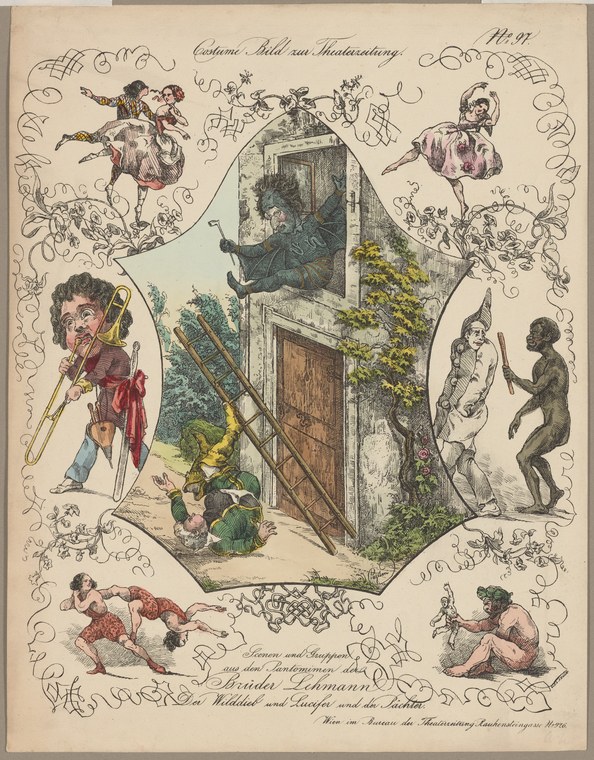
Scenen und Gruppen aus den Pantomimen der Brüder Lehmann Der Wilddieb und Lucifer und der Pächter
Unknown artist
- Collection:
- Prints depicting dance
- Source:
- New York Public Library
- Rights:
- Public domain — free to use, share and adapt.
- Recorded as:
- Public Domain
This work shows that in the eighteenth century, theatrical movement ranged far beyond ballet. The Lehmann brothers were as famous and influential as any dancer of the period, yet their art was pantomime—physical storytelling in which the body's capacity for distortion, acrobatics, and comic exaggeration took precedence over line and turnout. For dancers and choreographers, it is a reminder that ballet's formalized vocabulary is only one path; for historians, it is nearly the only surviving visual record of what popular German theater actually looked like in performance.
What you are looking at
A hand-colored engraving depicting scenes from pantomime performances by the Lehmann brothers. The composition is organized around a central architectural element—a dilapidated stone structure or grotto with a barred doorway—which serves as the focal point. Surrounding this central scene in an ornamental border of scrollwork are eight smaller vignettes showing individual figures and pairs in various poses of theatrical action. The figures are rendered in eighteenth-century costume: women in long skirts, jackets, and period headdresses; men in breeches and coats. The central scene shows figures in dramatic interaction near the structure, while the surrounding panels capture moments of exaggerated gesture, acrobatic posture, and comedic business. The palette is subtle—ochres, greens, and flesh tones against the aged paper—with the scrollwork border providing visual structure. The overall effect is that of a theatrical broadside or souvenir documenting a popular performance.
The dancing
The figures display exaggerated, theatrical postures characteristic of eighteenth-century pantomime: high-kicked legs, extended arms, and contorted spinal flexion. Several performers adopt impossible or precarious positions—one figure appears nearly horizontal in mid-leap; another bends backward with torso parallel to the ground. The central pair near the architectural element engage in what appears to be a dramatic confrontation or chase. Throughout the composition, the bodies are articulated to emphasize dislocation and comic distortion rather than balletic line; weight is often thrown onto a single leg in off-balance attitudes that suggest rapid motion and physical comedy.
The dance depicted
These are scenes from two pantomimes performed by the Lehmann brothers, a celebrated German pantomime troupe of the eighteenth century (the title names *Der Wilddieb* and *Lucifer und der Pächter*—*The Poacher* and *Lucifer and the Landlord*). The Lehmanns were known for physical comedy, acrobatic feats, and the commedia dell'arte tradition, performed in German theaters and courts. The theatrical movement shown here is not ballet proper but **pantomime—gestural narrative performance in which the body speaks without words.** The exaggerated postures and the variety of actions across the eight scenes suggest the episodic nature of pantomimic storytelling: flight, confrontation, seduction, revelation. The style is consistent with Harlequinade and German folk-theatrical traditions rather than the formalized court dances of the period.
How it was made
This is a hand-colored engraving, likely produced as a souvenir or advertising broadside for the Lehmann troupe's performances. The engraved line work is fine and precise, defining musculature and costume detail, while the watercolor or gouache overlay provides local color. The format—multiple scenes in a bordered frame—is typical of theater prints of the period, designed for circulation to audiences, collectors, and other theaters. The technique allowed for rapid reproduction and distribution; such prints were cheap, durable, and widely sold in German cities. The survival of this example in the New York Public Library suggests it was valued enough to be preserved, indicating either its fame or the Lehmanns' reputation.
About this work
This is a documentary record of a specific theatrical entertainment: scenes from German pantomime performances by the celebrated Lehmann brothers in the eighteenth century. It captures not ballet or courtly dance but the physical comedy and narrative mime of the popular stage—acrobatic, gestural, and rooted in commedia dell'arte convention. The engraving documents a now-vanished performance practice through a visual medium that was the era's chief way of circulating images of theater beyond the playhouse itself. For historians of dance, it is invaluable evidence of what eighteenth-century popular theater looked like, how bodies were used for comedy and narrative, and how performance was marketed and remembered.
How to look at it
Attend to the variety of body positions across the eight vignettes: no two figures adopt the same pose, and several push the body into contortions that would be impossible in ballet. Notice how the central scene uses the architectural element as a stage within the stage, anchoring a narrative moment while the surrounding scenes show fragments of action—chase, seduction, amazement, acrobatics. The scrollwork border, typical of decorative prints of the period, frames the theatrical scenes as precious objects worthy of collection and display. What the artist has chosen to capture is not a single dance but a sequence of moments from a narrative performance, emphasizing the physical extremes and comic possibilities of the body in motion.
The artist
The engraver is not recorded. The prints were likely produced by a commercial workshop in a German theater city (possibly Leipzig or Berlin) as part of the Lehmann brothers' marketing apparatus. The Lehmanns—the most famous German pantomime troupe of their era—performed across German-speaking territories and were celebrated enough to merit multiple documented performances and published images. The print's style and technique suggest a competent professional engraver working in the mid-to-late eighteenth century, producing the kind of theatrical publicity that was standard for successful performers.
The period
In the eighteenth century, pantomime and commedia dell'arte were flourishing across Europe as popular theater, especially in German territories. While ballet was developing in French courts and becoming increasingly codified and formalized, pantomime remained physically inventive and rooted in improvisation and folk tradition. The Lehmann troupe flourished in this context, performing for audiences hungry for physical comedy and narrative spectacle. Simultaneously, engraving as a medium was at its height as a means of documenting and advertising performance; before photography, such prints were the only way to circulate images of theater beyond those who had witnessed it live. The preservation of this print reflects both the popularity of the Lehmanns and the growing value placed on documenting performance visually.
Where it lives
The work is held in the New York Public Library's Prints collection and is identified as part of their holdings of dance-related imagery. It is a German engraving, likely from the mid-to-late eighteenth century, produced as a theatrical souvenir or broadside advertisement.
Questions about this work
Who were the Lehmann brothers?
The Lehmanns were a celebrated German pantomime troupe of the eighteenth century, famous across German-speaking territories for acrobatic comedy and narrative mime. They performed versions of commedia dell'arte and original works, and were among the most successful popular theater performers of their era. Little detailed biography survives, but their fame is evident from the circulation of prints like this one.
Is this ballet?
No. This is pantomime—gestural narrative performance rooted in commedia dell'arte and folk theater. While ballet was developing its formal vocabulary during the same period, pantomime remained physically inventive, acrobatic, and rooted in comic exaggeration. The Lehmanns' art privileges the body's capacity for distortion and storytelling over the turnout and line that would define classical ballet.
What are the two pantomimes shown?
The title identifies them as *Der Wilddieb* (The Poacher) and *Lucifer und der Pächter* (Lucifer and the Landlord). The eight surrounding scenes are likely key moments from these narratives—chases, confrontations, seductions, or reversals—but without a detailed script or program, the specific plot of each is not recoverable from the image alone.
Why was this engraving made?
It was almost certainly produced as a theatrical souvenir for sale to audience members and as advertising for the troupe's performances. Before photography, prints were the primary way to circulate images of theater and to extend a performer's fame beyond those who had seen them live. Such prints were inexpensive and widely sold in theater districts and at performances.
More dance artwork





