49 works in this view — arrow keys or swipe to move between them.
Dance in Art
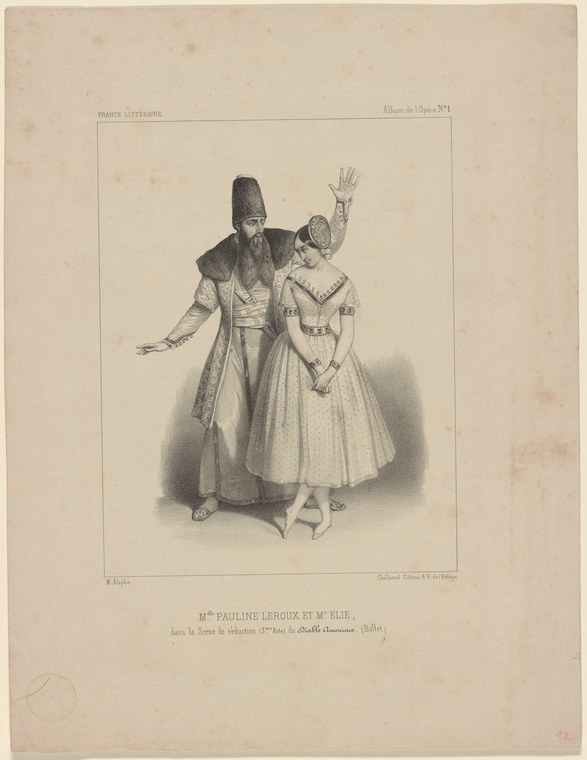
Melle. Pauline Leroux et Mr. Elie, dans la scène de séduction (3eme. Acte) du Diable amoureux
Unknown artist
- Collection:
- Prints depicting dance
- Source:
- New York Public Library
- Rights:
- Public domain — free to use, share and adapt.
- Recorded as:
- Public Domain
This work documents how dramatic gesture and seduction were performed and transmitted through 19th-century theatre. For dance historians, it shows the boundary between theatrical acting and dance—a scene that carries dance-like theatrical presence but is not balletic choreography. The print also preserves the names of performers (Pauline Leroux and Monsieur Elie) and a specific theatrical production, anchoring it in a recoverable moment of performance history.
What you are looking at
A man and woman in formal 19th-century dress face each other in a moment of theatrical seduction. The man, dressed in a dark coat with a distinctive tall hat and what appears to be military or formal tailoring, leans slightly forward with one arm extended in an expressive gesture while his other hand rests at his side. The woman, in a pale dress with puffed sleeves and a fitted bodice trimmed with darker bands, stands with her head tilted and one hand raised to her hat—a gesture suggesting surprise, coquetry, or resistance. The composition is intimate and frontal; the figures occupy most of the frame against a plain background typical of theatrical prints. The tonal modelling creates depth through careful shading, giving the figures sculptural presence. The work is a lithograph, recognizable from its characteristic grainy texture and the way light is rendered through tonal gradation rather than line.
The dancing
The pair stand at close quarters but not in a standard dance hold. The man's posture is animated and forward-leaning, his extended arm and open hand addressing the woman with courtship or persuasion; his weight appears to shift toward her. The woman's pose is more reserved—her body upright, her hand at her hat a protective or flirtatious gesture rather than a dancing gesture. Neither figure displays the rigorous frame or extension characteristic of ballet, nor do their limbs suggest active footwork. The moment is one of dramatic interaction rather than choreographed movement.
The dance depicted
The title identifies this as a scene of seduction (*scène de séduction*) from the third act of *Le Diable amoureux* (The Devil in Love), a theatrical work likely adapted from one of the several 19th-century versions of this tale. The scene depicts a dramatic moment between two characters—possibly supernatural or operatic in nature—rather than a formal dance number. While the figures are dressed for theatre and positioned as though on stage, the frozen gesture is one of dramatic confrontation or flirtation, not balletic or social dance proper. The work documents how seduction was staged in 19th-century theatre, where proximity, gesture, and costume carried narrative weight.
How it was made
This is a lithograph, a planographic printing technique that dominated theatrical and popular prints in the 19th century. The artist worked on stone with a greasy crayon or ink, allowing rich gradations of tone and soft transitions between light and shadow—visible here in the modelling of the figures' faces and fabric. Lithography was economical and allowed wide circulation; such prints were sold as souvenirs of famous theatrical productions, reaching audiences far beyond the theatre. The soft texture and the way light plays across the pale dress are characteristic of skilled lithographic work.
About this work
This is a theatrical print documenting a scene of seduction from a staged production of *Le Diable amoureux*. It captures the moment of dramatic confrontation between two characters—a formally dressed man making an emphatic gesture toward a woman in pale theatrical dress, her hand raised in a gesture of surprise or coquetry. The work belongs to the tradition of 19th-century theatrical souvenirs, prints that circulated among theatre-goers and dancers, preserving images of celebrated performances and actors. It sits at the intersection of theatre history, costume history, and the practice of theatrical portraiture in lithography.
The print is valued less for its documentation of choreographed dance than for what it reveals about how seduction and courtship were performed and staged in 19th-century theatre, and how theatrical costume and gesture carried dramatic meaning. It is evidence of a theatrical culture in which such prints were commodities, preserving the memory of live performance.
How to look at it
The artist has frozen a moment of charged dramatic interaction rather than executed movement. Attention should go to the man's gesture—the extended arm and open palm—which conveys persuasion, entreaty, or supernatural compulsion. The woman's hand-to-hat gesture suggests her awareness of being addressed, a moment of hesitation or flirtation. The spatial intimacy and the tonal emphasis on the figures' faces signal that this is a moment of psychological drama rather than spectacle. The formal dress and the clean background remove the scene from everyday reality, marking it as theatrical and staged.
The artist
The artist is not recorded. The print is credited to a lithographic workshop—the imprint reads "Printed by [printer] Paris," suggesting production by a commercial theatrical print publisher of the period. Such prints were often drawn by staff artists or journeymen rather than celebrated painters; the skill evident here in tonal control and figural modelling was typical of professional theatre print production in Paris.
The period
This print was made in an era when theatrical prints were a major form of mass media and popular entertainment documentation. The 1830s–1850s saw the height of lithographic theatrical portraiture in France, particularly in Paris, where celebrated actors and scenes from operatic and melodramatic productions were widely reproduced and consumed. *Le Diable amoureux* had multiple theatrical versions in this period—as a vaudeville, as an opéra comique, and as a melodrama—each staged with different music, dance, and spectacle. The print's style and the names of the performers date it to the mid-19th century, a moment when Romantic theatre embraced supernaturalism, seduction, and spectacular staging.
Where it lives
This print is held in the New York Public Library's collection of prints depicting dance. It is one of thousands of 19th-century theatrical prints—souvenirs of performances, advertisements, and documentary records—that circulated widely and were collected by institutions documenting visual culture and performance history.
Questions about this work
Is this a ballet?
No. While the scene is from a theatrical production and features theatrical costume and pose, it documents dramatic acting and gesture rather than choreographed ballet. The figures' postures and frames do not show balletic technique. The work is theatre history rather than dance history proper, though it sits at a boundary between the two.
Who were Pauline Leroux and Monsieur Elie?
They were performers in a production of *Le Diable amoureux*, likely in Paris in the mid-19th century. Their names are recorded only on this print and related theatrical documentation; further information about their careers is not readily available without archival research into theatrical records and cast lists of the period.
What is Le Diable amoureux?
It is a supernatural comedy tale adapted multiple times for the stage in the 18th and 19th centuries, usually involving a demon or devil figure seducing or tormenting a mortal. The story was particularly popular in French theatre, where it was staged as opéra comique, melodrama, and vaudeville. This print documents the third act, a moment of seduction between two characters.
How was this print made?
This is a lithograph, a printing technique that uses a stone surface treated with grease and water. The artist drew the image on the stone with a greasy crayon; ink adheres to the greasy areas and is repelled by the wet stone. The stone is then pressed against paper, transferring the image. This technique allowed rich tones and soft shading, and prints could be made in large quantities.
More dance artwork





