49 works in this view — arrow keys or swipe to move between them.
Dance in Art
Le Chalumaux
Unknown artist
- Collection:
- Prints depicting dance
- Source:
- New York Public Library
- Rights:
- Public domain — free to use, share and adapt.
- Recorded as:
- Public Domain
This work illustrates how eighteenth-century print collections classified imagery: movement, gesture, and the drama of the body in emotional situations could fall under 'dance' even when no actual dance was depicted. Understanding this broader meaning of 'dance' in historical print collections helps explain why such works were collected and studied together. For scholars of neoclassical imagery and sentiment, it demonstrates the period's interest in depicting emotional touch and pathos through the language of classical drapery and pose.
What you are looking at
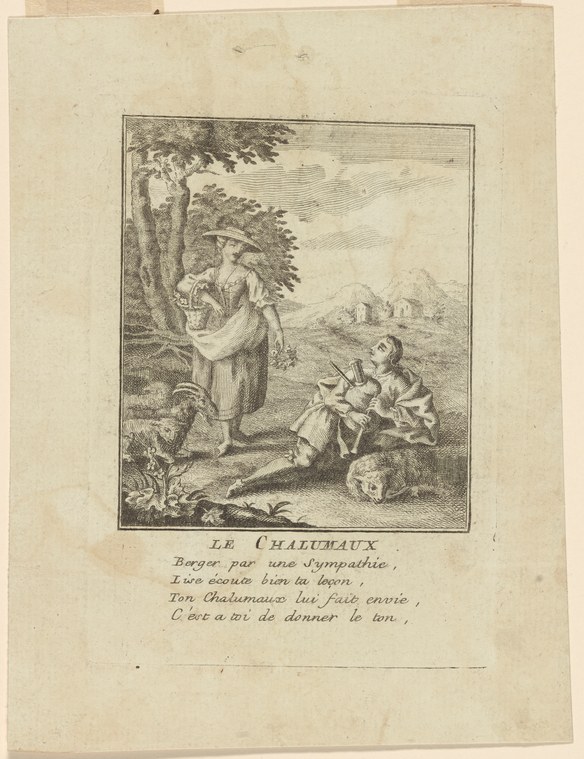
A pastoral scene unfolds in a shallow space defined by a large tree at left and distant buildings at right. In the foreground, two figures in classical drapery engage with each other: a standing woman gestures downward toward a seated youth who reclines on the ground, his body twisted away. The seated figure appears to play or mime playing a reed pipe (chalumeau), suggested by his raised arm and the tilt of his head. The ground is scattered with natural debris—fallen branches, plants—and the sky above is rendered with atmospheric perspective, suggesting evening or changeable weather. The entire scene is framed within a ruled border, characteristic of eighteenth-century reproductive engravings.
The dancing
The standing woman leans forward with her weight on one leg, her arm extended downward in a gesture of sympathy or entreaty; her drapery suggests movement and emotional engagement. The seated youth is supine or reclining, his torso twisted, one arm raised toward his face or instrument, the other across his body. The spatial relationship is intimate and emotionally charged—not a formal dance hold but a dramatic moment of contact. Neither figure is upright or in balletic alignment; the bodies convey pathos rather than technical precision.
The dance depicted
This is not a depiction of an actual dance but a narrative scene from pastoral or mythological tradition, likely illustrating a literary or musical story. The chalumeau (a small reed instrument, ancestor of the clarinet) identifies this as a scene of bucolic music-making, and the French caption suggests a sentimental or allegorical meaning. The touching and gestural quality suggests emotional drama rather than choreographed movement. This belongs to the tradition of classical or neoclassical illustration rather than dance documentation.
How it was made
This is a copperplate engraving, identifiable by the fine parallel hatching lines used to model form and shadow, the ruled border, and the overall finish characteristic of eighteenth-century French reproductive prints. The technique allowed wide circulation as a multiple, and the presence of a French caption suggests publication in an illustrated book or periodical. Engraving's precision and capacity for fine tonal gradation made it the dominant medium for art reproduction and instruction during this period.
About this work
Le Chalumaux is an eighteenth-century copperplate engraving depicting a moment from pastoral narrative: a standing woman gestures toward a reclining youth playing a reed pipe. Though it shows a moment of dramatic contact between two classically draped figures, it does not depict formal or social dance. Rather, it belongs to the broader tradition of neoclassical illustration—the representation of emotional scenes from literature, mythology, and bucolic tradition. The French caption suggests this was part of a larger illustrated work, possibly a set of moral or sentimental vignettes. Its presence in a collection of dance prints likely reflects the broader eighteenth-century category of 'dance prints,' which often included figure studies, theatrical scenes, and narratives of bodily movement even when not documenting an actual dance.
How to look at it
Attend to the gesture of the standing figure—the downward reach and the inclination of the body toward the recumbent youth—as the emotional heart of the image. The engraver has chosen a moment of intimate contact and unequal postures, suggesting vulnerability and sympathy. Note how the classical drapery (rather than contemporary dress) elevates the scene into a realm of timeless sentiment. The framing device of the border and the careful management of light and shadow create a theatrical 'stage' for this small drama, inviting the viewer to read it as a scene from a narrative or moral allegory.
The artist
The artist is not recorded. The style and technique are consistent with mid-to-late eighteenth-century French engraving; the refined execution and the presence of a French caption suggest a professional printmaker working within the reproductive tradition. Such engravings were typically made after drawings or paintings and distributed as prints for collectors, students, and the educated public.
The period
The work dates from the eighteenth century, when neoclassical aesthetics dominated European art and when printed engravings were the primary means of reproducing and circulating images. During this period, pastoral themes and scenes of classical simplicity were highly fashionable, reflecting both Enlightenment philosophy and a reaction against baroque ornament. In dance, this was the age of the minuet and refined social dance, but also of increasing theatrical spectacle and the development of ballet d'action—narratively dramatic ballets that used the body to tell stories. This print sits at the intersection of these currents: it depicts not formal dance but the language of bodily gesture and emotional expression that ballet was increasingly exploring.
Where it lives
Held in the New York Public Library Prints collection under the category 'Prints depicting dance.' The work is a reproductive engraving, likely one sheet from a larger series or illustrated publication.
Questions about this work
Is this actually a dance?
No. This engraving depicts a dramatic scene from pastoral or mythological narrative—a woman comforting or addressing a youth playing a pipe—rather than a formal or social dance. Its inclusion in a collection of 'dance prints' reflects the broader eighteenth-century meaning of the category, which encompassed gesture, movement, and scenes of bodily drama even when not documenting an actual dance.
What does the French caption mean?
The title Le Chalumaux (The Reed Pipes) identifies the subject. The couplet below provides moral or emotional commentary characteristic of sentimental or allegorical prints of the period, though the specific meaning requires translation and contextualization within the larger work from which this sheet was drawn.
When and where was this made?
Based on style and technique, this is an eighteenth-century French engraving. The artist is not recorded, and the current location is the New York Public Library. Without further documentation, more precise dating and attribution cannot be established.
Why are non-dancers included in a dance collection?
Eighteenth-century collectors and curators understood 'dance prints' broadly to include any prints depicting movement, gesture, and the trained body in theatrical or allegorical situations. This reflected the period's view of dance as part of a larger system of bodily eloquence and expression.
More dance artwork





