49 works in this view — arrow keys or swipe to move between them.
Dance in Art
Le tourbillon: galop pour le piano, composé pour les bals de 1838
Unknown artist
- Collection:
- Prints depicting dance
- Source:
- New York Public Library
- Rights:
- Public domain — free to use, share and adapt.
- Recorded as:
- Public Domain
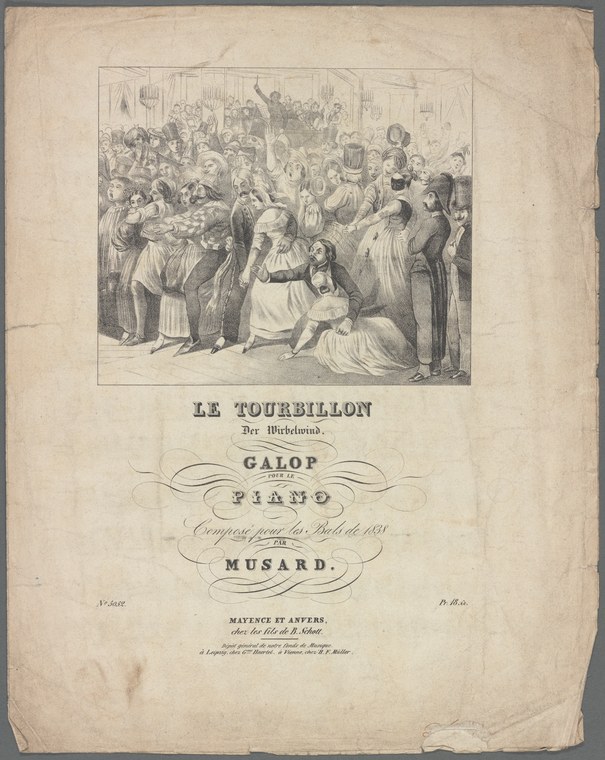
This print is among the few contemporary visual documents of the galop in its original social context. It shows not a staged performance or academic reconstruction, but an actual ballroom in motion—evidence of how couples actually danced, how closely they held each other, and how the dance was integrated into mixed-gender social gathering. For historians and dancers, it is a record of technique and social practice that no written description quite captures.
What you are looking at
A crowded ballroom or dance hall scene captures a galop in progress, likely at a public ball in 1838. The composition is densely packed with figures in formal dress—women in full skirts with corseted waists, men in tailcoats and trousers—arranged across the entire pictorial space. The perspective compresses the crowd into a unified mass of movement, with couples scattered throughout at various depths. The energy is centripetal: figures lean, gesture, and turn as the dance sweeps them forward. In the foreground, a woman's skirt is caught mid-whirl, her companion supporting her through the motion; other couples are interlocked in the characteristic close frame of the galop. The background fades into an architectural interior suggesting a grand ballroom, with hints of columns or doorways. The engraving technique gives the scene a documentary quality, as if capturing the actual social spectacle of the ballroom.
The dancing
Dancers are predominantly in closed couple position—man facing forward with arm around woman's waist, woman's hand on man's shoulder—the standard frame for the galop. The close frame and forward-leaning posture throughout the composition indicate rapid, propulsive movement: bodies are animated and slightly off-vertical, as though caught mid-stride. Skirts billow and flare where the turn is sharpest. The artist shows understanding of partner dance: most couples maintain contact, with the woman's weight shifted onto her partner. Upper bodies are relatively still; the action drives from the lower body and legs, characteristic of a couple dance designed for speed and lightness.
The dance depicted
This is a galop, a fashionable ballroom dance of the 1830s–1840s characterized by rapid hopping steps and circular motion performed in closed couple position. The title explicitly names it a galop (subtitle "Der Wirbeltanz"—The Whirling Dance), and the published date of 1838 places it at the height of the galop's popularity in European ballrooms. The galop was a social dance for mixed couples, typically danced in sequences at formal balls, and this print documents that social context. The composition suggests the characteristic speed and circular energy of the dance—the repeated turning and the forward propulsion visible throughout the scene. The image does not depict professional theatrical dancers but rather the fashionable ballroom public of the Parisian or European elite.
How it was made
This is an engraving or finely detailed lithograph on paper, reproduced from what appears to be a press print. The technique allows for tonal modeling and mass effect: the artist uses varied line density to suggest crowds, with foreground figures articulated clearly and background figures dissolved into texture. This was a common format for music covers and dance instruction prints in the 1830s. The work was published as sheet music for piano ("pour le piano"), meaning it was produced in quantity for the commercial music market. The technique and format indicate an audience of amateur musicians and dancers of the middle-to-upper classes—people who bought music for home performance and attended public balls.
About this work
Le Tourbillon is a print documenting a specific ballroom dance—the galop—at the moment of its fashionable peak in 1838. It serves dual purposes: as cover art for a piano reduction of a galop score, and as a visual record of how the dance looked and how it fit into the social world of the European ballroom. The artist's choice to show the crowd rather than isolated dancers captures the galop's essential character: a rapid, exhilarating dance that swept entire ballrooms into synchronized circular motion. The engraving technique and commercial distribution as sheet music indicate that this image shaped how dancers and musicians across Europe understood and performed the dance. It is a primary document of ballroom culture at a moment when the galop was displacing the quadrille as the fashionable partner dance.
How to look at it
Notice the artist's choice to show the continuous swirl rather than a moment of stillness: almost every figure is in motion, leaning or turning. The closed holds throughout the composition are consistent—a sign that the engraver understood the dance's structure. Pay attention to the architectural depth and the way the crowd recedes: the print captures both the intimacy of a couple's frame and the social spectacle of the ballroom as a unified moving mass. The title "Der Wirbeltanz" (The Whirling Dance) points to what the image conveys: the galop was defined by its centrifugal energy and the way it made the ballroom itself seem to spin.
The artist
The print is unsigned and no artist is recorded in the catalogue. It was published by Mayence (Mainz) of Antwerp, a music publisher of the period, and engraved by what appears to be a commercial workshop supplying sheet-music covers. The style suggests mid-19th-century European commercial printmaking: competent, lively, and designed for swift mass production rather than fine-art display.
The period
The 1830s were the height of the galop's international vogue. Introduced from Germany around 1825, the dance had by 1838 become the defining partner dance of European ballrooms, particularly among the urban middle and upper classes. It displaced the quadrille in some contexts and existed alongside it in others. In visual culture, the galop appeared frequently in satirical prints, fashion plates, and dance-instruction materials. Musically, galop compositions proliferated—Strauss, Tolbecque, and dozens of minor composers produced galops for piano and for orchestra. This print, as a music cover, sits at the intersection of commercial music publishing and social documentation, a format that became increasingly common as the century progressed.
Where it lives
The work is part of the New York Public Library's collection of prints depicting dance. It is a commercial music-cover print, one of thousands produced during the 19th century to accompany published dance music. Such prints were distributed to amateur musicians, music sellers, and dancers across Europe and North America.
Dance in this work
Questions about this work
What is a galop?
The galop was a fast, whirling couple dance in 2/4 time, popular in European ballrooms from the 1820s onward. Couples danced in a closed frame, moving in rapid hopping steps and circular patterns. It was lively, athletic, and sociable—a ballroom dance for the general public rather than a courtly or theatrical form.
Is this a painting or a print?
This is a print—most likely an engraving or lithograph—produced commercially as a cover for sheet music. The technique allowed for rapid reproduction and distribution. Such prints were common accompaniments to published dance music in the 19th century.
Who danced the galop?
The galop was a social dance for mixed couples in public ballrooms, primarily among the urban middle and upper classes of Europe and America in the 1830s–1860s. It was not a theatrical dance, though some professional dancers performed galops on stage. This print shows the social ballroom context.
Why is the composition so crowded?
The crowding is intentional. It documents the galop's social reality: it was a dance performed by many couples simultaneously in a single ballroom, all moving in synchronized patterns. The density of the composition conveys the spectacle and energy of the ballroom at its height.
More dance artwork





