49 works in this view — arrow keys or swipe to move between them.
Dance in Art
Lola Montez
Unknown artist
- Collection:
- Prints depicting dance
- Source:
- New York Public Library
- Rights:
- Public domain — free to use, share and adapt.
- Recorded as:
- Public Domain
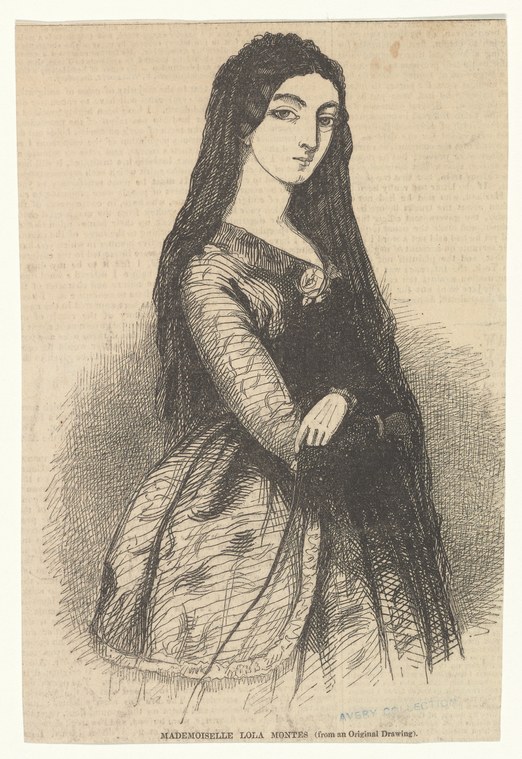
Lola Montez was one of the first international celebrity dancers and a pioneering performer of the exotic and sensational. While this portrait does not show her dancing, it is historical evidence of how she was commercially reproduced and marketed to the public—a crucial part of 19th-century performance culture.
What you are looking at
A three-quarter-length portrait of a woman in mid-19th-century dress, shown in profile facing left. She wears a dark bodice with long sleeves featuring detailed cross-hatching that suggests a patterned or textured fabric, paired with a full skirt of lighter tone rendered in flowing parallel lines. Her dark hair falls in long waves past her shoulders. The woman's posture is upright and composed, with one arm visible at her side. The background is plain and unshaded, a light cream tone typical of period portraiture. The entire image is executed as a line engraving or etching, with the artist using dense parallel hatching to create shadow and volume.
The dancing
A single standing figure shown in a formal, stationary pose. Her weight appears settled and centered, with no indication of movement or active dancing posture. The arm position is relaxed at the side. There is no partner, no frame of reference for a dance hold, and no visible suggestion of footwork or dynamic weight transfer. The pose is that of a portrait subject rather than a dancer in motion.
The dance depicted
The catalogue record identifies this as Lola Montez, the famous dancer and courtesan of the 1840s–1850s. However, nothing in this image—the static pose, the formal portraiture convention, the lack of stage costume or movement—depicts her actually dancing. Montez was renowned for her Spider Dance, a theatrical solo performance. This portrait appears to be a documentary or publicity image of the woman herself rather than a representation of her art in performance.
How it was made
This is a line engraving or etching, identifiable by the consistent parallel hatching lines used to model form and create tonal variation—a hallmark of intaglio printmaking. The technique required skilled hand-work and would have circulated as a reproducible image, making it likely a commercial portrait print or illustration for a newspaper or periodical. The note 'from an Original Drawing' suggests the engraver worked from a painting or drawing by another hand, a common practice for reproducing celebrity images of the period.
About this work
This is a mid-19th-century celebrity portrait engraving of Lola Montez, the notorious Spanish dancer and performer. While the catalogue places it in a dance collection, the image itself documents the woman rather than her performance; it is a formal three-quarter-length portrait in the documentary style of the era. It belongs in a dance history context because Montez was a significant theatrical figure and because her image circulated widely in print, shaping how she was seen and remembered. The work demonstrates how popular performers were packaged and consumed as images, not only as stage artists.
How to look at it
The viewer should register that this is a portrait of a person famous for dance, not a depiction of dancing itself. The formal, static pose—the calm frontal gaze, the composed arm, the settled weight—is a period convention for celebrity documentation. The careful rendering of expensive fabric and fashionable dress signals status and glamour. This is how Montez wished to be seen when not performing: elegant, respectable, composed—a contrast to her theatrical reputation.
The artist
The engraver is not recorded. The inscription 'from an Original Drawing' indicates that the engraver was adapting work by another artist. This was standard practice in 19th-century print production, where specialized engravers transformed paintings and drawings into reproducible formats for mass distribution.
The period
The 1840s–1850s saw the rise of celebrity culture and mechanical reproduction, particularly in prints and periodicals. Lola Montez danced in this era, famous for her scandalous Spider Dance and her affairs with European nobility. Romantic ballet was dominant in the same period, but Montez represented a different theatrical tradition—part courtesan performance, part exotic spectacle, drawing audiences through personality, scandal, and physical display rather than narrative or classical technique. Engravings and lithographs of famous performers were a major vehicle for publicity and fame.
Where it lives
The work is held in the New York Public Library's collection of prints depicting dance. The source information lists it as an engraving 'from an Original Drawing,' indicating it is a reproductive print adapted from another artist's work.
Questions about this work
Is this engraving showing Lola Montez actually dancing?
No. This is a formal celebrity portrait, not a stage image. It shows her as a fashionable woman of the period, not performing. It documents her public persona and celebrity status rather than her art. Montez was famous for her Spider Dance, a theatrical solo, but that is not depicted here.
Who was Lola Montez?
Lola Montez (1821–1861) was a Spanish dancer and performer famous across Europe and America in the 1840s–1850s. She was known for her scandalous Spider Dance, her affairs with European nobility (including King Ludwig I of Bavaria), and her combination of theatrical performance and courtesan culture. She was one of the first international celebrity performers and a significant figure in 19th-century entertainment.
Why is a portrait in a dance collection?
Because celebrity images of famous performers are part of dance history, even when they do not depict the person dancing. This engraving documents how Montez was seen and marketed to the public. It is a piece of performance culture and celebrity history, not a documentary record of her choreography or technique.
What technique was used to make this?
This is a line engraving or etching, made by incising lines into a metal plate and printing from the recessed lines. The parallel hatching you see is characteristic of this technique. The inscription notes it was made 'from an Original Drawing,' meaning the engraver adapted a painting or drawing by another artist—a standard 19th-century practice for producing reproducible celebrity portraits.
More dance artwork





