49 works in this view — arrow keys or swipe to move between them.
Dance in Art
Portrait
Unknown artist
- Collection:
- Prints depicting dance
- Source:
- New York Public Library
- Rights:
- Public domain — free to use, share and adapt.
- Recorded as:
- Public Domain
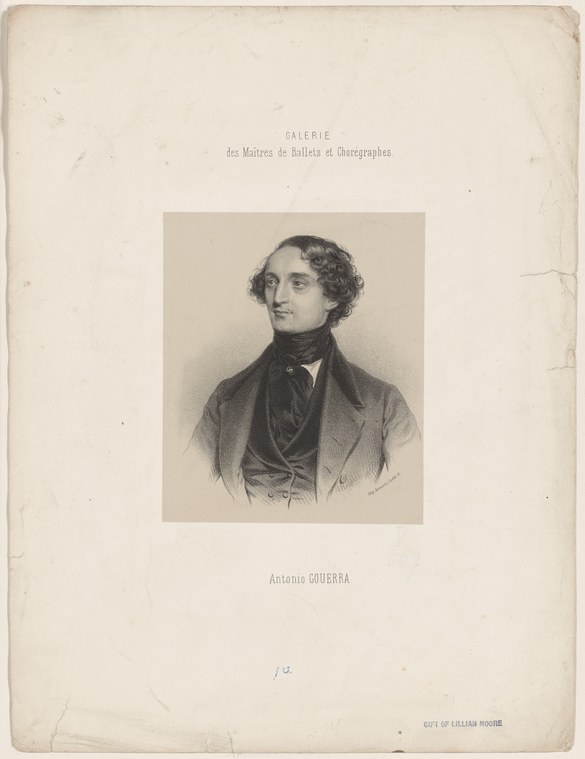
This image documents the nineteenth-century elevation of choreographers from anonymous craftspeople to named artists whose work merited recognition and biography. It shows how dance was being integrated into the cultural discourse of the period through the visual culture of portraiture and print.
What you are looking at
This is a portrait bust of a man in mid-nineteenth-century dress, rendered in lithograph with soft modeling and careful attention to character. The sitter faces three-quarter right, his shoulders draped in a dark coat with visible white collar and cravat. His hair is dark and curled, his expression thoughtful and slightly distant. The lithographer has used fine shading to suggest volume in the face and clothing, with the background left neutral and pale. The work is mounted on cream paper stock with printed text identifying the subject as "Antoine Gauberra" and crediting it to a gallery of "Maîtres de Ballets et Chorégraphes" (Masters of Ballets and Choreographers).
The dancing
This is a portrait head and shoulders, not a depiction of dance in motion. The figure is stationary and frontal in presentation. The gesture is reserved and formal, appropriate to mid-nineteenth-century portraiture conventions. There is no dance posture, hold, or footwork visible.
The dance depicted
This is a portrait of a named choreographer or ballet master, not a depiction of dance itself. The text identifies Antoine Gauberra as a master of ballet and choreography. The work belongs to a gallery or series documenting the key figures in nineteenth-century dance rather than showing a dance scene or performance. Without additional biographical information about Gauberra, the image tells us only that he was recognized as significant enough to be included in such a commemorative series.
How it was made
This is a lithograph, a planographic printing process that allowed for soft tonal gradation and fine detail. The artist achieved subtle modeling of the face through careful use of the lithographic crayon, building tone gradually to suggest form. Lithography's relative economy made it ideal for series publication and circulation among educated audiences interested in the arts. The cream paper and printing quality suggest this was produced as part of a bound or collected series rather than as a single sheet.
About this work
This portrait of the choreographer Antoine Gauberra is part of a nineteenth-century printed series celebrating the masters of ballet and choreography. It documents not a performance but the figure of a dance maker—a recognition that choreography and ballet mastery were fields with recognized practitioners worthy of commemoration in the manner of visual artists and other cultural figures. The work sits at the intersection of portrait practice and the professionalization of dance as an art form with named authorship and historical documentation.
How to look at it
Attend to the formality and restraint of the portrait: this is a man presented not in action but as a historical figure, a maker rather than a performer. The careful rendering of the face suggests individual physiognomy and character study—the lithographer is representing this specific person, not a type. The inclusion in a "Gallery" of masters indicates an archival or documentary impulse: dance history was being recorded and canonized through portraiture.
The artist
The lithograph is credited to the "Galerie des Maîtres de Ballets et Chorégraphes" (Gallery of Masters of Ballets and Choreographers), a published series. Individual artists who executed the portraits within the series are not identified in the inscription shown. This was typical of commercial print series, where the series itself held authority rather than the individual lithographer's name.
The period
The mid-nineteenth century saw the codification of ballet as a serious art form and the emergence of the professional choreographer as a named and celebrated figure. Before this period, choreography was often uncredited or attributed only to dancers. Series such as this one, collecting portraits of key figures in ballet and choreography, paralleled similar series devoted to painters, composers, and writers, reflecting the growing status of dance in European cultural hierarchies.
Where it lives
This work is held in the New York Public Library's collection of prints depicting dance. It is part of a published gallery or series commemorating choreographers and ballet masters of the nineteenth century.
Questions about this work
Is this a picture of someone dancing?
No. This is a portrait of a choreographer or ballet master named Antoine Gauberra. It documents the person who made dances, not a dance performance itself. The work is part of a larger series celebrating the figures who shaped nineteenth-century ballet.
Who was Antoine Gauberra?
The portrait identifies him as a master of ballets and choreography, but no biographical details appear in the inscription. He was significant enough to be included in a major printed gallery of dance makers, but further research would be needed to establish his specific works and career.
What is a lithograph?
A lithograph is a print made from stone or metal, using the principle that oil and water repel each other. The artist draws on the stone with a greasy crayon, then inks the surface; the greasy areas hold ink while wet areas repel it. This process allowed for soft tonal effects and made prints relatively affordable to produce and circulate.
Why would dancers care about this image?
This portrait documents the historical recognition of choreography as a named and valued art form. It shows how nineteenth-century dance was professionalizing and being preserved through visual culture, the way other arts were.
More dance artwork





