49 works in this view — arrow keys or swipe to move between them.
Dance in Art
Lola Montez
Unknown artist
- Collection:
- Prints depicting dance
- Source:
- New York Public Library
- Rights:
- Public domain — free to use, share and adapt.
- Recorded as:
- Public Domain
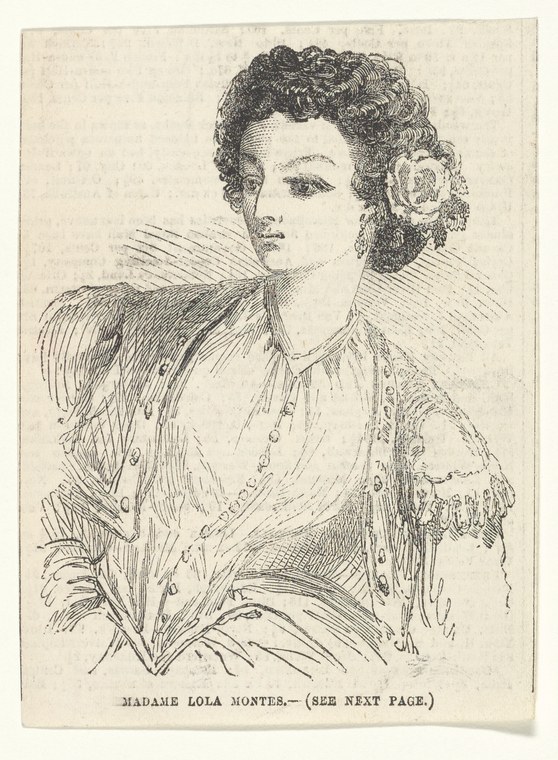
Lola Montez represents a critical moment in dance history when the performer's body, costume, and personality became as important as the choreography itself. This engraving documents how dancers of the mid-19th century were visualized and commodified for an emerging mass audience, showing the theatrical dress codes and aesthetic conventions of Romantic-era popular performance.
What you are looking at
A three-quarter portrait of a woman in theatrical dress, rendered as a fine line engraving. She wears an elaborate mid-19th-century costume: a white blouse with voluminous sleeves gathered at the shoulders, heavily decorated with vertical pleating and ornamental buttons or jewels down the front. Over this sits a short, fringed jacket or bolero with elaborate braiding. Her dark hair is styled in long ringlets pulled back from her face and gathered at the nape with what appears to be a large decorative flower or ornament. The woman gazes downward and to the left in a romantic, contemplative pose typical of theatre portraiture of the period. The engraving employs fine parallel lines for shading, particularly in the fabric textures and the dark hair, creating substantial depth and dimension. The composition is cropped at the waist, and a caption at the foot reads "MADAME LOLA MONTEZ.—(SEE NEXT PAGE.)"
The dancing
A single standing figure, shown from the waist up. The pose is static and presentational rather than actively dancing—the woman faces somewhat to the side with a downward gaze, one arm relaxed and the other implied beneath the ornate costume. There is no visible hold, frame, or footwork suggested by the composition. The body appears composed and still, suitable for a portrait rather than a moment captured mid-movement.
The dance depicted
Lola Montez (1821–1861) was a celebrated dancer and courtesan of the 19th century, famous for her "Spider Dance"—a theatrical performance in which she mimed the removal of a tarantula from her skirts. This engraving shows her in theatrical costume but does not depict her actively dancing. The elaborate dress—the pleated blouse, ornamental jacket, and jewelled details—reflects the exotic, sensual style of stage performance in the 1840s–50s, when Montez performed across Europe and America. The costume suggests the Romantic-era theatrical tradition of Spanish or Italianate exoticism, though Montez's own dances drew from multiple traditions and were more about spectacle and provocation than any single codified style.
How it was made
This is a line engraving, likely created for circulation as a theatrical portrait print. The technique uses fine parallel lines (hatching and cross-hatching) to build tone and texture, particularly evident in the dark hair and fabric folds. Engraving was the standard reproductive medium for theatrical publicity in the mid-19th century, allowing multiple impressions to be printed and distributed to audiences, critics, and collectors. The fineness of the line work and the careful attention to fabric detail suggest this was made by a skilled reproductive engraver, probably after a painted or drawn portrait. The caption and reference to a "next page" indicate this was part of a larger publication, likely a theatrical journal or illustrated biography.
About this work
This is a mid-19th-century line engraving of Lola Montez, the Irish-born dancer and performer who became one of the most notorious figures of the Romantic era. It shows her in the ornate stage costume of the 1840s–50s, presenting her as a theatrical persona rather than capturing a moment of dance. The work belongs in a gallery about dance not because it depicts movement, but because it documents the visual culture of theatrical performance at a moment when dancers were being celebrated and marketed as celebrity personalities. Montez's fame rested partly on her technical skill as a dancer but largely on her ability to provoke audiences—through costume, movement, and her off-stage persona. This engraving participates in that machinery of celebrity, presenting her image for public consumption.
How to look at it
This is not an action image; it is a portrait meant to convey glamour, theatrical presence, and celebrity status. The viewer should attend to the costume as the primary subject—the elaborate pleating, the ornamental fastenings, the layered textures that would have impressed an audience from the gallery. The downward gaze and contemplative expression were conventions of Romantic portraiture, intended to suggest depth of feeling and artistic refinement. The fine engraving technique itself signals the work's status as a reproducible commodity, a print you could buy and keep, making Montez accessible to people who could not afford to see her perform live.
The artist
The engraver is not recorded in the catalogue. However, this is clearly a professional reproductive print, likely created for a theatrical journal, illustrated newspaper, or biographical publication aimed at a paying public. The skill and finish suggest it was made by an established engraver working in the mid-19th-century London or European press.
The period
The 1840s–50s were the height of the Romantic era in theatre and dance. Ballet was entering its decline in Europe (the Romantic ballet tradition of Taglioni and Elssler was waning), but theatrical dance remained a major form of popular entertainment. The rise of new reproductive media—engraving, lithography, photography—allowed dancers' images to circulate widely, transforming performers into celebrities. Dancers like Montez, who blended technical skill with sensational marketing, thrived in this environment. Exoticism was a powerful draw: audiences craved performers who promised access to foreign, sensual, or transgressive worlds. Montez's Spanish-derived persona (though she was actually Irish and trained in London) fit this appetite perfectly.
Where it lives
This engraving is held in the New York Public Library's collection of prints depicting dance. The notation "(SEE NEXT PAGE)" indicates it was part of a larger publication or series. Without access to the full source document, the specific title and date of publication cannot be confirmed from the image alone.
Questions about this work
Who was Lola Montez?
Lola Montez (1821–1861) was an Irish-born dancer, actress, and courtesan who became one of the most famous performers of the Romantic era. She trained in London and performed across Europe and America, becoming notorious for her scandalous Spider Dance and her relationships with wealthy and powerful men, including King Ludwig I of Bavaria. She was as much a celebrity personality as a dancer.
What is the 'Spider Dance' she was famous for?
The Spider Dance was Montez's signature performance, in which she appeared on stage and mimed the discovery of a tarantula in her skirts, engaging in dramatic gestures of distress and removal. It was more theatrical spectacle than technical choreography, designed to provoke and shock audiences. The dance epitomized the sensational style of mid-19th-century popular theatre.
Is this engraving showing her dancing?
No. This is a theatrical portrait print showing Montez in costume but not in active motion. It was created for circulation to audiences and admirers, functioning as a form of celebrity merchandise. The portrait documents her stage persona and the costume conventions of Romantic-era theatre.
What does the costume tell us about performance style in this era?
The elaborate pleating, ornamental jacket, jewelled details, and carefully arranged hair signal the aesthetics of Romantic theatrical performance: luxury, exoticism, and a carefully cultivated image of the performer as an object of desire and fascination. Dancers of this era were expected to be visually spectacular, and costume was a major part of that spectacle.
More dance artwork





