49 works in this view — arrow keys or swipe to move between them.
Dance in Art
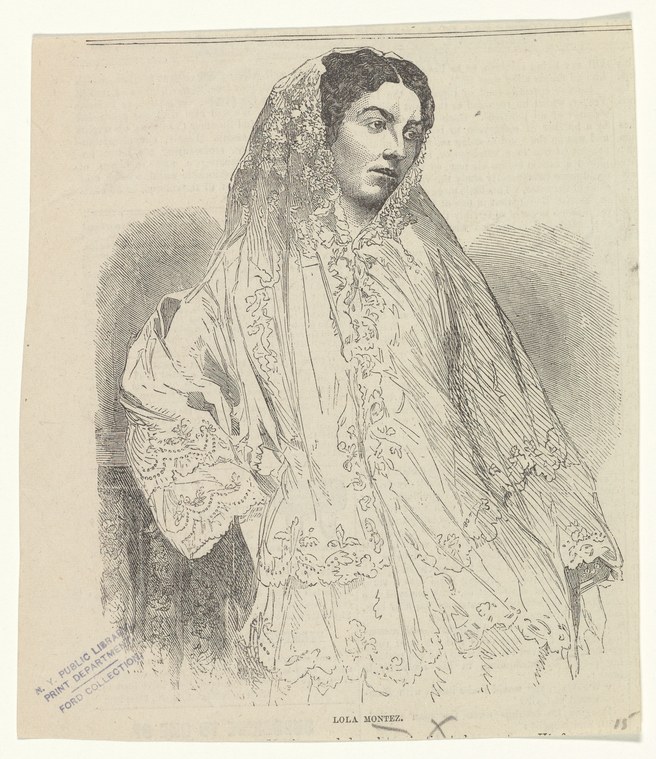
Lola Montez
Unknown artist
- Collection:
- Prints depicting dance
- Source:
- New York Public Library
- Rights:
- Public domain — free to use, share and adapt.
- Recorded as:
- Public Domain
Lola Montez was a controversial and influential dancer whose career bridged Europe and America in the mid-19th century; her image circulated widely and shaped public understanding of theatrical performance and exoticism. This engraving is evidence of how performers were promoted and how dance celebrities were made visible to mass audiences before photography became universal.
What you are looking at
A three-quarter-length portrait of a woman in theatrical costume, shown against a plain background. She wears an elaborate white lace veil or mantilla that drapes from her head to below her shoulders, densely embroidered or patterned with ornamental details. Beneath the veil, a dark dress is visible at the shoulders. Her pose is frontal and composed, with her head turned slightly to one side, her gaze directed outward. The figure is rendered in fine engraved line work with careful cross-hatching to suggest volume and the play of light on fabric. The veil's diaphanous quality is conveyed through delicate linear patterns; the contrast between the dark tones of her hair and the light ground creates strong definition. This is a portrait of a performer in character or costume, not a depiction of movement or a dance scene.
The dancing
The figure stands still in a frontal pose with no suggestion of active movement. Both arms are at rest. The body is upright and composed; there is no weight shift, no extension, no turn characteristic of dance performance. The pose is that of a portrait subject or performer preparing to be viewed or photographed, not a dancer in motion.
The dance depicted
The image does not depict dance. It is a portrait of a performer—identified in the inscription as Lola Montez—in stage costume. The elaborate white veil and dark dress suggest 19th-century theatrical dress, likely from a dramatic or exotic-themed role. Lola Montez was famous as a dancer, particularly for her performance of the *Spider Dance*, but this image captures her in a static portrait pose wearing costume, not in the act of dancing. The veil may reference roles performed or a signature element of her theatrical identity, but the body attitude and framing are those of portraiture, not dance documentation.
How it was made
This is an engraving, rendered in fine lines and cross-hatching to create tone and shadow. The technique allows for precise delineation of the veil's intricate pattern and the subtle modeling of the face and shoulders. The linear approach creates a delicate effect appropriate to the subject's theatrical glamour. Engravings of this type were produced for circulation in newspapers, magazines, and illustrated books, making them accessible to a broad public audience interested in theatrical performers and personalities of the period.
About this work
This is a portrait engraving of Lola Montez, the 19th-century dancer and performer, shown in theatrical costume. Although Montez was celebrated for her dance performances—especially the *Spider Dance*—this image is not a depiction of dance but rather a formal portrait of the performer in character dress. The work belongs in a gallery of dance in art as historical documentation of a significant figure in dance history, even though the specific moment captured is one of presentation and pose rather than movement. The image tells us how Montez was marketed and visualized to the public: as an exotic, glamorous theatrical figure whose identity was inseparable from costume and performance.
How to look at it
Attend to the costume and its details—the intricate patterning of the veil, the contrast of black hair against white lace, the theatrical formality of the presentation. This is not a candid image or a moment stolen from performance, but a constructed portrait designed for public consumption. The artist chose to emphasize the veil and the performer's face; the composition frames her as an object of visual attention rather than as a mover in space. Notice how the engraving technique creates a silvery, precious quality to the veil that would have appealed to 19th-century audiences' sense of theatrical glamour.
The artist
The artist is not recorded. The engraving is of a type commonly produced by illustrators and engravers working for periodicals and publishers in the mid-to-late 19th century; such portraits circulated widely and were a key form of public knowledge about theatrical performers. The inscription 'LOLA MONTEZ' suggests this was intended as a commercial portrait for reproduction.
The period
This engraving dates to an era when theatrical dance was becoming a form of mass entertainment and celebrity. Lola Montez performed in the 1840s–1850s across Europe and America; she was famous for roles that combined European ballet technique with exotic costuming and provocative choreography. The *Spider Dance*, which became her signature, involved a scandalous plot about a woman removing spiders from her clothing. The period saw the rise of lithography and engraving as means of circulating images of performers to audiences who could not attend live performances.
Where it lives
The work is held in the Prints depicting dance collection of the New York Public Library. It is a commercial engraving produced for public circulation, likely in a periodical or illustrated book.
Questions about this work
Was Lola Montez really a dancer?
Yes. Montez performed as a dancer across Europe and America from the 1840s onward, though she often performed to scandal and controversy. She claimed to be a Spanish dancer but was actually from Ireland or Scotland. Her performances combined elements of ballet, exotic dance, and drama.
What is the Spider Dance?
Montez's most famous role, first performed in 1851. It was a short dramatic piece in which she performed a solo, supposedly removing spiders from her clothing during the dance. The piece was provocative and often censored; it mixed theatrical narrative with dance and became her signature act.
Why is this portrait in a dance collection if she isn't dancing?
Because it is documentary evidence of a significant figure in 19th-century dance history and how her image was created and circulated. Portraits and prints of performers are part of the material and visual culture of dance, even when they do not show movement.
More dance artwork





