49 works in this view — arrow keys or swipe to move between them.
Dance in Art
The Cally polka arranged by Allen Dodworth
Unknown artist
- Collection:
- Prints depicting dance
- Source:
- New York Public Library
- Rights:
- Public domain — free to use, share and adapt.
- Recorded as:
- Public Domain
The polka was the first truly international popular dance, uniting Europe and America in a shared social practice. This print is a primary source for understanding the polka's visual and social meaning in its moment—not the exotic or theatrical polka of stage performance, but the polka as lived by urban middle-class dancers. The attribution to Dodworth anchors it to a named historical figure and a documented commercial practice of dance publishing.
What you are looking at
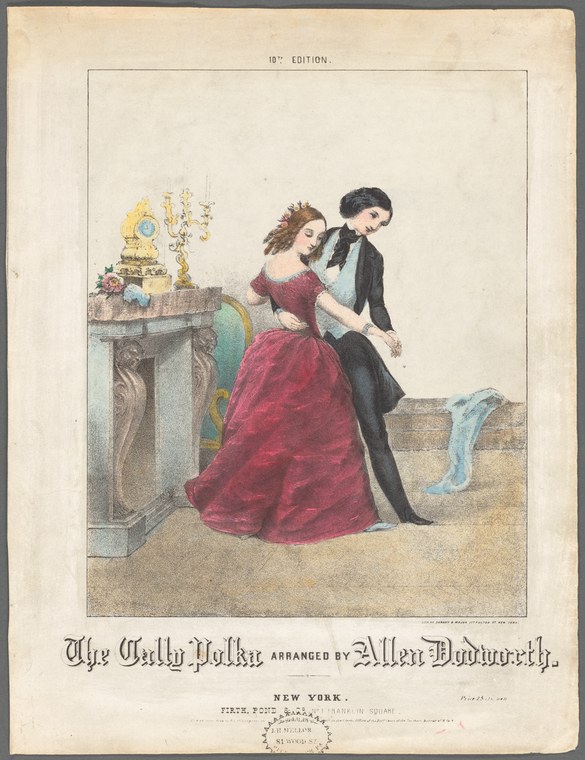
A young couple in formal dress occupy a richly appointed interior. The woman wears a deep crimson ball gown with off-shoulder neckline and voluminous skirt; the man wears black evening dress with white shirt and bow tie. They stand before an ornate mantelpiece topped with a gilt clock, candelabra, and floral arrangements. The woman holds a blue handkerchief or ribbon in her right hand, which trails downward. The man stands behind and to the side of her, leaning slightly forward with his right hand at her back. The setting and their posture suggest a moment of intimate social dance—the formal positioning and the woman's elegant gesture with the handkerchief suggest the polka, a dance of the period that emphasized display and courtship ritual. The background is rendered in soft earth tones; the foreground figures are brightly colored in the style of hand-colored theatrical prints.
The dancing
The pair stand in a social rather than strictly closed ballroom hold. The man's hand placement at the woman's back is light and directional rather than the firm frame of later standard technique. The woman's posture is upright with her left shoulder slightly forward, her right arm extended low, holding the decorative ribbon in a gesture of flourish rather than technical purpose. Her weight appears settled rather than in motion, suggesting a posed moment between steps or at the climax of a turn. The overall frame is open and displays-oriented, prioritizing the visual spectacle of the woman's gown and the couple's elegance over technical precision.
The dance depicted
This is a polka, as confirmed by the title. The polka emerged in the 1830s and became one of the dominant social dances of the mid-nineteenth century, performed in ballrooms throughout Europe and North America. The image captures the polka's character as a display dance for fashionable society: the emphasis on the woman's elaborate dress, the public setting, and the gentleman's attentive but unobtrusive role all reflect how the polka functioned as an occasion for courtship and social show. Allen Dodworth, identified as the arranger, was a prominent New York dance master and orchestra leader; his involvement suggests this was a published piano or band arrangement for social dancing, not theatrical performance. The woman's gesture with the handkerchief is characteristic of period polka etiquette, where small props and flourishes added charm and flirtation to the dance.
How it was made
This is a hand-colored lithograph, identifiable from the characteristic texture, the translucent layering of pigment, and the reproductive mark visible at lower center. Lithographic prints allowed multiple colored impressions and were the standard medium for theatrical and social dance imagery of the 1850s–1870s, enabling wide distribution to middle-class households. The notation "18° EDITION" at top indicates this is from an established print series—polka publications were commercial products sold by music publishers and print dealers. The hand-coloring is selective and decorative rather than complete, highlighting the figures while leaving background and setting in outline, a technique that reduced cost while maintaining visual focus on the dancers.
About this work
This is a lithographic print documenting the polka, one of the defining social dances of the nineteenth century. The work preserves both the dance itself—the posture, gesture, and courtship dynamic of polka performance—and the cultural context in which it was consumed: a fashionable interior, a young couple in formal dress, a published arrangement by a named dance master. The 'Cally Polka' was one of many polka variants that circulated in dance-master publications; this print served as both advertisement and instructional image for middle-class ballroom dancers. It belongs in a dance history collection not as art history but as social documentation: evidence of how dance looked, how it was taught, and how it was imagined by and for the people who danced it.
How to look at it
Attend to the woman's posture and the placement of her right arm: the handkerchief gesture is neither accidental nor purely decorative but a conventional flourish of period polka etiquette. Notice the lightness of the man's frame—his hand guides rather than controls, reflecting the social etiquette of a public ballroom where dominance would be improper. The print captures not the moment of fastest motion but a moment of display, where both dancers are visible and elegant, the moment a ballroom observer would admire. The interior setting is as important as the dancers: the print affirms that polka belongs in fashionable society, not in folk or theatrical contexts.
The artist
The artist of the image is not recorded. Allen Dodworth (1822–1896) was a prominent New York dance master, orchestra leader, and composer; he is known for his social dance instruction and his published arrangements. Dodworth's publications were widely distributed and represent a significant strand of nineteenth-century dance transmission—the dance master's published guide. He would not have been the visual artist but is identified as the arranger of the music or dance, suggesting his name carried commercial weight sufficient to appear on the print.
The period
The polka exploded in popularity after its emergence in Prague in the 1830s, reaching New York and London by the 1840s and dominating ballroom dancing through the 1870s. It was faster, more playful, and less rigidly prescribed than the waltz, and it suited the social ambitions of the rising middle class. Dance prints flourished in the same period as mass literacy and rising consumer culture for leisure activities. Publishers produced polka publications—instruction books, music scores with choreography, and decorative prints—to meet demand from dancers and to market dance masters' expertise. The print's style and quality suggest professional production for a substantial market.
Where it lives
The print is held in the New York Public Library's prints collection documenting dance. It is one of many social dance prints from the nineteenth century, part of a documented archive of how dances were published, marketed, and consumed. The collection includes similar prints for polka, waltz, quadrille, and other period dances.
Dance in this work
Questions about this work
What is the polka and why was it so popular?
The polka was a lively couple dance that emerged in Bohemia in the 1830s and became the dominant social dance of the mid-nineteenth century across Europe and North America. It was faster and less formally prescribed than the waltz, which made it accessible to broader social classes and especially popular with the rising urban middle class. Its playful character and emphasis on the dancers' joy made it ideal for public ballroom dancing.
Who was Allen Dodworth?
Allen Dodworth was a New York dance master, orchestra leader, and composer active in the mid-nineteenth century. He published instruction books and music arrangements that were widely distributed and helped establish standards for American ballroom dancing. His name on a print or publication was a mark of legitimacy and commercial success.
What does the handkerchief in the woman's hand represent?
The handkerchief was a conventional prop in polka performance, used for flourishes and to add charm and flirtation to the dance. It was part of the visual and social etiquette of period polka, signaling elegance and courtship. In dance instruction, the gesture with the handkerchief was sometimes codified as part of the polka's vocabulary.
How do we know this is the polka and not another dance?
The title explicitly identifies it as 'The Cally Polka.' The posture, the open frame, the social setting, and the decorative gesture with the handkerchief are all consistent with polka performance of the period. The attribution to Dodworth, a dance master known for polka arrangements, supports the identification.
More dance artwork





