49 works in this view — arrow keys or swipe to move between them.
Dance in Art
Jules Perrot and Carlotta Grisi dancing the polka
Unknown artist
- Collection:
- Prints depicting dance
- Source:
- New York Public Library
- Rights:
- Public domain — free to use, share and adapt.
- Recorded as:
- Public Domain
Polka prints are among the most abundant surviving documents of 19th-century social dance practice, yet they are rarely analyzed for what they reveal about technique and style. This image, attributed to two named virtuosos, is unusually valuable: it places the polka within the world of professional dance and shows how ballroom steps were adapted and elevated for the theater. For dance historians, it is evidence that the polka was not merely a folk or popular phenomenon but was taken seriously by the classical ballet establishment.
What you are looking at
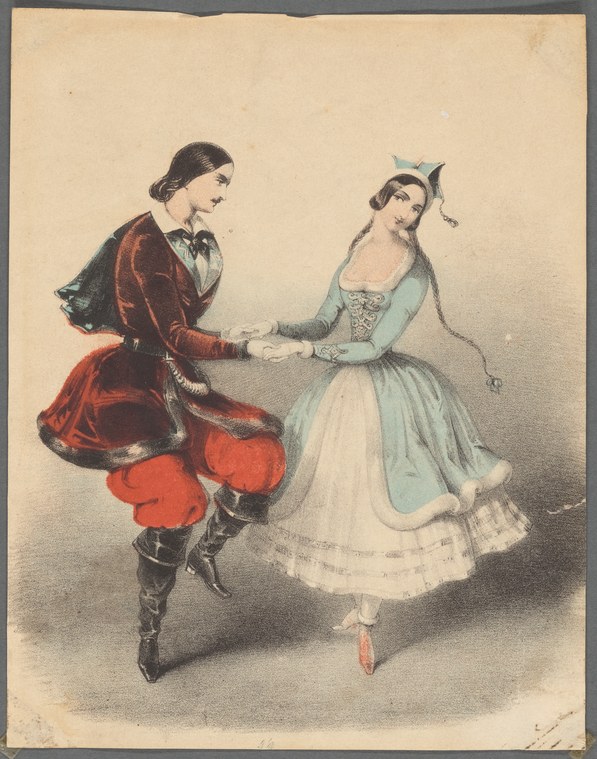
A man in a red velvet jacket with matching breeches pirouettes with a woman in a pale blue-green dress with a white underskirt, their hands clasped in the center of the composition. The man is caught mid-turn, his body angled sharply, one leg extended, the other supporting his weight as he executes a rotational step. The woman faces him with her body held upright, her skirt lifted and spread by the momentum of the dance, her head tilted back slightly. The background is a neutral beige wash with subtle shadow modeling beneath the figures' feet, placing them in an undefined interior space. The print has the quality of hand-colored theatrical ephemera, with careful attention to the textures of fabric—the deep red pile of the man's coat contrasts with the translucent layers of the woman's skirt.
The dancing
The pair is in a closed, face-to-face position with hands joined at waist height. The man's frame is dynamic and rotational, his torso twisted and one leg extended in a motion that suggests rapid spinning; the woman's frame remains relatively vertical and stationary, anchoring the turn while her skirt rises and billows from centrifugal force. Both dancers are on the ball of the foot or heel, consistent with the quick, bouncing action of social dance of the period. Their relative heights and the angle of the man's body suggest he is the lead and she is being turned.
The dance depicted
This is a polka, a central European couple dance that swept through European and American ballrooms in the mid-19th century. The title attribution to the celebrated dancer Jules Perrot and the prima ballerina Carlotta Grisi suggests this depicts a theatrical version of the polka, likely from a ballet or staged entertainment rather than a ballroom context. The image captures the essential character of the polka: a fast, rising action with a slight hop or bounce, most evident in the man's extended leg and lifted deportment. The polka was danced in closed position with a quarter-turn action repeated to progress around the floor, exactly what is shown here—the man's spiral and the woman's responsive upright carriage.
How it was made
This is a hand-colored lithograph or engraving, a reproduction technique that allowed rapid mass production of theatrical and dance ephemera in the 19th century. The printing process—visible in the even, finely graded tones of the background and the precision of the figure outlines—enabled affordable distribution to a broad audience of theater subscribers and dance enthusiasts. The hand-coloring, applied after printing, gave each print individuality and visual appeal while keeping production costs low. This combination of mechanical printing with hand finishing was the standard for theatrical portraits and dance documentation of the 1840s–1860s.
About this work
This is a mid-19th-century portrait print of two of the era's most celebrated dancers performing the polka, a fashionable couple dance that had recently arrived in European cities from central Europe. The polka was simultaneously a ballroom phenomenon and a stage attraction, and this print sits at that intersection—it documents a theatrical interpretation of a social dance by two figures known for both ballet and ballroom popularity. Perrot and Grisi were stars of the Romantic ballet, and their engagement with social dance forms reflects the permeable boundary between stage and ballroom in mid-Victorian entertainment. The print is a primary record of how the polka was performed at the highest level and how it was marketed to a mass audience.
How to look at it
Notice the moment the artist chose: not a static pose but a turn in progress. The man's extended leg and twisted torso capture the lift and spiral action essential to the polka's character. The woman's upright carriage and the way her skirt rises show how the dance generated visible motion in costume—this is not a ballroom pose but an action frozen mid-movement. Observe also how the two bodies relate: despite the dynamic asymmetry, they remain in contact and aligned, the basis of closed-position partner work. The print asks you to read the dance through the body's geometry and the fabric's response.
The artist
The artist is not recorded. However, the style and printing technique are consistent with the work of mid-19th-century theatrical lithographers active in London, Paris, and Vienna—centers where Perrot and Grisi performed and where demand for colored dance prints was highest. Prints of this type were usually rapid commercial productions, designed for sale in theater lobbies and print shops rather than for collection as fine art, which explains the loss of artist attribution.
The period
The polka emerged in Bohemia around 1830 and reached Paris and London by the 1840s, where it became the dominant social dance of the mid-century ballroom, rivaling the quadrille. Its arrival coincided with the height of Romantic ballet, when figures like Perrot (a dancer, choreographer, and mime) and Grisi (a prima ballerina assoluta) dominated European stages. The two were closely associated: Perrot choreographed many works in which Grisi starred, and they were partners in both professional and personal life. The 1840s-1850s were a moment when the ballroom and the stage were still culturally porous; elite dancers performed in both contexts, and social dances were routinely staged. By the 1860s, this crossover would diminish as ballet became increasingly specialized.
Where it lives
This print is part of the NYPL's collection of dance-related prints and ephemera. It survives as part of a large corpus of mid-19th-century colored lithographs documenting fashionable dances, ballroom life, and theatrical dance entertainment. Such prints were commercial products, widely distributed, and many have survived in institutional collections.
Dance in this work
Questions about this work
Who were Jules Perrot and Carlotta Grisi?
Jules Perrot (1810–1894) was a French dancer, choreographer, and mime artist best known for his creation of the Romantic ballet La Esmeralda and his role in establishing ballet in Russia. Carlotta Grisi (1819–1899) was an Italian prima ballerina and a star of the Romantic era, famous for originating the role of Giselle. They were professional partners and personal companions during the 1840s and 1850s.
What makes the polka different from other dances of the time?
The polka is danced in fast 2/4 time with a distinctive hop-step pattern that gives it a bouncing, rising quality. Unlike the quadrille (which is a figure dance for groups) or the waltz (which emphasizes smooth rotation), the polka is energetic and playful, with a sharp rhythmic articulation. Its popularity came partly from its relative ease compared to other fashionable dances and its fun, youthful character.
Is this a stage performance or a ballroom dance?
The attribution to Perrot and Grisi suggests this is a theatrical interpretation, likely from a staged divertissement or ballet that incorporated the fashionable polka. However, the image captures the authentic steps and hold of the ballroom polka, showing how stage and ballroom versions were closely related. The print blurs the distinction—it documents a stage moment that faithfully represents social dance practice.
How do you know this is a polka and not another dance?
The title explicitly states it is a polka. Additionally, the visual evidence supports this: the fast, bouncy quality suggested by the man's extended leg and lifted frame, the closed face-to-face position, and the spiraling turn are all characteristic of polka technique and style.
More dance artwork





