49 works in this view — arrow keys or swipe to move between them.
Dance in Art
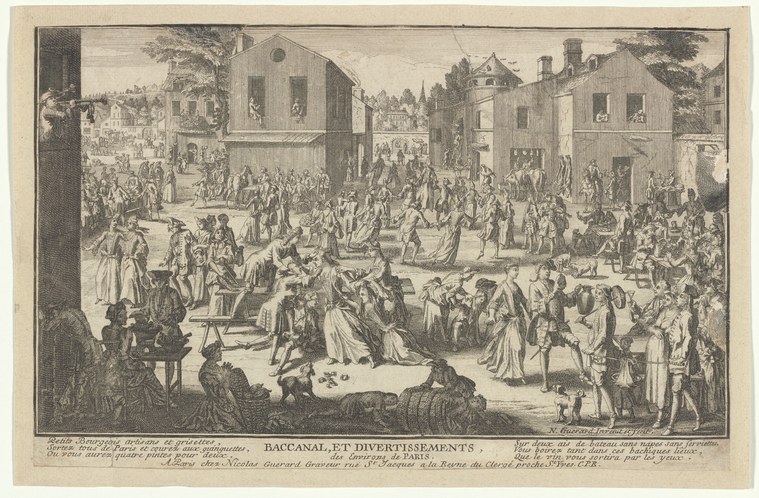
Baccanal, et divertissements, des environs de Paris
Unknown artist
- Collection:
- Prints depicting dance
- Source:
- New York Public Library
- Rights:
- Public domain — free to use, share and adapt.
- Recorded as:
- Public Domain
This image is one of the few surviving visual records of how ordinary people danced in the 17th century—not the formal minuets and galleys of the court, but the vigorous, social dances of village celebrations. For historians of social dance, it documents the movement vocabulary, partnering conventions, and cultural context of folk dance at a precise historical moment. The work also shows how printmakers represented the body in motion and communal celebration, revealing what was considered worth recording about popular culture.
What you are looking at
A crowded outdoor celebration unfolds in a village square framed by substantial buildings—a church with a rounded apse on the left, domestic structures on the right. The scene is densely populated with figures in 17th-century dress engaged in various forms of revelry and social interaction. In the foreground, couples dance while others sit at tables eating and drinking; musicians play instruments (visible bagpipes and other folk instruments) to accompany the festivities. The composition pulls back to show the full breadth of the gathering, with figures scattered across the square in multiple clusters of activity—some dancing, some conversing, some attending to food and drink. The engraving captures a moment of uninhibited festivity, with particular attention to the mingling of social classes and the variety of body language and costume that suggests a carnival or bacchanal atmosphere.
The dancing
The dancers visible in the foreground show loose, energetic postures typical of folk revelry rather than formal dance technique. Figures are dressed in period costume with full skirts, breeches, and hats. The hold between partners appears informal; some couples face each other with arms raised, others touch waist and hand in simpler configurations. The weight is distributed for vigorous, grounded movement rather than the lift of courtly dance. Groups of non-dancers—seated figures, standing drinkers, musicians—interrupt the dancing figures, suggesting a social rather than choreographed event.
The dance depicted
This depicts a bacchanal or carnival dance of the sort that took place in the environs of Paris (as the title specifies) in the 17th century. These were outdoor peasant and working-class celebrations distinct from court dances; the movement language evident in the engraving—loose partnering, vigorous footwork, informal grouping—reflects folk and social dance rather than the formal baroque techniques practiced indoors. The inclusion of musicians and the abundance of food and drink confirms this as a celebration where dancing was one element among many forms of merrymaking. The specific styles cannot be named from the image alone, but the visual character aligns with the country dances and branles that were adapted for street and village use.
How it was made
This is an engraving, almost certainly a copper-plate engraving given the fine parallel line work (hatching) visible throughout to create tone and shadow. The technique allowed for detailed rendering of the crowd and setting while maintaining legibility of individual figures across a complex composition. The presence of a printed caption in French below the image indicates this was a published print, likely distributed as a broadsheet or included in a collection of customs and manners. The small scale and fine detail suggest it was intended for viewing at close range, probably in a bound volume or print collection circulating among educated urban audiences.
About this work
This is a 17th-century engraving of a village bacchanal or carnival dance near Paris, showing a dense social gathering where dancing, eating, drinking, and musical performance occur simultaneously in a public square. The work captures both the movement and the ritual context of folk celebration—the dancers are only one element of a larger scene of communal festivity. As a historical document, it is valuable evidence of how ordinary people danced outside the court, and of the social conventions and dress of provincial France in the baroque era. The engraving's composition and detail make it a significant record of vernacular culture at a moment when most artistic attention was directed toward courtly display.
How to look at it
Study the foreground dancers first: notice the open, grounded postures and the variety of partnering configurations—some couples are quite close, others separated. Observe the role of the musicians and the arrangement of tables and food, which dominate portions of the composition as much as the dancers do. The engraver has chosen to show the moment not as a climax of synchronized movement but as a simultaneity of different activities, which is historically accurate—a bacchanal was not a choreographed performance but a social event. The fine line work throughout creates texture and depth, allowing the eye to move through a crowded scene without losing individual figures.
The period
The 17th century was a period of stark contrast between court and country in France. While the royal court at Paris was developing the codified baroque dance technique that would become classical ballet, rural populations and urban working classes maintained older folk traditions and created new social dances adapted to their circumstances. The engraving's date is uncertain, but the style of dress and the subject matter are consistent with the mid-to-late 17th century, when prints depicting customs and manners (often with a satirical or documentary intent) became popular in northern Europe. The title's emphasis on "environs of Paris" suggests a metropolitan audience's curiosity about rural practices just outside the city.
Where it lives
Held in the NYPL Prints collection. This is a catalogued broadsheet or print, likely part of a series documenting French customs and celebrations, typical of popular prints circulated in the 17th and 18th centuries.
Dance in this work
Questions about this work
What is a bacchanal in this period?
A bacchanal was an outdoor celebration or carnival, named after Bacchus and associated with uninhibited merriment, drinking, and dancing. In 17th-century France, such events were common among rural and urban working populations, particularly around harvest time or religious festivals. This engraving documents the actual practice rather than the mythological or theatrical version.
Why don't these dancers look like the court dancers of the same period?
Court dances of the baroque era were highly formalized, with codified positions, turns, and partnering. Folk and street dances developed independently, using the body more freely and with different aesthetic values. This engraving shows the 'vernacular' dance of the time—how ordinary people actually danced in their own social contexts.
Can you identify the specific dances being performed?
The image is not precise enough to identify named dances with certainty. However, the loose partnering, vigorous movement, and the presence of folk instruments suggest country dances, branles, or other popular social dances of the era. The engraver was more interested in capturing the atmosphere of celebration than in documenting specific choreography.
Who made this print and when?
The artist is not recorded in the catalogue. Based on the style and subject matter, it is likely a 17th-century engraving, possibly from the mid-to-late 1600s. The work may be by a specialist in prints of customs and manners, a genre popular among Northern European printmakers of that period.
More dance artwork





