49 works in this view — arrow keys or swipe to move between them.
Dance in Art
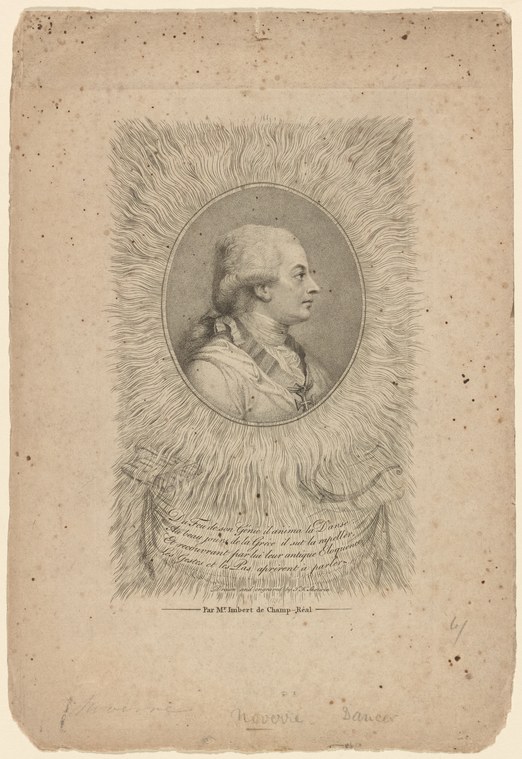
Du feu de son génie il anima la danse
Unknown artist
- Collection:
- Prints depicting dance
- Source:
- New York Public Library
- Rights:
- Public domain — free to use, share and adapt.
- Recorded as:
- Public Domain
This print records how dance was valued within Enlightenment intellectual culture—worthy of memorial commemoration through fine engraving—and suggests the subject's role as a significant figure in dance innovation or theory. It is a primary document of dance historiography and the social status of dance intellectuals in the period.
What you are looking at
A profile portrait of a man in 18th-century dress, enclosed in an oval frame and surrounded by an elaborate radiating halo of fine lines suggesting divine light or inspiration. The subject wears a coat with a cravat or neck cloth, his hair styled in the period fashion, his gaze directed upward and to the left. Below the oval, a decorative banner or scroll contains text in French script, though the inscription is not legible at this resolution. The composition employs the formal iconographic language of memorial or commemorative portraiture, elevating the subject through both the halo device and the classical oval format. The entire image is rendered in fine engraving on aged, speckled paper, suggesting an 18th-century production.
The dancing
A single figure in strict profile, the head and shoulders only. The posture is static and dignified, the neck extended, the chin slightly raised. There is no indication of bodily movement, dance position, or the dynamic gesture that characterizes dance imagery. The figure is presented as a portrait subject, not as a performing body.
The dance depicted
This is not a depiction of dance. The work is a commemorative portrait engraving of an individual, presented in the formal heraldic and memorial tradition. The French title translates approximately to 'By the fire of his genius he animated the dance,' which is a poetic inscription that attributes to the subject a role in dance—likely as a choreographer, composer, or dance theorist—but the image itself shows no dancing and contains no visual evidence of dance practice or performance.
How it was made
Engraving on paper, executed in the fine-line burin technique characteristic of 18th-century reproductive portraiture. The radiating halo is built from hundreds of parallel lines, demonstrating the precision and labour-intensive skill of the engraver. This technique allowed for the mass production of commemorative prints, which circulated among educated audiences and were collected as part of scholarly and artistic libraries. The aged paper, with its foxing and discoloration, indicates an original or early impression from the period of production.
About this work
This is an 18th-century engraved memorial portrait of an individual credited with a contribution to dance history, indicated by the French inscription. The work exemplifies the formal portraiture conventions of the Enlightenment, using classical devices—the oval frame, the radiating halo, the elevated profile view—to confer dignity and intellectual or creative authority on the subject. While the inscription claims a role in 'animating the dance,' the image is a portrait, not a depiction of dancing, and documents the person rather than the practice. It belongs in a dance history collection as evidence of how dance practitioners and theorists were commemorated and circulated in print during the 18th century.
How to look at it
Observe the formal language of the portrait: the halo is not religious but intellectual, signifying genius and creative influence. The inscription is the key to understanding the image—it is a textual claim that what the portrait visually represents (a dignified, cultivated man) bears on dance history. The viewer is meant to recognize the subject from the inscription and the portrait together, not from the visual depiction of dance itself.
The artist
The artist is not recorded. The engraving is unsigned or the signature is not visible in this reproduction. The style and technique are consistent with French reproductive engraving of the mid-to-late 18th century, a period when portraiture of cultural figures was a major commercial and scholarly enterprise.
The period
The 18th century saw dance elevated to the status of a liberal art and object of theoretical and philosophical inquiry. Choreographers such as Jean-Georges Noverre were transforming ballet from court spectacle into a narrative and dramatically coherent art form. The prominence given to dance practitioners in memorial print culture reflects this new intellectual prestige. Such engraved portraits circulated among aristocratic collectors, dancers, musicians, and court officials, making them both commemorative and pedagogical documents.
Where it lives
The work is held in the New York Public Library's collection of prints depicting dance. The catalogue record is minimal and does not identify the subject, artist, or precise date, suggesting it may be part of a larger uncatalogued or recently acquired archive. The inscription and style place it in the 18th-century French print tradition.
Questions about this work
Why is there a halo around this man's head if it's not a religious image?
In 18th-century portraiture, radiating lines or halos around the head signified intellectual brilliance or genius, not divinity. The device was borrowed from religious art but repurposed for Enlightenment commemoration of thinkers, artists, and cultural innovators. Here it elevates the subject as a creative force in dance.
Is this a portrait of a famous dancer?
The inscription suggests the subject made a contribution to dance, but the catalogue record does not identify them. Without legible text in the banner, we cannot determine whether this is a dancer, choreographer, composer, or dance theorist. The formal portrait style suggests a figure of some renown or institutional importance.
Why is this in a dance collection if it's not a picture of dancing?
Commemorative portraits of dance figures are valuable historical documents. They show how dance practitioners were viewed and remembered, what social status they held, and how their contributions were circulated in print. This engraving is evidence of 18th-century dance culture and historiography, not a performance record.
What does the French inscription say?
The visible portion translates roughly as 'By the fire of his genius he animated the dance,' a poetic attribution of creative force in dance to the subject. The lower portion of the text, likely containing the subject's name and credentials, is not legible in this image.
More dance artwork





