49 works in this view — arrow keys or swipe to move between them.
Dance in Art
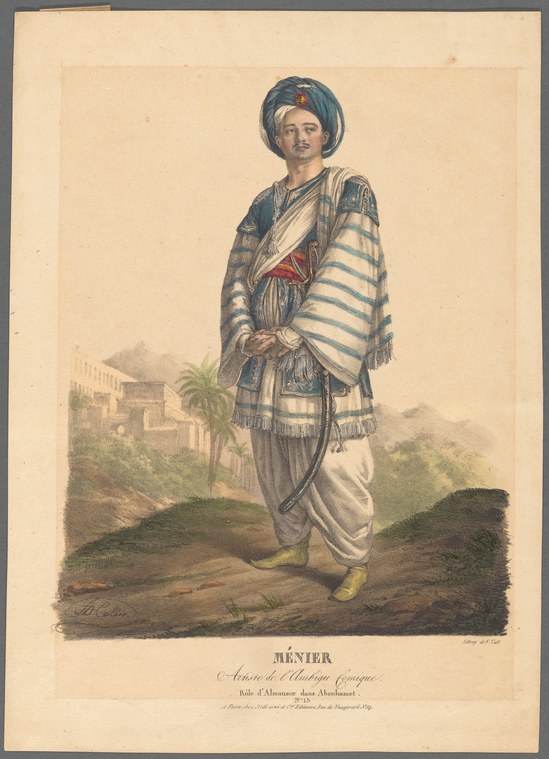
Ménier, artiste de l'Ambigu Comique, rôle d'Almanzor dans Abenhamet, no. 15
Unknown artist
- Collection:
- Prints depicting dance
- Source:
- New York Public Library
- Rights:
- Public domain — free to use, share and adapt.
- Recorded as:
- Public Domain
This print is a primary document of early 19th-century Paris theater costume and the visual codes of the 'exotic other' in European performance. For historians of dance, it shows how non-European dress was imagined and deployed on European stages, and what visual vocabulary of character the actor's body was expected to embody.
What you are looking at
A single figure stands in three-quarter view against a hazy landscape, wearing a striped outer robe in blue and white over white trousers and shoes. The costume is completed by a dark blue turban with a red ornament. The figure holds a curved sword or scimitar in the right hand, positioned diagonally across the body. Behind the figure, rendered in soft focus, is a fortified structure with crenellations and a palm tree, suggesting a North African or Middle Eastern setting. The print employs hand-coloring over an engraved base, with the figure sharply rendered while the architectural background dissolves into atmospheric wash. The composition presents a static portrait rather than a narrative moment, emphasizing the costume and bearing of the character.
The dancing
The figure stands with weight evenly distributed, feet apart in a stable stance. The torso is upright and frontal. The right arm extends diagonally downward, holding the curved sword with a loose grip; the left arm hangs at the side. There is no indication of motion or active dance vocabulary—the pose is presentational rather than kinetic. The bearing is dignified and alert, suggesting a military or heroic character rather than a performer caught mid-movement.
The dance depicted
This is a theatrical costume portrait, not a depiction of dance in motion. The subject is identified as Ménier, an actor at the Ambigu Comique (a Paris theater known for melodrama), in the role of Almanzor in a production titled Abenhamet. The print documents stage costume and character type rather than choreography or dance technique. No dance is visible; the work is a record of theatrical dress and character presentation.
How it was made
This is a hand-colored engraving or aquatint, typical of early 19th-century theatrical costume documentation. The fine linear work and tonal gradations suggest engraving; the soft atmospheric effects in the background indicate aquatint or similar tonal processes. Hand coloring was applied afterward. This technique was standard for documenting performers and roles for theatrical promotion and circulation among print collectors and theater enthusiasts.
About this work
This work documents a Parisian theatrical costume from the early 19th century, recording the character of Almanzor as performed by the actor Ménier at the Ambigu Comique. It belongs in a dance collection not because it depicts dance, but because theatrical costume prints of this era are part of the material culture of performance and help establish what danced and dramatic roles looked like on stage. The print represents the character type of the exotic military hero, a stock figure in European melodrama and sometimes in theatrical dance of the period.
How to look at it
This is a costume portrait, not a scene or narrative image. Attend to the details of dress: the specific cut and stripe pattern of the robe, the wrap and color of the turban, the style of the sword—these are the signs the artist thought mattered for identifying the character and the production. The stable, frontal stance is theatrical presentation, not dance documentation. The softened architectural backdrop locates the character in a narrative space (a fortified frontier) without showing action.
The artist
The artist is not identified in the catalogue record. The style and execution are consistent with professional theatrical print production of the 1820s–1840s. Such prints were typically commissioned by theaters or published by print specialists catering to theater-going audiences in Paris.
The period
The early 19th century saw a boom in printed theatrical costume documentation, driven by the expansion of popular theater (boulevard theaters like the Ambigu Comique), the growth of a middle-class theater audience, and the commercial market for costume and character prints. Orientalist and exotic themes dominated European theater during the Romantic era, from Byron to Delacroix. Abenhamet (also known as Abén-Hamet) was a popular melodrama, with multiple versions performed across Europe; the plot typically centered on Moorish or Ottoman heroic conflict. Such costume prints served both as souvenirs for theatergoers and as reference materials for actors and costume makers.
Where it lives
The work is held in the New York Public Library's Prints collection under the title 'Ménier, artiste de l'Ambigu Comique, rôle d'Almanzor dans Abenhamet, no. 15'. The notation 'no. 15' suggests it was part of a numbered series of costume prints, likely a commercial set sold to theater patrons or print collectors.
Questions about this work
Is this person actually dancing?
No. This is a costume portrait of an actor in a theatrical role, not a documentation of dance or choreography. The figure is posed statically to display the character's dress and bearing. Prints like this were sold as souvenirs of theater productions and as reference materials for performers and makers.
What was the Ambigu Comique?
The Ambigu Comique was a popular Parisian theater on the Boulevard du Temple, known for producing melodramas and spectacular theatrical entertainments from the late 18th century through the 19th century. It catered to middle-class audiences and was famous for lavish costumes and exotic settings.
What is Abenhamet?
Abenhamet (or Abén-Hamet) was a popular melodrama, with versions performed across Europe in the 19th century. The story typically centers on Moorish or Ottoman heroes and frontier conflict, reflecting the Romantic era's fascination with exotic and orientalist themes.
Why is this in a dance collection?
Theatrical costume prints document the visual culture of performance and help historians understand how bodies were dressed and presented on stage. While not depicting dance itself, they record the visual vocabulary and character types that inform how performance—including dance—was imagined and executed in the theater.
More dance artwork





