49 works in this view — arrow keys or swipe to move between them.
Dance in Art
Folk dancing in England and Scotland in nineteenth-century prints
Unknown artist
- Collection:
- Prints depicting dance
- Source:
- New York Public Library
- Rights:
- Public domain — free to use, share and adapt.
- Recorded as:
- Public Domain
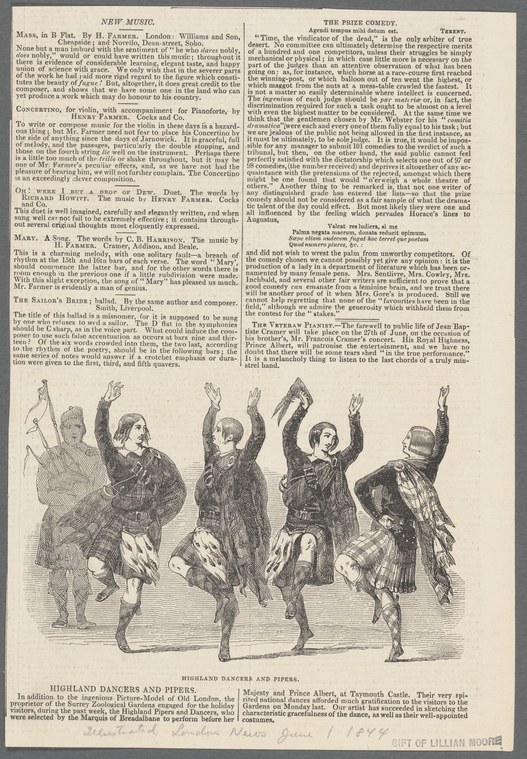
This is a rare visual record of how Highland dance was actually performed in the mid-Victorian theatre, before the rigid competitive codification of Highland dancing in the twentieth century. The image also documents the Zoological Gardens as a site of popular performance and cultural exchange—a place where rural or regional dance was presented to an urban audience in a mixed programme with natural history display and concert music.
What you are looking at
This is a page from a nineteenth-century periodical featuring two distinct sections. The upper portion contains typeset text describing various musical works and performances, with footnotes and critical commentary. Below this lies a wood engraving depicting five figures in Highland dress executing a vigorous leaping dance outdoors. The dancers—at least three clearly male, at least two in tartan kilts—are captured mid-jump with legs extended, arms raised high and spread wide, bodies angled dynamically. The foreground figure wears a patterned jacket; the others display plaids and traditional Scottish garments. A landscape setting is suggested behind them. The caption identifies them as "Highland Dancers and Pipers" and notes their performance at the London Zoological Gardens, staged by Scotsmen including one Francis Conner. The composition emphasizes explosive vertical movement and the particular athleticism of the dance.
The dancing
Five dancers occupy the frame, all airborne or nearly so, with weight transferred upward through extended legs and feet pointed downward in a springing motion characteristic of Highland reeling. Arms are raised to shoulder height and spread wide, elbows bent at acute angles—a frame far more open and exuberant than ballroom or court dance. The dancers' weight distribution shows the recoil of a forceful upward push; several appear captured at the apex of a jump. Torsos remain relatively upright despite the vigorous limb action. The grouping is loose and processional rather than partnered, suggesting a communal rather than couples-based form.
The dance depicted
This depicts Highland dancing, specifically the type of Scottish vernacular reeling and stepping that was performed in public concerts and at venues such as the Zoological Gardens in mid-to-late Victorian London. The vertical emphasis, the spread-armed frame, and the executed leaps are consistent with strathspey and reel technique as performed in that era—energetic, weight-centered movement executed by individuals or small groups moving through space rather than turning in place. Highland dancing at this date sat between vernacular Scottish tradition and theatrical display; this image captures the theatrical end, where the movement is amplified for audience visibility. The performers are identified as Scotsmen, suggesting this was presented as ethnic or regional performance in a London entertainment venue.
How it was made
This is a wood engraving, a relief printing technique that allowed fine detail and rapid reproduction in periodical publication. The engraver has used parallel lines and cross-hatching to suggest volume in the figures' garments and the landscape; the white of the paper becomes the brightest highlights—the exposed legs and arms of the dancers. The technique demands strong silhouettes and clear gesture, which the engraver has achieved through careful attention to the dancers' extended limbs and raised arms. The quality of line and the clarity of the image suggest this was made for a well-funded publication, likely a weekly or monthly periodical aimed at a educated middle-class audience. The integration of engraving with letterpress text was standard for illustrated periodicals of the 1870s–1890s.
About this work
This is a page from a nineteenth-century music and performance periodical, combining critical text about concert music with a wood engraving documenting a specific theatrical performance. The image records Highland dancers performing at London's Zoological Gardens, a venue that offered audiences exposure to both natural history and ethnic or regional performance. The engraving captures a moment of energetic reeling or strathspey dancing—the explosive vertical and lateral movement that defines Highland technique—as it was adapted for public entertainment in Victorian London. The work belongs to a category of dance imagery that sat between documentary record and promotional theatre art, using the precision of wood engraving to circulate knowledge of a performance that few readers would see in person.
How to look at it
Look first at the bodies in flight: the engraver has frozen five dancers at or near the apex of a jump, showing the moment of maximum extension and airborne suspension. Notice the open, spread-armed frame—arms not held at the sides or in a closed ballroom position, but raised and spread wide, with elbows bent. Observe the pointing of the feet and the angle of the legs, which shows both the drive upward and the preparatory flex for the next landing. The Highland dress—tartans, plaids, jackets—is rendered with linear detail that helps readers identify the regional identity of the dancers. The loose, non-partnered grouping and the processional sense of movement suggest this is documentation of a theatrical performance rather than a reconstruction of ceremonial or social dance.
The artist
The engraver is unidentified in the catalogue record. However, the quality and style of the work suggest a skilled commercial engraver working for a London periodical publisher in the 1870s–1890s. The integration of text and image, and the specificity of the scene documentation, point to a professional periodical house with resources to commission custom engravings of timely performances and events.
The period
In the mid-Victorian period, Highland dance was undergoing transformation from rural ceremonial and recreational practice to theatrical spectacle and, later, competitive sport. The late nineteenth century saw growing tourism to Scotland, increased interest in 'authentic' regional culture among the English middle class, and the rise of public performance venues—museums, gardens, exhibition halls—where visitors could encounter dance and music presented as ethnic or regional display. At the same time, concert music and music criticism were becoming more professionalized and central to educated leisure culture, as evidenced by the substantial text portion of this periodical page. Highland dancers performing in London were part of a larger Victorian traffic in regional or 'folk' performance, which included Irish step dancing, Welsh singing, and other forms of regional entertainment.
Where it lives
This page is held in the New York Public Library's collection of prints depicting dance. It appears to be extracted from a bound or loose periodical collection; the typeface, layout, and printing method are consistent with mid-to-late Victorian music and performance periodicals such as _The Musical Times_, _The Athenaeum_, or similar publications.
Dance in this work
Questions about this work
What is Highland dancing and what does this image show about how it was performed?
Highland dancing is a Scottish tradition of solo and group reeling, stepping, and solo competitive dance performed to pipe music. This engraving shows the energetic, aerial version performed in a London theatre venue—vigorous jumping, wide arm movements, and rapid footwork. The dancers are suspended mid-leap, which the engraver emphasizes to convey the athleticism and spectacle of the performance as a paying audience would have experienced it.
Why were Scottish dancers performing at the Zoological Gardens?
Victorian zoological gardens and museums were not only natural history venues; they were also entertainment and cultural display sites. The Zoological Gardens in London hosted concerts, theatrical performances, and demonstrations of regional or 'ethnic' music and dance as part of their programming. Presenting Highland dancers was a way to offer the urban public access to regional British culture in a controlled, staged setting.
How does the engraving technique shape what we see in this image?
Wood engraving demands strong silhouettes and clear gesture to communicate through line alone, without color or shading. This pushed the engraver to emphasize the dancers' extended limbs, raised arms, and vertical motion—choices that actually capture something true about Highland dancing, but amplified for clarity and visual impact in print.
More dance artwork





