49 works in this view — arrow keys or swipe to move between them.
Dance in Art
Folk dancing in England and Scotland in nineteenth-century prints
Unknown artist
- Collection:
- Prints depicting dance
- Source:
- New York Public Library
- Rights:
- Public domain — free to use, share and adapt.
- Recorded as:
- Public Domain
The work reveals how Victorian visual culture associated dance and rhythmic movement with any heterosexual social gathering, treating courtship and leisure as choreographed phenomena. It is evidence of the period's anxiety about the boundaries between formal dance and social life, and of the gendered spectacle involved in public leisure.
What you are looking at
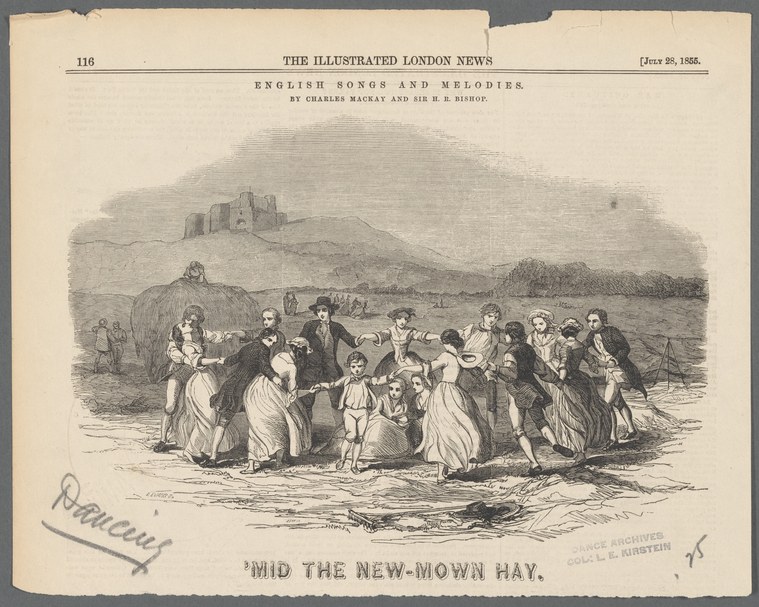
A seaside gathering in bright daylight shows a mixed group of roughly twenty figures in Victorian dress arranged in a shallow arc at the water's edge. The women wear full skirts and bonnets typical of the 1860s; the men are in dark coats and hats. At the center, several figures stand in the water up to their knees or waists. The composition suggests a moment of leisure and courtship rather than formal dance—some figures gesture toward the water, others stand in conversation or embrace. A castle or fortified structure crowns a distant hill; the coastline stretches behind them with trees and rough terrain. The engraving technique renders the scene in fine cross-hatching, giving it the pale, detailed character of a wood-engraved newspaper illustration. The title 'Mid the New-Mown Hay' is inscribed below, though the setting is unmistakably maritime rather than rural.
The dancing
The figures stand mostly upright in informal postures—some leaning toward companions, others with arms at their sides or gestures directed outward. No closed holds, rigid frames, or synchronized footwork are visible. The arrangement is social and spatially loose, with no clear leader or geometric formation. Children and adults mix freely. This is a promenade or courtship scene rather than a codified dance, though bodies move with the stylized grace expected of Victorian engraving.
The dance depicted
This is not a depiction of formal ballroom or theatrical dance. The scene captures an outdoor social gathering—a bathing party or seaside excursion—rendered in the Victorian convention that associates gathering, proximity, and heterosexual company with rhythmic or dance-like movement. It belongs to the tradition of «social promenade» imagery rather than to any specific dance form. The title's reference to hay-making suggests rural festivity, a popular subject for depicting folk celebration, though the marine setting contradicts this.
How it was made
This is a wood engraving, a relief-printing technique that produces the fine parallel hatching and crisp lines visible throughout. The technique was the dominant medium for newspaper and magazine illustration in the 1860s–1870s, allowing rapid reproduction in large quantities. The pale tones and small scale suggest it was designed for periodical publication rather than exhibition or fine-art sale. The presence of the artist credits (Charles Mackay and H. R. Bishop) indicates this was part of a serialized or editorial project, likely The Illustrated London News.
About this work
This is a social scene of Victorian leisure and courtship rendered as a wood engraving for mass-circulation periodical publication. It depicts a seaside gathering framed as a moment of collective festivity, using the visual language of dance and rhythmic movement to convey social ease and romantic opportunity. The image belongs to a large body of Victorian graphic art that treated everyday social life—promenades, garden parties, seaside excursions—as inherently dance-like occasions, suitable subjects for visual celebration of middle-class leisure and gender relations.
How to look at it
Notice the absence of any rigid formation or synchronized movement: this is not a ballroom scene. Instead, observe how the engraver uses proximity, gesture, and the shallow arc of figures to suggest a collective, rhythmic moment without depicting actual steps. The title's reference to rural hay-making and the artist credits to a song suggest this image was meant to accompany or evoke a musical or narrative work—the «dance» here is literary and social rather than literal. Look at the contrast between the orderly, hatched rendering of the figures and the rough texture of the landscape: civility is imposed through the precision of the line.
The artist
Charles Mackay (1812–1887) was a Scottish poet, songwriter, and journalist; H. R. Bishop (1786–1855) was a prominent English composer and conductor. The credits suggest this was part of a collaboratively illustrated series on English songs and melodies, designed to pair visual narrative with musical or literary content for the periodical press.
The period
The 1860s–1870s saw a boom in wood-engraved social reportage in British periodicals, particularly The Illustrated London News. Seaside bathing and excursion culture were new, commercially significant leisure activities, and their depiction in mass media was a form of aspirational middle-class identity-building. Simultaneously, the Victorian ballroom and its coded dance forms—waltz, quadrille, galop—were still the primary contexts of formal courtship, making the association of any mixed-gender gathering with dance a visual convention reflecting anxiety about propriety and control.
Where it lives
This work is part of the Prints collection at the New York Public Library, catalogued as a nineteenth-century wood engraving from The Illustrated London News or a related periodical. It is likely one of a series illustrating English songs and melodies.
Questions about this work
Why is a seaside bathing scene included in a dance collection?
Victorian visual culture treated any heterosexual social gathering as inherently dance-like, using the language of rhythmic movement and formation to frame courtship and leisure as choreographed events. This image uses that convention to elevate an everyday seaside excursion into a moment of collective festivity. The association of dance with social gathering—not just formal ballroom steps—is itself a historical fact about how Victorians understood gender, movement, and propriety.
What does the title 'Mid the New-Mown Hay' mean?
The title is likely a reference to a song, poem, or literary work (given the artist credits to Charles Mackay, a songwriter, and H. R. Bishop, a composer). Rural harvest and hay-making were popular subjects for sentimental Victorian verse and songs about courtship and community. The title evokes nostalgia for rural festivity, though the actual setting depicted is a fashionable seaside resort—a tension between literary convention and visual reality.
How do we know this is a wood engraving?
The technique is identifiable from the fine parallel hatching (cross-hatching) that models light and shadow, the crisp black lines, and the overall pale tone. Wood engraving on end-grain boxwood was the standard medium for periodical illustration in the 1860s–1870s because it could withstand multiple print runs and reproduce fine detail. The small scale and design for page layout also confirm periodical publication.
More dance artwork





