49 works in this view — arrow keys or swipe to move between them.
Dance in Art
Folk dancing in England and Scotland in nineteenth-century prints
Unknown artist
- Collection:
- Prints depicting dance
- Source:
- New York Public Library
- Rights:
- Public domain — free to use, share and adapt.
- Recorded as:
- Public Domain
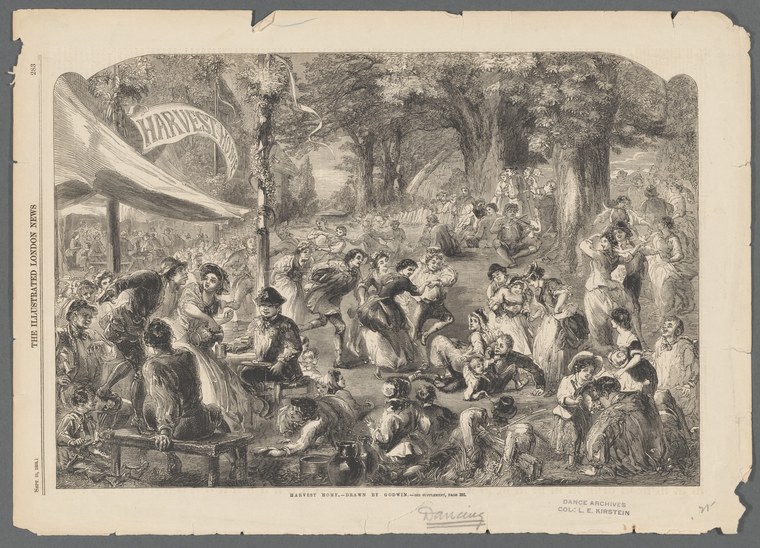
This engraving documents vernacular social dancing in 19th-century Britain at a moment when such practices were rapidly being formalized and standardized. It shows dancers in natural, unprescribed postures rather than the codified positions of ballroom or folk competition, preserving a record of everyday movement that would otherwise be invisible. For dance historians, it is a rare visual record of social dance as lived practice rather than performed spectacle.
What you are looking at
A crowded outdoor festive gathering under tall trees, rendered as a wood engraving in fine detail. The composition is dense with figures in mid-19th-century dress: women in long skirts and bonnets, men in coats and hats, arranged in loose groups across a sylvan setting. A banner bearing text (partially legible as "HARBEN...") hangs from a tree on the left, suggesting an organized event or fair. The foreground shows clusters of dancers and spectators in animated poses—some couples appear to be in motion, others standing in conversation or observation. The middle distance opens to reveal more figures and trees receding into the background, creating depth through the accumulation of detail. The light is even and cool, characteristic of wood-engraved prints, with shadow created through close parallel line-work rather than tonal wash.
The dancing
The dancers move in pairs and small groups without a single dominant formation. Most couples stand in close proximity with arms at varied heights and angles, suggesting social proximity rather than a formal closed ballroom hold. Some figures lean toward partners; others gesture with hands raised. The women's full skirts appear to be in motion—several show the characteristic silhouette of a dancer mid-turn or step. The postures suggest walking, turning, and social interaction rather than the rigid frame of formal ballroom technique. Weight appears distributed naturally rather than held in a ballroom carriage.
The dance depicted
This is a social outdoor gathering of the type common in 19th-century England and Scotland, most likely a summer festival, garden party, or village fair featuring informal folk dancing and social mingling. The image does not depict a specific codified dance form but rather the vernacular social dancing of working and middle-class communities. The absence of musicians visible in the image, the scattered positioning of couples, and the mix of dancing and standing suggest music-making may have occurred off-frame or the scene captures a moment of rest between dances. The styles evident—if any—would be country dances, squares, or simple promenade figures typical of 19th-century popular recreation.
How it was made
This is a wood engraving, identifiable by the fine, dense parallel line-work (hatching and cross-hatching), the pure black-and-white tonal range without intermediate gray, and the uniform surface finish. Wood engraving, which uses the end-grain of boxwood and a burin for precise detail, allowed for high-quality reproduction and wide circulation in periodicals and illustrated books. The level of detail—individual features, fabric texture, foliage—indicates a skilled professional engraver working from a drawn or painted design. The technique's popularity for journalistic and social documentation suggests this was likely made for mass publication.
About this work
This is a 19th-century wood engraving depicting an informal outdoor dance gathering in England or Scotland, one of a series documenting folk and social dancing practices of the era. The work captures not a specific choreographic style but a moment of popular recreation—the texture of how people danced together in village and garden settings. It is a document of social history as much as dance history, preserving the dress, posture, and spatial arrangements of dancers when formal ballroom convention did not apply.
The image belongs in a dance collection because it shows how dance functioned as communal social practice outside the theater and the ballroom. It records the informal, heterogeneous movement and dress of ordinary dancers, the role of outdoor space in enabling dance, and the integration of dancing with spectating and socializing. For historians of folk dance and social practice, it is valuable evidence of who danced, how they held themselves, and the settings in which dance occurred.
How to look at it
Attend to the lack of formation: there is no single line, circle, or rigid geometric structure that would characterize a codified country dance or square. Instead, couples and small groups scatter across the space, suggesting multiple simultaneous dances or a moment of mingling between figure dances. Notice the women's skirts: several show the lifted, spiraling silhouette of a woman in a turning step, evidence that the engraver understood movement. The trees frame and contain the scene, marking it as rural or semi-rural and public in a way that the enclosed ballroom is not.
The artist
The engraver is not recorded in the catalogue. The work's style and printing quality suggest it was produced for a reputable illustrated periodical or book publisher of the mid-19th century, when wood engraving was the dominant medium for news and feature illustration. The level of narrative detail and human observation suggests the original design came from a practiced illustrator of social scenes, possibly working from observation or a sketch made at an actual event.
The period
The 19th century saw a widening gulf between the codified ballroom dances of the urban middle and upper classes and the surviving folk and village dances of rural and working-class communities. By the 1860s–1880s, illustrated periodicals were documenting these regional and social dance traditions as picturesque, endangered practices. Simultaneously, folk dance was being collected and standardized by antiquarians and dance teachers, transforming living social practice into recorded repertory. This engraving sits at that moment—capturing social dancing as it was still being lived, before systematic collection and modernization.
Where it lives
The work is held in the New York Public Library's collection of prints depicting dance and comes from a series on folk dancing in 19th-century Britain. It is representative of the journalistic and documentary illustration that was the primary visual record of social and folk dance before photography became the standard medium.
Dance in this work
Questions about this work
Is this a specific named dance or a social gathering?
This appears to be a social gathering or fair featuring informal dancing rather than a single choreographed dance form. The scattered positioning of couples, the lack of a unified formation, and the mix of dancers and spectators suggest the scene captures a moment of recreational mingling and social dancing rather than a formal figure dance or country-dance progression.
What can you tell from the clothing?
The dress is consistent with English and Scottish working and middle-class fashion of the 1860s–1880s: women wear long skirts (some with visible bustles or gathered fabric), bonnets or hats, and fitted jackets or bodices. Men wear coats, waistcoats, and hats. The informality of outdoor dress and the absence of ball gowns or evening wear confirm this is recreational rather than formal dancing.
Why is there a banner in the image?
The banner (partially legible) suggests this is an organized event—possibly a festival, fair, charity gathering, or village celebration. Banners were typical of 19th-century public events and fairs, marking sponsored occasions and adding visual spectacle.
How do we know this is English or Scottish?
The catalogue record identifies it as depicting folk dancing in England and Scotland. The style of dress, the outdoor woodland setting, and the informal social arrangement are all consistent with documented English and Scottish village and fair dancing of the period, as distinct from Continental or American practices.
More dance artwork





