49 works in this view — arrow keys or swipe to move between them.
Dance in Art
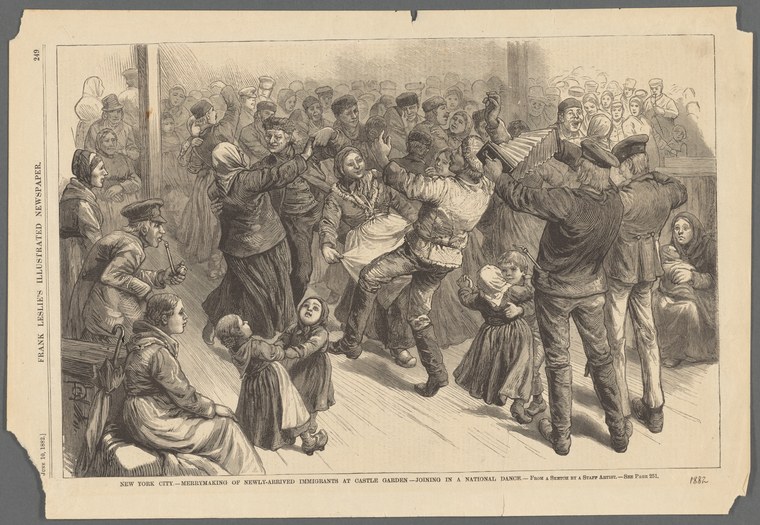
New York City; merrymaking of newly-arrived immigrants at Castle Garden; joining in a national dance
Unknown artist
- Collection:
- Prints depicting dance
- Source:
- New York Public Library
- Rights:
- Public domain — free to use, share and adapt.
- Recorded as:
- Public Domain
This work is rare documentary evidence of how European immigrants used dance to assert continuity and community in a moment of radical displacement. It shows that by the 1880s, press coverage of immigration recognized dance as newsworthy—a visible sign of immigrants' humanity, resilience, and social bonds. For historians of dance, it is one of few contemporary images of folk and social dance practice in America, captured not in a studio or ballroom but in the actual site of arrival.
What you are looking at
A crowded indoor scene of immigrants at Castle Garden, New York's immigration processing center, captured in an energetic moment of social dancing. The composition is densely packed with figures—men, women, and children in late 19th-century dress—arranged throughout a wooden-floored interior with structural posts visible. In the center, several couples are actively dancing while others cluster around them, watching, clapping, or preparing to join. The figures wear heavy coats, hats, and long dresses typical of newly arrived immigrants; some have set down belongings. The atmosphere is one of spontaneous celebration: the engraver has captured animated gestures, raised arms, and the sense of music and movement filling the space. The title's claim that this depicts a "national dance" suggests the artist intended to show immigrants expressing joy through vernacular movement—likely a reel, quadrille, or other social dance common across European traditions.
The dancing
The dancers in the center show couples in loose, energetic frame—arms raised or extended, bodies in motion. The nearest couples appear to be in a simple face-to-face or side-by-side arrangement rather than the formal closed ballroom hold; their postures suggest vigorous stepping and turning rather than the controlled frame of trained dancers. Surrounding figures lean in, watch intently, clap, or gesture encouragement. The engraver has used varied arm and leg positions to suggest movement across the crowd—some figures are mid-step, others pivoting or swaying. There is no evidence of trained or technical execution; the impression is of folk or social dancing adapted to available space and skill.
The dance depicted
The image depicts social dancing at an immigration checkpoint, likely a reel, country dance, or similar folk-ballroom hybrid common among European immigrants of the 1880s–1890s. The "national dance" in the title is vague—it could reference Irish, German, Polish, or other regional traditions brought by arrivals, or it could be generic journalistic language. The dancing appears spontaneous and participatory rather than performed: newcomers seem to be dancing for themselves and each other, not for an audience or press. The setting—Castle Garden, which operated as an immigration station until 1890—and the dress and density of figures support a date in the 1880s. What matters is not the precise style but the social fact: that dance was an immediate, joyful response to arrival, a way of marking transition and community.
How it was made
This is a wood engraving or steel engraving, a technique indicated by the fine parallel line-work (hatching and cross-hatching) used to model form, shadow, and texture throughout the composition. The delicate, precise lines are characteristic of engraved illustration for mass reproduction—this was almost certainly published in a magazine or newspaper, where engravings were the standard medium for news imagery before photomechanical halftone printing became dominant in the 1890s. The technique required a skilled hand and allowed for fine detail across a crowded composition; the engraver could capture individual facial expressions and gestures while maintaining legibility at small size. This format suggests the image was made for journalistic circulation—a visual report on immigrant life, intended for middle-class American readers.
About this work
This engraving captures the moment when immigration and dance intersect: newly arrived families at Castle Garden, New York, dancing together as an expression of arrival, community, and relief. The work is a documentary image, not a performance piece, showing vernacular social dance as a lived practice rather than a spectacle. It belongs in a dance gallery because it records how ordinary people used dance—in this case, familiar folk and country forms—to mark a threshold moment and affirm connection in a crowded, uncertain setting. The image is also significant as evidence of 19th-century American popular culture: it shows that social dancing was not confined to ballrooms but was woven into immigration processing itself, suggesting the cultural centrality of dance to immigrant identity and integration.
How to look at it
Look first at the composition: the engraver has organized the crowd to create a clear line of sight to the dancers at the center, but the surrounding figures are equally important. Notice the varied gestures of the onlookers—some clap, some gesture, some watch intently—which tells you that this is participatory social dancing, not a performance. Attend to the dress: the heavy coats, hats, and long skirts are period-accurate for the 1880s immigrant population. Finally, examine the footwork and arm positions of the active dancers. The lack of formal frame or trained posture suggests folk or vernacular dancing rather than ballroom technique. The engraver's technique—the fine parallel lines and careful modeling—allows him to render crowded figures with surprising clarity and individuality.
The period
Castle Garden operated as New York's official immigration station from 1855 to 1890, before Ellis Island opened. By the 1880s, immigration to the United States had reached unprecedented levels, with southern and eastern European arrivals predominating. American newspapers and magazines increasingly documented immigrant life, both sympathetically and with condescension. This engraving belongs to a wave of journalistic imagery aimed at American readers curious about the foreign newcomers reshaping the nation's cities. At the same time, social dancing in America was undergoing rapid change: rural and immigrant traditions (reels, country dances, polkas) coexisted with the rise of ballroom dances (waltz, quadrille, later ragtime dances). The image captures a moment of cultural continuity—immigrants dancing in their own traditions—within a larger story of cultural transformation.
Where it lives
This engraving is held in the New York Public Library's collection of prints depicting dance. It is likely a page or clipping from a 19th-century newspaper or illustrated magazine, intended for mass circulation and audience.
Dance in this work
Questions about this work
What is Castle Garden and why was it significant for immigrants?
Castle Garden, located on the Battery in lower Manhattan, was New York's official immigration processing station from 1855 to 1890. It was the first federal immigration center in the United States, where hundreds of thousands of immigrants were inspected, registered, and processed before entering the country. After 1890, that role was transferred to Ellis Island. For many arrivals, Castle Garden was the first American building they entered, making it a symbolic threshold.
What kind of dance is being shown here?
The image does not specify the exact dance, but the title's reference to a "national dance" suggests a traditional folk or country dance—possibly a reel, quadrille, or polka brought by the immigrants themselves. The loose frame and energetic stepping indicate vernacular social dancing rather than trained ballroom technique. The specific style would have depended on the immigrants' origins: Irish reels, German polkas, and Eastern European circle dances were all common among arrivals of the 1880s.
Why would immigrants dance at an immigration station?
Immigration processing could take hours or days. Waiting periods afforded opportunities for passengers to rest, eat, and socialize. Music and dancing likely provided psychological relief during a stressful transition, as well as a way for immigrants to maintain cultural identity and community bonds. The act of dancing together was also a form of self-presentation—a way of asserting normalcy and humanity to American observers.
Who made this engraving, and when?
The artist is not recorded in the available catalogue information. The image was likely published in a New York newspaper or illustrated magazine in the 1880s, based on the dress, setting (Castle Garden), and the engraving technique used. The exact publication date and context remain unknown, but the work is part of a larger body of journalistic imagery documenting immigrant life in this period.
More dance artwork





