49 works in this view — arrow keys or swipe to move between them.
Dance in Art
Miss Taglioni
Unknown artist
- Collection:
- Prints depicting dance
- Source:
- New York Public Library
- Rights:
- Public domain — free to use, share and adapt.
- Recorded as:
- Public Domain
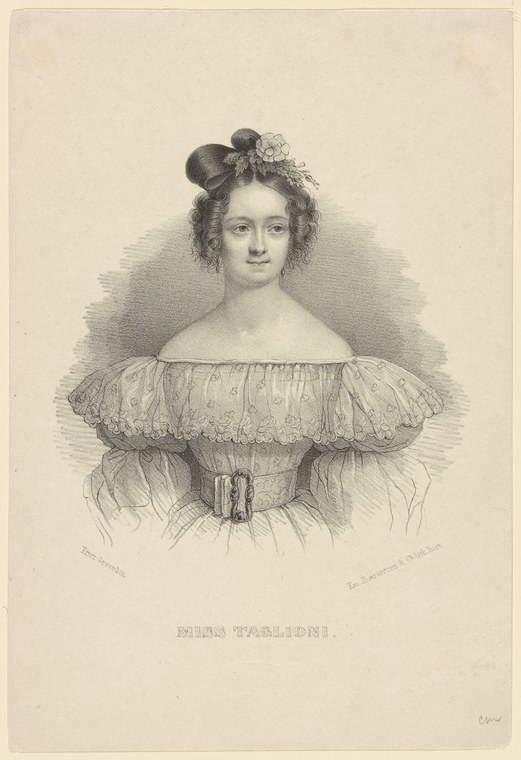
The Taglioni family name is inseparable from the history of Romantic ballet; this engraving documents the circulation of their image in the popular media of the day. It shows how dancers—particularly women of prominent families—were marketed as social and cultural celebrities, their likenesses distributed as luxury goods to drawing rooms and collections across Europe.
What you are looking at
A three-quarter length portrait of a young woman in early 19th-century dress, shown against a neutral background with subtle shading that creates depth. She wears an off-shoulder evening gown with an extraordinarily wide, voluminous neckline formed by gathered white fabric that frames her shoulders and upper chest like a massive collar or bertha. The dress is cinched at the waist with what appears to be a jeweled or decorative belt. Her dark hair is arranged in an elaborate upswept style with loops or buns on top and delicate curls framing the face. Her expression is serene and direct, gazing slightly to the viewer's left. The engraving is rendered in fine linear technique with careful cross-hatching to model form and fabric texture, creating an almost ethereal quality to the gossamer drapery.
The dancing
The subject is posed formally and statically in three-quarter view, with the body facing slightly left and the head turned to address the viewer. There is no indication of movement, weight shift, or the muscular engagement characteristic of dance. The arms are not visible, obscured by the voluminous fabric of the neckline. The posture is upright and composed, the bearing aristocratic and still.
The dance depicted
This is a portrait, not a depiction of dance. The inscription reads 'Miss Taglioni,' identifying the subject as a member of the famous Taglioni ballet family, likely one of the daughters or relations of Marie Taglioni, the legendary Romantic ballet dancer. While the subject was connected to dance through family and likely trained as a dancer, the image itself shows her in formal evening wear appropriate for social presentation, not in action or costume. The absence of pointe shoes, ballet dress, or any indication of movement means this cannot be classified as dance imagery, though it documents a figure of dance history.
How it was made
This is a steel engraving, a reproductive print technique that was the dominant means of circulating portraiture in the early 19th century. The fine, parallel lines used to build tone and model form are characteristic of the engraving process, which allowed for crisper detail and longer print runs than earlier etching. The delicate handling of the fabric—especially the gauzy neckline—demonstrates the technique's capacity to suggest transparency and luxury. Such engravings were sold individually and in collections as affordable copies of original paintings, making them a principal medium through which the appearance of celebrated figures was disseminated to middle-class audiences.
About this work
This is a portrait engraving of a member of the Taglioni family, documented through the formal inscription. It belongs in a gallery of dance in art not as a representation of dance itself, but as a historical record of a figure connected to the Romantic ballet era. The Taglioni family dominated European ballet in the first half of the 19th century, and their images circulated widely through exactly this medium—the reproductive engraving—making them available to audiences who would never see them dance. The work sits alongside other portraits of dancers, revealing how celebrity, social status, and theatrical fame were visualized and commodified in the period.
How to look at it
Look at the scale and delicacy of the neckline—the engraver has lavished extraordinary technique on rendering the gossamer texture and volume of the fabric, suggesting both refinement and a certain visual fragility. The stillness of the pose is key: this is not a dancer caught in action, but a woman of rank and beauty presented for social admiration. The formal, frontal presentation and the careful attention to costume and coiffure follow conventions of society portraiture, not theatrical imagery. The fact that the inscription alone identifies her connection to dance suggests that by the 1830s–1840s, a famous dancer could be presented in pure portrait mode, her identity as performer understood without any visual reference to the stage.
The artist
The artist is not recorded in the catalogue. The engraving carries no visible signature, though some inscriptions on the margins (too faint to read clearly in reproduction) may identify the engraver or publisher. Reproductive engravings of this type were often produced by specialist print workshops rather than attributed to individual artists, and many such portraits were based on paintings by society portraitists whose names were recorded separately.
The period
The dress and style place this in the 1830s–1850s, the height of the Romantic ballet era and the peak of the Taglioni family's dominance. Marie Taglioni's creation of the ethereal, pointe-work Romantic aesthetic revolutionized ballet aesthetics in the 1830s, and the family's celebrity extended well beyond the theatre. The fashion for steel engravings as a means of circulating portraits coincides exactly with this period; the technology and the cultural appetite for images of celebrated performers rose together. This was the age in which ballet dancers, particularly women, became visual celebrities in ways unprecedented before.
Where it lives
The work is held in the New York Public Library's prints collection documenting dance. Such collections often preserve reproductive engravings as historical sources for the appearance and celebrity status of performers, even when the images themselves show no dancing.
Questions about this work
Is this a picture of someone dancing?
No. This is a formal portrait, not a representation of dance. The subject is shown in evening dress, standing still, in the style of society portraiture. However, the inscription identifies her as Miss Taglioni, connecting her to the Taglioni ballet family and by extension to Romantic ballet history.
Who was the Taglioni family?
The Taglioni family were the dominant force in European ballet in the first half of the 19th century. Marie Taglioni, the most famous, created the Romantic ballet aesthetic and technique centered on pointe work and ethereal, weightless movement. Her family members were dancers, teachers, and cultural celebrities whose images circulated widely through prints like this one.
Why is a portrait in a gallery of dance?
Portraits of dancers are historical documents showing how performers were visualized, costumed, and presented to society. They reveal the gap between theatrical identity and social presentation, and they document the circulation of celebrity through print media. This engraving shows how a Romantic-era dancer was marketed and remembered.
What technique was used to make this?
This is a steel engraving, a reproductive print process that used fine parallel lines to build tone and detail. Steel engravings were the dominant medium for circulating high-quality portraits in the early 19th century, allowing wide distribution of images of celebrities to middle and upper-class audiences.
More dance artwork





