49 works in this view — arrow keys or swipe to move between them.
Dance in Art
Folk and ethnic dancing in wood engravings
Unknown artist
- Collection:
- Prints depicting dance
- Source:
- New York Public Library
- Rights:
- Public domain — free to use, share and adapt.
- Recorded as:
- Public Domain
Masquerade and carnival dances are poorly documented in the visual record compared to court and theatrical dance; this engraving is a rare snapshot of popular festive culture. It shows that 19th-century dance history includes far more than ballet and ballroom—it encompasses the licensed disorder of carnival, the mixing of social classes, and the role of costume and spectacle in enabling transgressive play.
What you are looking at
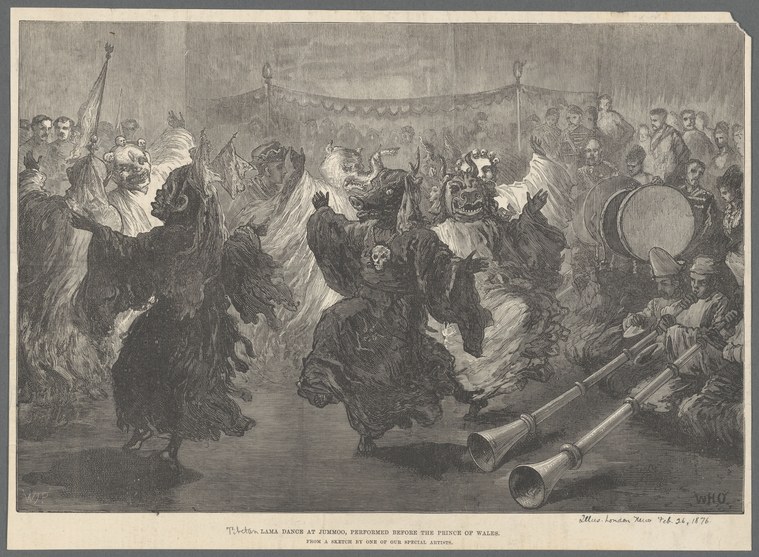
This wood engraving depicts a masquerade ball or carnival celebration, with costumed figures dancing under a canopy or pavilion lit from above. The scene is crowded and animated: in the foreground, dancers in elaborate costumes—including what appear to be animal masks and dark formal dress—move across the floor while musicians play large brass instruments (horns or trumpets) at the right. The background shows a dense crowd of spectators in period dress watching from behind. The composition uses strong contrasts between light and shadow typical of wood engraving, with the central figures brightly lit while the crowd dissolves into darker tones. The overall effect is one of festive disorder and theatrical excitement, with multiple focal points drawing the eye across the scene.
The dancing
The central dancers move with loose, unbounded gestures—arms raised and extended, bodies twisting in postures that suggest uninhibited social movement rather than codified technique. Several figures appear to be in pairs or small groups, but there is no visible closed ballroom hold. The costumes include masks and heavy fabric that obscures precise body position. The dancers' weight shifts appear dynamic and weight-distributed rather than upright or poised; the overall impression is of spontaneous, social movement rather than trained performance dance.
The dance depicted
This depicts masquerade or carnival dancing, a social rather than theatrical context. The presence of masks, the loose costuming, the mixed crowd, and the brass musicians all point to a public festive gathering—likely a carnival ball or similar popular celebration. The style of movement visible—free-form, unstructured, with partners dancing informally—is consistent with 19th-century European carnival or masquerade traditions. The work documents social dance rather than a specific named technique, capturing the social function and atmosphere of such events rather than the execution of a particular style.
How it was made
This is a wood engraving, identifiable by its fine parallel line work, high contrast between black and white, and the characteristic texture created by cutting into the end-grain of a wood block. The technique allows for sharp detail and mass reproduction, suggesting this was a commercial print—likely from a newspaper, periodical, or popular publication. The inscription at the bottom indicates this appeared in print with a publication date and source. Wood engraving was the dominant medium for mass-produced illustrated journalism in the 19th century, making this an artifact of popular visual culture rather than fine art.
About this work
This wood engraving records a masquerade ball, a major form of public social entertainment in 19th-century Europe. The artist captures the chaos and spectacle of the event—the mixing of spectators and dancers, the theatrical costumes, the live music—rather than documenting technique. The work sits at the intersection of social history, festive culture, and popular visual documentation, showing how dance functioned as a vehicle for carnival excess and transgressive play. For a dance historian, it is valuable not as a record of a named style but as evidence of how ordinary people danced together in public, what costumes and settings they inhabited, and what kind of energy and disorder such events contained.
How to look at it
Attend to the chaos of the composition: there is no single focal point, but rather multiple centers of action competing for attention, which mirrors the actual experience of a crowded ballroom. Notice how the artist uses costume—masks, dark dress, elaborate fabrics—to flatten and abstract individual bodies, making them read as types rather than individuals. The raised arms and twisted torsos convey energy and abandon rather than precision. The presence of the orchestra at the right edge anchors the scene in the live music that drove such events.
The artist
The artist is unattributed in the catalogue record. The style, technique, and composition are consistent with mid-to-late 19th-century commercial printmaking, when wood engraving was the standard medium for newspaper and periodical illustration. The work was likely created by a professional illustrator working for a London publisher (given the inscription).
The period
The 19th century saw a flourishing of masquerade balls and carnival celebrations in European cities, particularly during Lent and seasonal festivals. These events were simultaneously fashionable among the wealthy and popular among all classes, creating spaces of temporary social inversion. In the same period, wood engraving was at the height of its use as a mass medium, before photographic reproduction displaced it in the 1880s-90s. This engraving likely dates to the mid-Victorian era, when such festive scenes were popular subjects for illustrated newspapers and periodicals.
Where it lives
This work is held in the New York Public Library's Prints collection, specifically in a set titled 'Folk and ethnic dancing in wood engravings.' The inscription visible at the bottom indicates a London publication date (partially visible in the image).
Dance in this work
Questions about this work
How do I know this is a masquerade and not a ballroom dance?
The masks, heavy costumes, and loose movement all signal a masquerade or carnival setting rather than a formal ballroom. The spectators pressed close around the dancers, the brass band, and the overall disorder of the composition also differ from the formal spatial arrangement of ballroom dancing. The title also indicates 'folk and ethnic dancing,' which suggests popular rather than elite dance.
When was this made?
The catalogue record does not provide a date, but the style of wood engraving, the clothing visible, and the printing technique suggest a mid-to-late 19th-century date, likely between 1850 and 1890. The inscription on the image may contain a publication date, though it is only partially legible in this copy.
Is this documenting a specific place or event?
The inscription suggests a London publication, but the image itself does not identify a specific ballroom or occasion. It is likely a generic illustration of a masquerade ball, created as a scene of popular entertainment for a newspaper or periodical rather than a record of an actual event.
More dance artwork





